
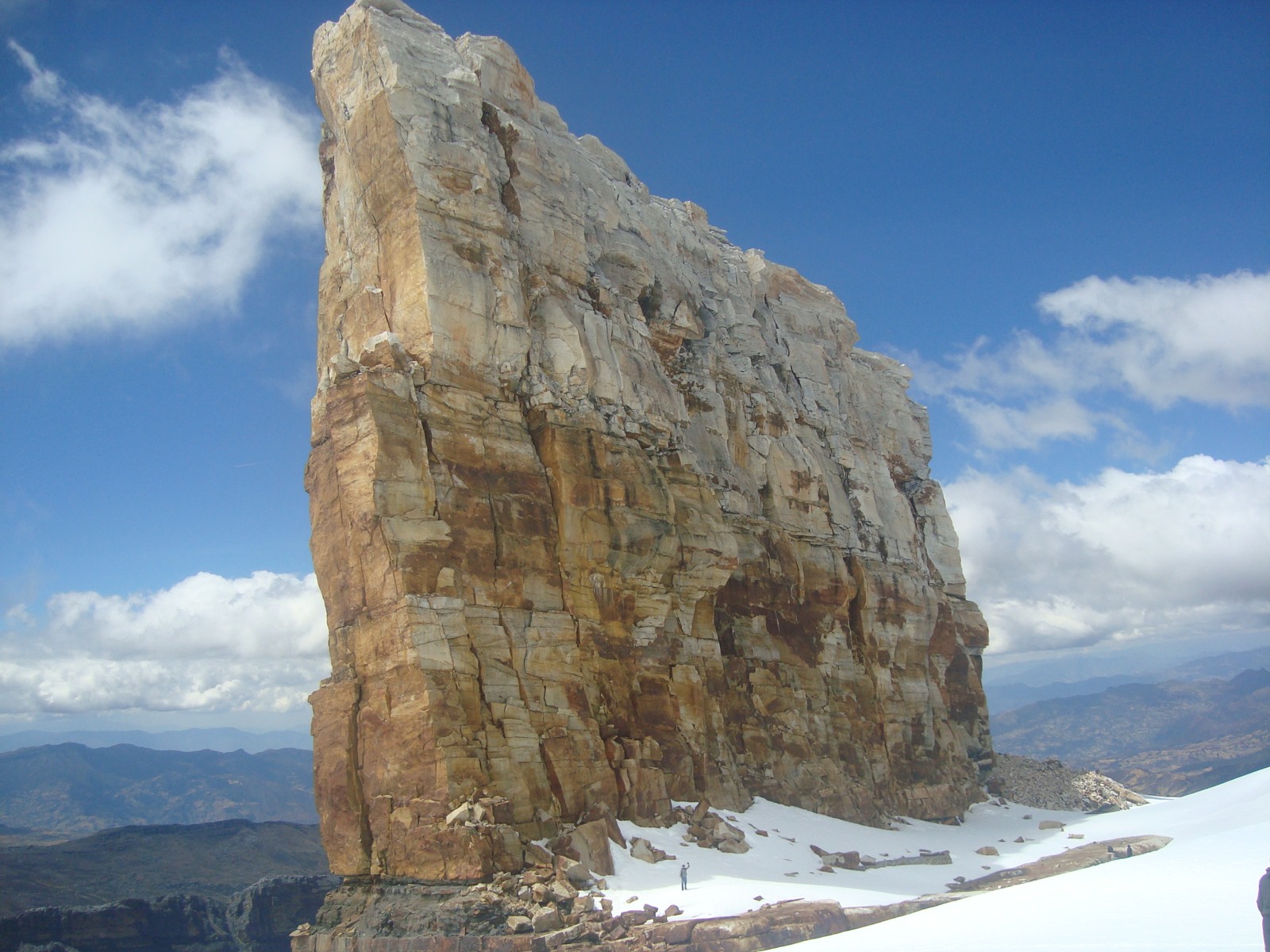
South face and local account
The photograph of 30 January 2013, taken from the corridor between Púlpito and Nevado Pan de Azúcar, shows the south face with its clearly defined strata and cracks, snow at the base, and a human figure that gives the tower its scale. The Gobernación de Boyacá records a local account attributed to Castañeda and Suárez in 1989, according to which the devil would sit there at night and trigger rockfalls and thaws.
The summit cards
On 5 January 1944 Frédéric Marmillod, Dorly Marmillod-Eisenhut, and Erwin Kraus climbed the north face and left summit cards together with a Colombian flag. Kraus's note states that the party followed the centre of that face. The cards remained on the summit until January 1976, when Polish mountaineer Walenty Fiut found them upon completing his own ascent of the north face as part of the Andes-75 expedition, whose report was published in 1977.
Zizuma and the U'wa people
Zizuma is the name the U'wa people give to the range as a whole. The range holds spiritual significance for the U'wa as the dwelling of spirits and gods, and is an essential water source. In 2016 ASOU'WA, the association of traditional U'wa authorities, publicly declared its defence of the range. In 2024 the Inter-American Court of Human Rights ordered the Colombian State to convene U'wa representatives in order to agree on their participation in the joint management and conservation of the area where the park overlaps with the Indigenous reserve.