
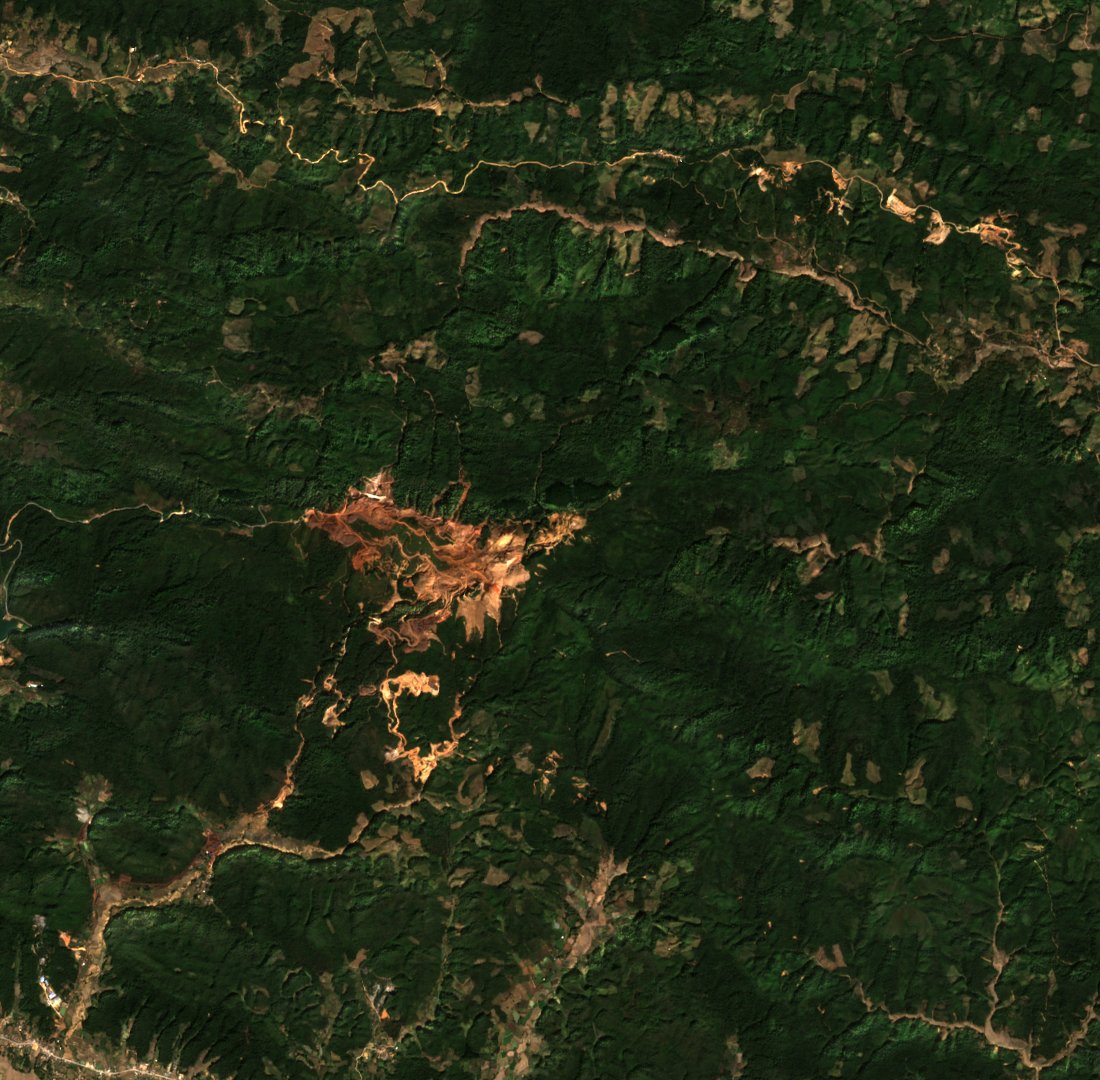
Terrain and Topography
The 1:50,000 map shows the ridge oriented east to west, with closely spaced contours indicating steep flanks and marking the positions of the eastern and western ridge points. That terrain pattern is consistent with the visible contrast between the forested crest and the adjacent valley floors in the December 2025 Sentinel-2C satellite image, rendered in natural colour.
The ridgeline and surrounding elevated ground place Phou Gnouan among the heights enclosing the valley near Xieng Khouang. In a retrospective chronology of his Air America service covering 1970, Harry R. Casterlin identifies Phou Gnouan and Phou Khe as heights held by government forces near that valley in February of that year, noting the capacity of such elevated terrain to command the low ground below.
Vegetation and Bird Records
A field team led by J. W. Duckworth conducted visits across the plateau in February, October, and November 1999 and April 2000, with observations on the mountain itself during October and November 1999 and April 2000. The team described upper montane evergreen broadleaved forest beginning at roughly 1,700 m and continuing toward the top, with cultivation, fallow plots, scrub, and disturbed woodland occupying the belt below. Those observations confirm the presence of montane forest on the upper slopes in 1999 and 2000.
Among the species documented at that elevation, the field team recorded the yellow-bellied fantail (Chelidorhynx hypoxanthus) repeatedly in the high forest during October and November 1999, then found a single bird on 19 April 2000. The authors noted the possibility that the species may visit the area outside a breeding season, leaving that interpretation open. Their findings were published in Forktail 18 (2002).
Archaeological Context of the Plateau
The Xiangkhouang Plateau is the setting for megalithic jar sites inscribed by UNESCO as a World Heritage property in 2019. The inscription covers discrete archaeological sites distributed across the plateau, containing stone vessels and associated funerary features dated broadly from around 500 BCE to around 500 CE.