
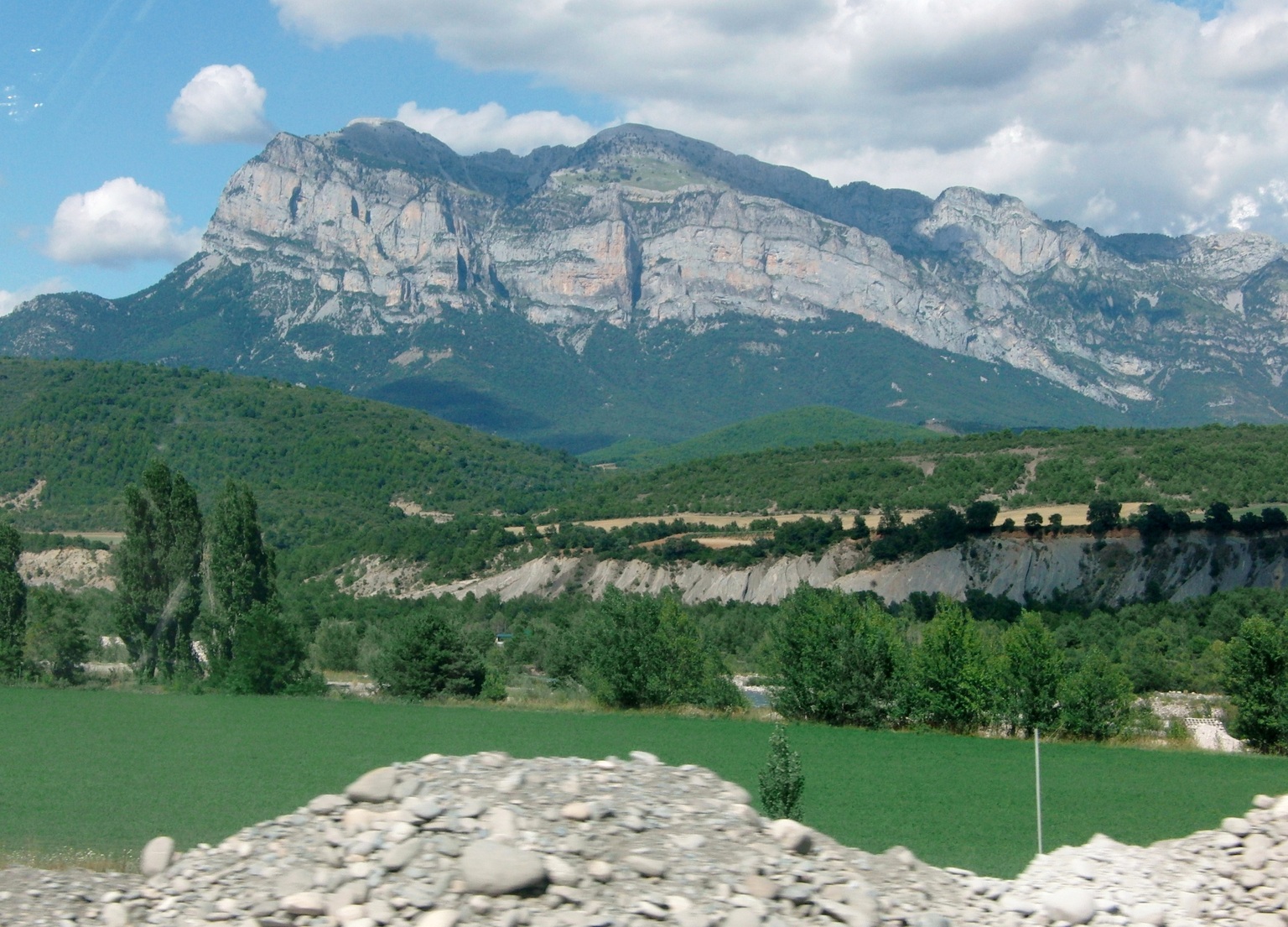
Limestone and thrust faulting
The walls of Peña Montañesa are formed by limestone stacked over more recent marls, an arrangement that explains the Peña Montañesa–Sierra Ferrera thrust fault as older materials were displaced over younger ones. At the Piedra de San Beturián stop, within the San Victorián georoute, those limestones are around 52 million years old. The rock's greater resistance to erosion produces the vertical scarps of the silhouette, and detached blocks accumulate in the scree slopes below.
Monastery and tradition
On the slopes of Peña Montañesa stands the Royal Monastery of San Victorián, declared a Site of Cultural Interest in 2002. In 1853, architect Víctor Estradera drew up its topographic plan, which documents the dependencies of the complex, the community spaces and the areas reserved for guests. Local tradition associates the hermitage of La Espelunga and the Piedra de San Beturián with the saint's retreat in this place.
Birds on the north slope
The Special Protection Area for Birds of Cotiella–Sierra Ferrera, designated by the Government of Aragon, incorporates the north slope as characteristic habitat for the capercaillie. For the protected area as a whole, the official data sheet also records the presence of bearded vulture, golden eagle, Egyptian vulture and griffon vulture, species linked to the different environments encompassed by the perimeter of the area.