
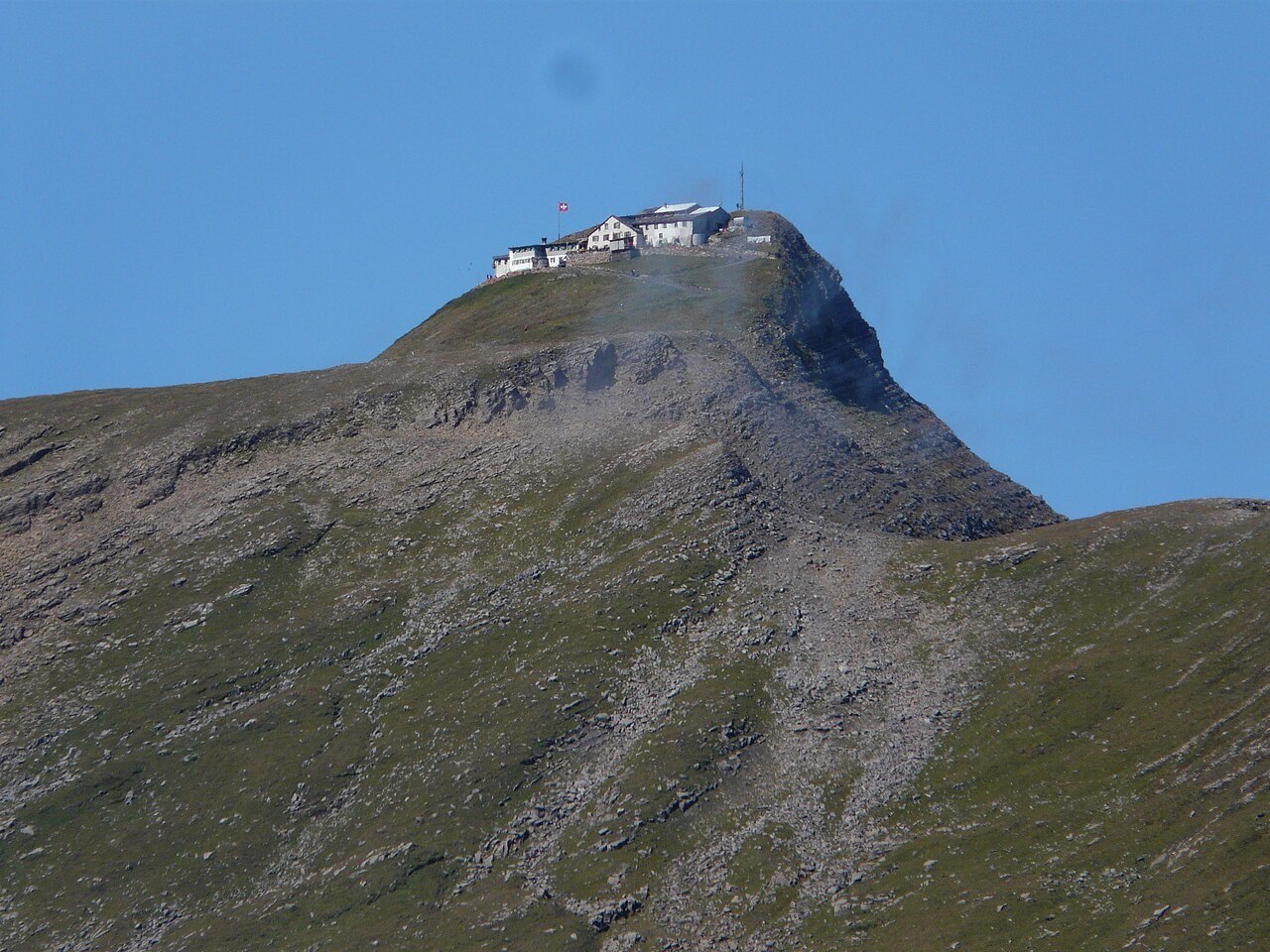
Name and Geology
The name Faulhorn derives from a regional term for soft, crumbly rock — a reference to the character of the summit's material rather than any judgment about access or difficulty. This geological specificity in a place name is consistent with an older tradition of naming Alpine features for their physical properties, and it ties the Faulhorn's identity directly to the nature of its own ground. The summit sits at 2,681 metres, placing it well above the Grindelwald valley floor while remaining below the glacier zone that defines the higher Bernese peaks to the south.
The Summit Hotel and Fritz Bohren
The existing hotel building at the Faulhorn dates to 1832, making it one of the earlier permanent structures to have been erected at a Swiss summit. For thirty-eight years between 1888 and 1926, the hotel was run by Fritz Bohren, known locally as Pintenfritz, whose tenure became closely identified with the character of the summit. Period postcards from his era show guests using horn sleds to descend from the summit toward Grindelwald, documenting a form of winter recreation that was already established practice by the late nineteenth century.
The Sled Run and Winter Use
The modern sled run named after Fritz Bohren extends approximately fifteen kilometres, a length that reflects the sustained vertical and horizontal terrain between the summit zone and the valley. That a recreational descent documented in period postcards eventually gave rise to a named, measured route of this scale illustrates how informal winter practice at a summit can consolidate over time into a defined and identifiable feature of the landscape. The hotel and the sled run represent two distinct but related chapters in the Faulhorn's history of winter use, one centred on shelter and hospitality, the other on the descent itself.