
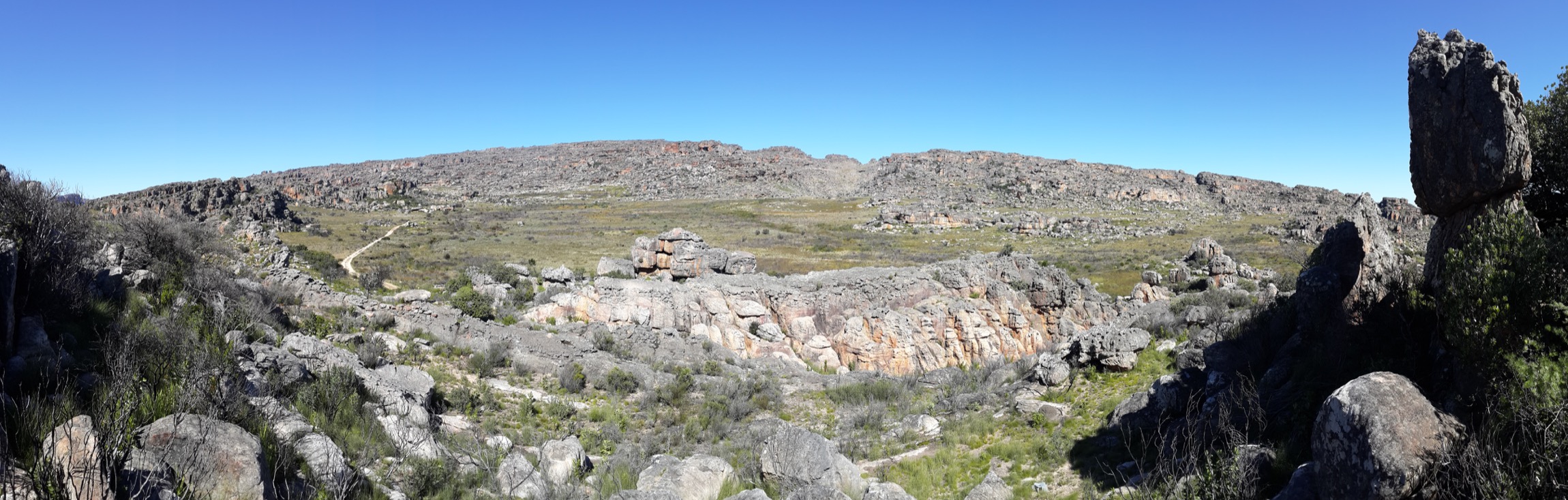
Sandstone Terrain and Pakhuis Pass
The northern Cederberg is built from Table Mountain sandstone, which weathers into the pronounced ledges, loose rock, and open mountain fynbos that characterize the terrain around Pakhuis Pass. The pass crosses the mountain barrier separating the Clanwilliam district from the route toward Calvinia and the Karoo, and its completion in April 1877 was the work of road engineer Thomas Bain. The enabling Cape legislation authorized the local Clanwilliam Divisional Council to borrow against road rates and toll revenue for construction over Pakhuis Mountain.
Rooibos and the Clanwilliam Landscape
Aspalathus linearis, the plant whose dried needle-like leaves become rooibos tea, is native to the Cape fynbos and reaches its greatest diversity in the area around Citrusdal and Clanwilliam. Formal research and legal recognition have both documented that Khoi and San communities held traditional knowledge of the plant before it entered commercial trade. Stellenbosch archival work for the South African Rooibos Council found that shops in the Cederberg stocked rooibos from at least the 1890s, though surviving records indicate trade at that period was limited in scale.
By the early twentieth century, trader Benjamin Ginsberg and his family helped commercialize a tea being offered by local people. Around 1930, Clanwilliam physician Le Fras Nortier began experimenting with cultivated rooibos. A 1933 sample from Ginsberg's archive, analyzed by Stander and colleagues, produced a chromatogram virtually identical to that of a cultivated 2016 sample — a finding specific to those two samples rather than a statement about all rooibos or any single genotype.
Recognition, Benefit Sharing, and Protected Status
In November 2019 an industry-wide agreement was launched among rooibos industry parties and Khoi and San representatives, acknowledging traditional knowledge holders and establishing a levy of 1.5 percent of the farmgate price on a pilot basis.
In 2021, the European Union registered Rooibos and Red Bush as a protected designation of origin, covering defined South African production areas that extend well beyond Clanwilliam itself. That registration placed a geographic boundary around the name in European trade law, anchoring the product's identity to the wider Cape fynbos region of which the Cederberg above Clanwilliam remains a central part.