
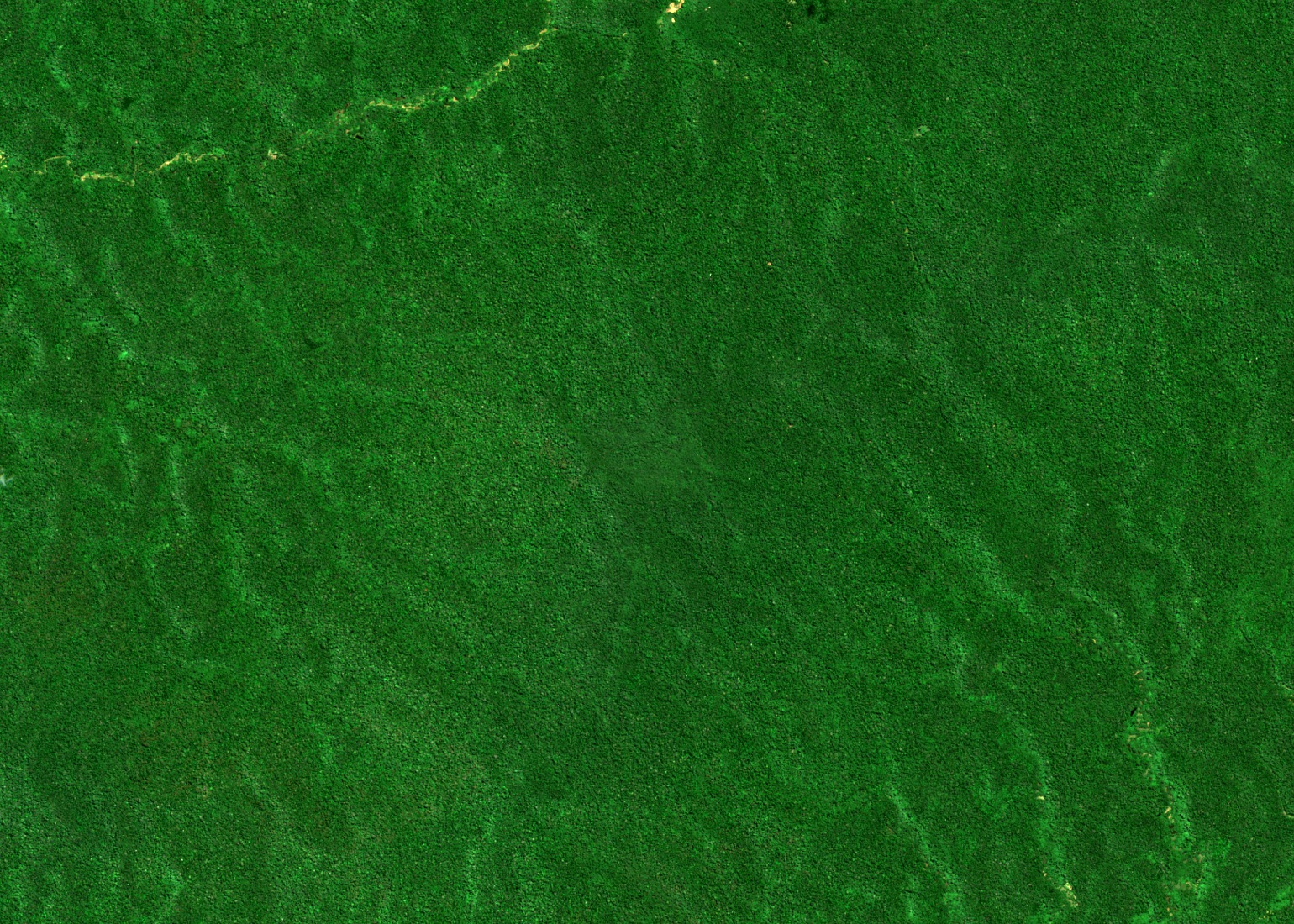
Geology and plateau morphology
The massif rests on Precambrian volcano-sedimentary rocks belonging to the Inini greenstone belt. A lateritic duricrust caps the plateaus and slows erosion of the underlying bedrock. At the margins, erosion cuts into the slopes and exposes laterite blocks. Torrents form waterfalls there.
Vegetation and forest formations
The 1985 mission and the inventory describe in particular two formations among several. Cloud forests develop in the enclosed valleys and on the slopes where clouds linger for extended periods. On the summit plateau, the trees are shorter owing to lateritic outcrops that restrict rooting and to wind exposure. Mosses, epiphytes and tree ferns characterise this first formation, while other species stand out on the plateau blocks.
1985 botanical mission
From 5 August to 17 September 1985, Jean-Jacques de Granville and Georges Cremers conducted a mission using five successive field camps from the Grand Inini up to the plateau. They surveyed habitats along this altitudinal gradient and assembled 284 photographs, comprising 136 colour slides and 148 black-and-white photographs according to the count established on page 11 of their report.
Among the specimens collected is a specimen of a plant in the laurel family gathered on 3 September 1985 on a wooded ridge to the east of the massif, at between 600 and 700 m elevation. Santiago Madriñán formally described this plant in 1996 under the name Rhodostemonodaphne scandens. The Muséum national d'Histoire naturelle holds an isotype of this collection under the reference P00800950. The Smithsonian National Museum of Natural History holds another specimen from the same collection. The species has also been recorded in the Brazilian state of Amapá.