
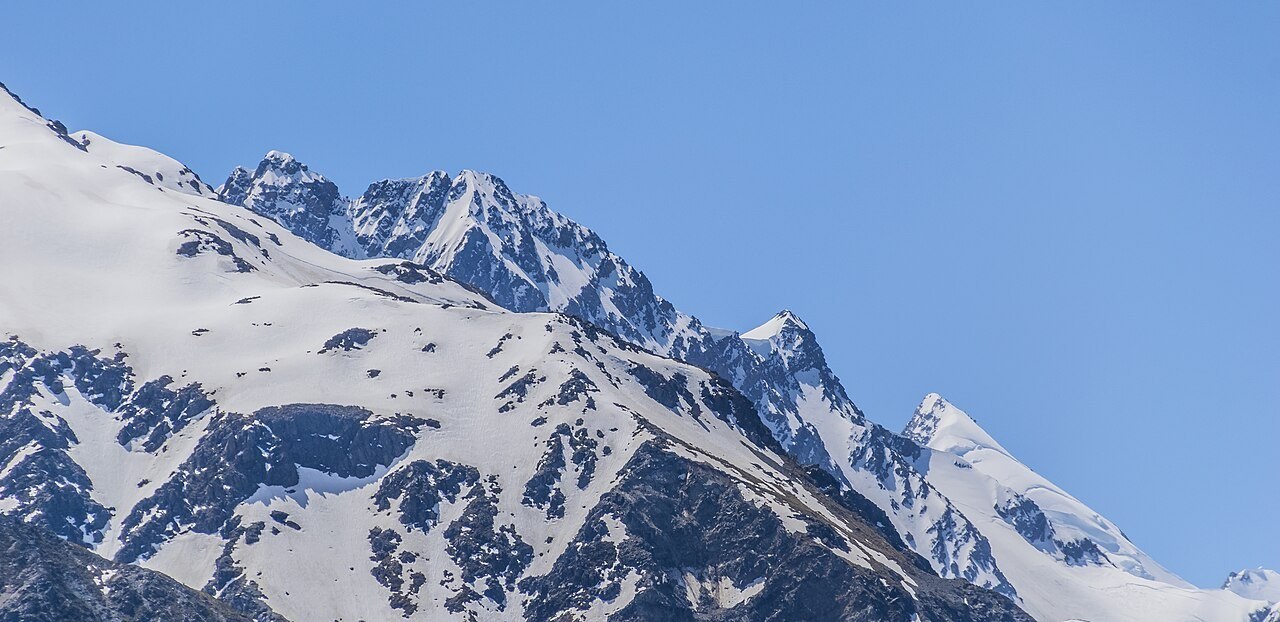
A Summit Among Three
Low Peak occupies the southern end of the main Aoraki massif in the Southern Alps of New Zealand's South Island. Its elevation of 3,593 metres distinguishes it as a named peak in its own right rather than a mere subsidiary point, and the Department of Conservation records it separately on its official mapping of the Aoraki/Mount Cook area. Middle Peak and High Peak stand as distinct objectives to the north along the same crest.
The long connecting ridge joining Low Peak, Middle Peak, and High Peak provides the terrain over which the Grand Traverse is conducted. Te Ara records the Grand Traverse as a defining route of New Zealand mountaineering, threading across all three summits along this shared ridgeline at extreme altitude.
The South Ridge and the Hillary Ridge
In 1948, Harry Ayres, Mick Sullivan, Edmund Hillary, and Ruth Adams completed the first recorded ascent of the South Ridge route on Aoraki/Mount Cook. This was an ascent of a particular route, not the first ascent of the mountain or of Low Peak itself. The South Ridge traces a line above Endeavour Col and passes distinct buttresses on the western side of the massif above the Empress Glacier.
The New Zealand Alpine Club records that in August 2011 the South Ridge route was formally renamed the Hillary Ridge, in recognition of Edmund Hillary's association with the 1948 ascent. The renaming honours a specific climbing line through the mountain's high terrain rather than any administrative boundary, and the route retains its original geographical character along the same ridgeline above Endeavour Col and the Empress Glacier buttresses.
Name and Identity
The peak carries a dual name reflecting both te reo Māori and English traditions. Aoraki is the name used in Māori cosmology and oral tradition for the entire massif, and its use alongside the English Mount Cook was formalised in the naming of Aoraki/Mount Cook National Park. The qualifier Low Peak distinguishes this southern summit from its two named companions within the same massif, a distinction that the New Zealand Alpine Club, the Department of Conservation, and Te Ara all observe in their separate records.