
Geology and reclassification
The wide northern opening of the cone and a northward lava flow were initially interpreted as features young enough to date to the Holocene. Higher-resolution imagery led the Smithsonian to reclassify that activity as late Pleistocene.
First documented ascents
In October 1965, a Chilean expedition comprising Sergio Kunstmann, Pedro Rosende, and Claudio Maier ascended Acotango after visiting Guallatiri, according to the account published in the 1966 American Alpine Journal. Subsequently, other climbers documented a route via the northwest face and the upper north-northeast ridge.
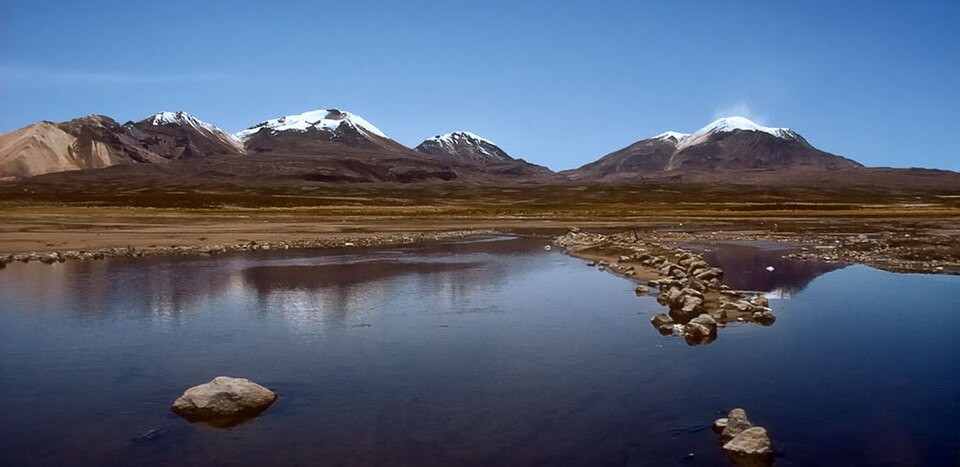
Acotango from Chungará
In the 1990 photograph taken from Lake Chungará, Acotango occupies the central position among the three volcanoes: Humarata lies to the left and Capurata to the right. Guallatiri, with its active fumaroles and belonging to a separate system, appears at the far right beyond the border trio.