
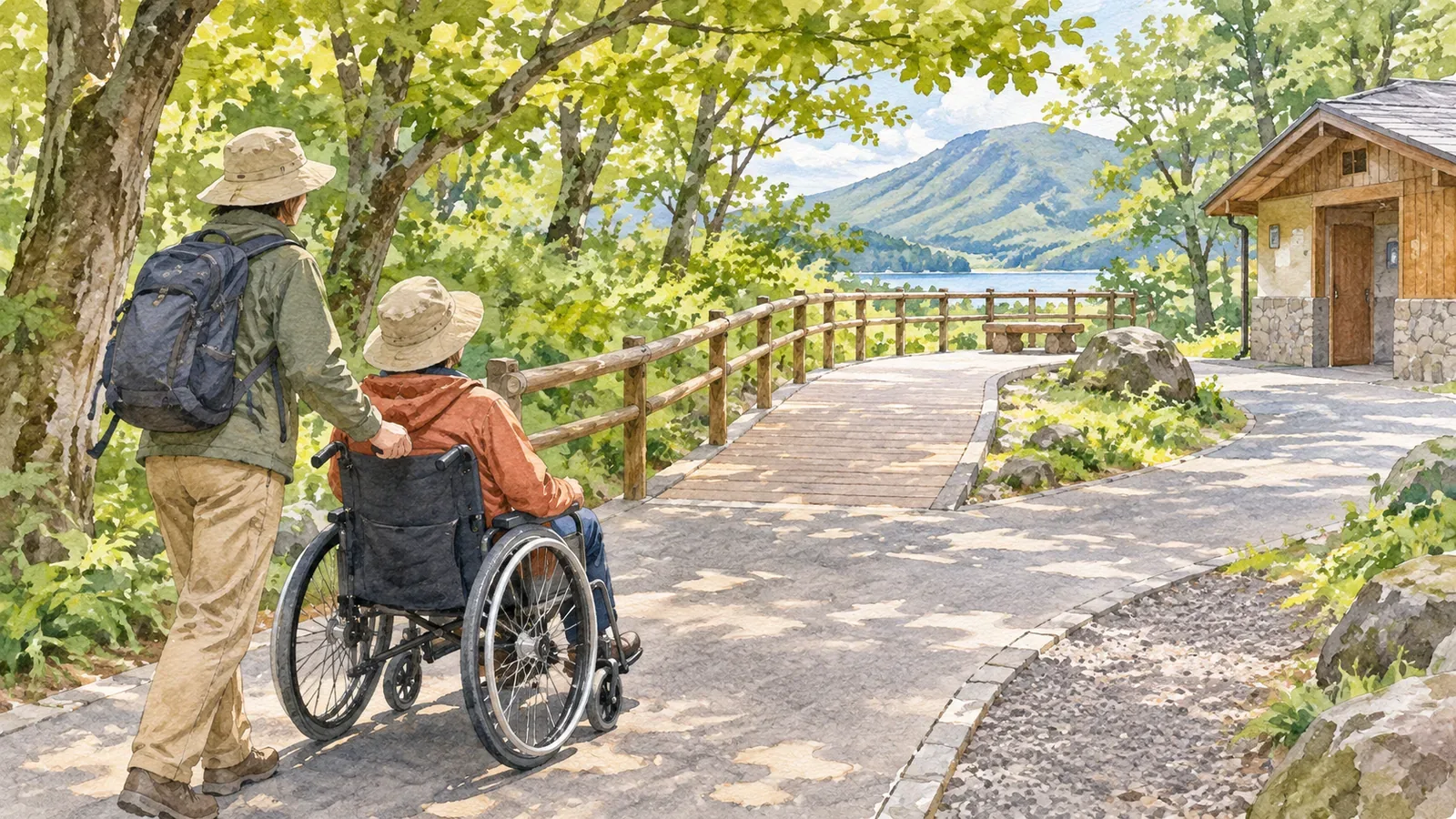
A wheelchair-accessible label is a helpful starting point when choosing somewhere to spend time outdoors. It leaves questions open about where the slopes are and what condition the path is in. Check the route from the entrance to the main sights and places to rest so that the wheelchair user can decide what works for them.
Ask what the label covers
When a site describes itself as wheelchair accessible, start by asking which facilities the label covers. Japan's Ministry of the Environment notes that the accessibility features listed for each national park apply only at some facilities, and asks visitors to inquire ahead. Find out whether the label covers parking, buildings, trails or restrooms, and check the route to whatever you want to see.
At a discussion on universal design in national parks reported by DPI Japan, participants asked for wheelchair users to be able to reach the main attraction at each site. Check the full route from the entrance to the place you are there to visit.
When planning, map out the route from the car park or bus stop to the entrance, main sights and restrooms, then back to your transport. For each section, check for steps and slopes, find out about the surface and width, and identify places to rest. Ask the site manager about any gaps in the information.
Check where slopes are and how steep they get
Ask for the grade if available, where on the trail the slope is, how long it lasts and whether you can rest along the way. A downhill section on the way out becomes an uphill section on the return. A description in one direction may give you too little information to judge the return.
Japan's Ministry of Land, Infrastructure, Transport and Tourism gives examples of standards for path and ramp grades in its urban park accessibility guidance. It also describes exceptions for terrain and protection of the natural environment. The guidance applies to the urban park facilities it covers. Mountain trails can have different grades.
A workable grade depends on the kind of wheelchair, the person's preferences, whether they have someone with them, the surface and the weather. Share the details so the person using the wheelchair can decide for themselves. Ask whether they need assistance at the site and what kind of help they would like.
Check the condition of the surface
Ask whether the path is paved, gravel or dirt, and check for unevenness, joints, puddles and fallen leaves. Kamikochi's official FAQ says many paths are unpaved, including wooden boardwalks and gravel paths. The urban park guidance gives uneven stone paving as an example of a barrier to getting around. Look at the condition of the surface as well as what it is made of.
If photos are available, check where and when they were taken. A flat stretch in one photo may tell you little about what comes before and after it, or whether there is a step at the entrance. Weather and construction can change the surface. Asking the site about current conditions shortly before you go gives you more to work with.
Ask about narrow sections, corners and places to rest. A path can be wide enough to get through yet leave little room to turn or pass a companion. If measurements and photos are unavailable, consider another site or another way to visit so you do not have to push on when you reach an uncertain section.
Ask specific questions
When you contact the site, give the date of your planned visit, the points you want to reach, the type of wheelchair and what you need to know. Questions about a specific place, such as the steepest stretch from the car park to the viewpoint or steps on the way to the restroom, make it easier to apply the answer to your route. Ask for photos or a diagram if they would help.
Check which features the restroom has and how you will get to it. The ministry's guidance notes that heavy demand for multipurpose restrooms can be a problem and calls for information about installed equipment and features to reach the people who need them. Ask the wheelchair user which features they need.
When sharing a reply with your companions, include the date you checked and the section it covers. If you publish information after your visit, say what kind of wheelchair you used and describe conditions at the time. Other people can use those details to make their own decisions. You can also leave a way to report changes or corrections.
Give wheelchair users the information to decide
Use a wheelchair-accessible label as a starting point. Find out where the slopes are and how long they last, what shape the trail is in, how wide it is, and how to reach rest areas and restrooms. Ask the wheelchair user what they need and go through the site manager's information together.
References and sources
- Japan Ministry of Land, Infrastructure, Transport and Tourism: overview of accessibility guidelines for urban parks
- DPI Japan: discussion on universal design in national parks (December 13, 2024)
- Japan Ministry of the Environment: park-by-park directory of topics and universal design features
- Kamikochi official website: frequently asked questions