
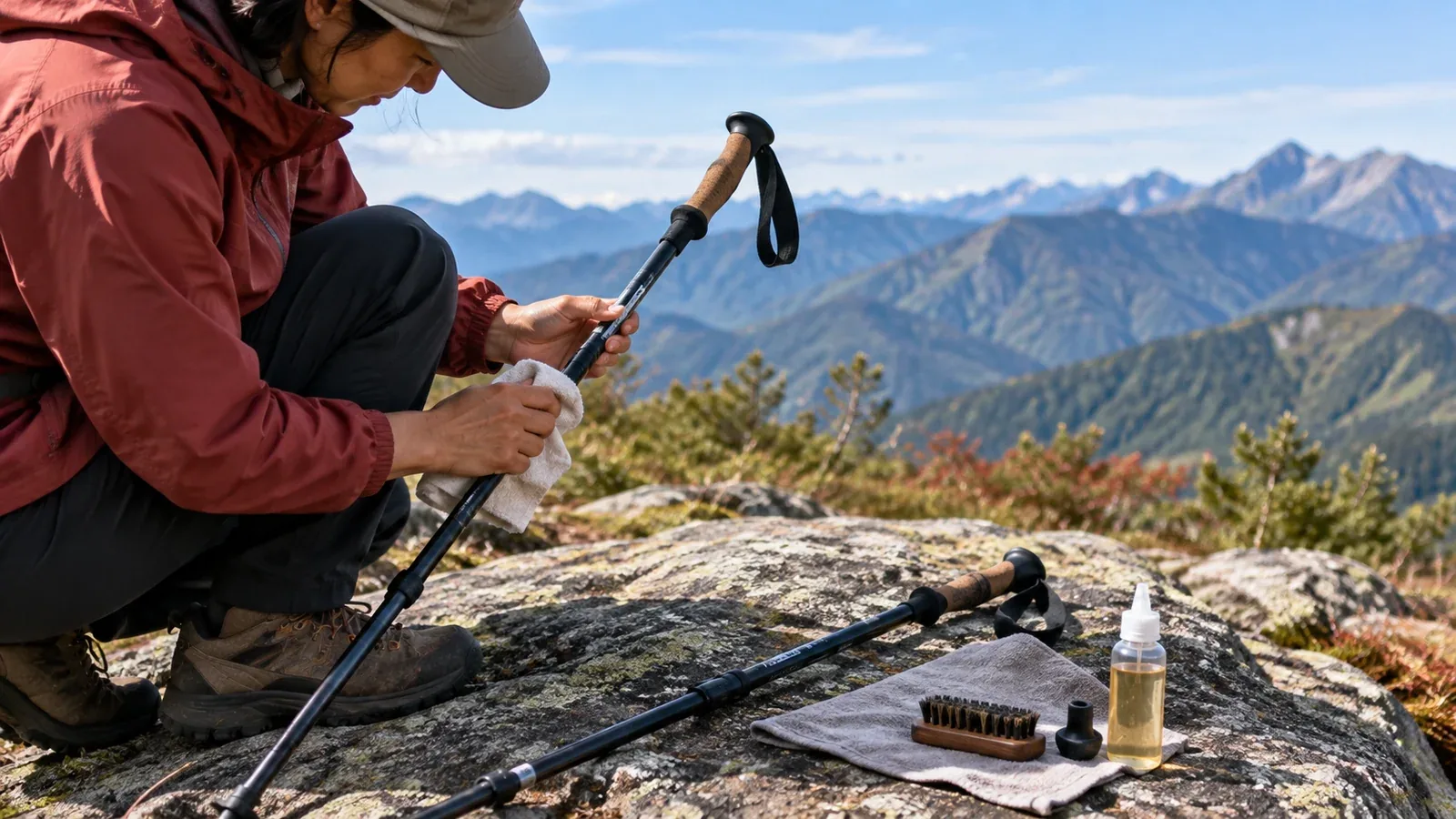
A trekking pole can go into storage working fine and come out with a stuck section. Dirt, trapped moisture, and corrosion on metal parts can all contribute.
This guide explains why poles stick, what to do after a hike, how to prepare them for long-term storage, and what to check when a section or lock will not move.
Why sections stick
Two common causes are buildup of mud, grit, or salt and locking the sections together while they are still wet.
Mud and grit inside the telescoping section can obstruct tubes or locks. Moisture and salt can corrode metal parts. Even on poles with carbon shafts, keep joints and fittings free of dirt and moisture.
Lever and twist locks work differently and collect dirt in different places. Some folding poles are held together by an internal cord. Consult the instructions for which sections can come apart and how to clean them.
Basic care after a hike
When you get home, follow these steps so your poles are not left wet or dirty.
- Open the sections as instructed. On a telescoping model with removable sections, unlock and remove only the designated parts. For folding or non-separable models, follow the drying instructions without forcing parts apart.
- Remove mud and grit. Wipe with a cloth as directed and rinse only parts the manufacturer says can be washed.
- Inspect the locks. Look for visible grit, mud, corrosion, cracks, or bent parts.
- Dry the poles in a well-ventilated place. Wait until the separated sections are dry before reassembly, and avoid collapsing and storing the poles wet.
- Check that the locks hold after assembly. Close them as instructed and, on secure footing, apply light pressure to check that the length does not change.
After using the poles in rain or along a stream, check the joints for trapped moisture even if the outside looks dry.
Where lubricant is permitted
Lubricant on the shaft or friction surfaces that hold the length can make a pole collapse during use. Avoid oiling telescoping sections as a matter of routine.
- Shafts and locking surfaces: Keep them free of silicone spray, oil, and grease. Clean and dry them as instructed.
- Areas the manufacturer allows you to lubricate: For the models concerned, apply only the specified type and amount to the specified spot, such as a lever pivot.
- Models that prohibit lubrication: Follow the manufacturer's cleaning instructions and avoid oil, penetrating spray, and grease.
Whether lubrication is allowed depends on the model. If you suspect lubricant has reached a locking surface, stop using the pole and ask the manufacturer how to proceed.
Preparing poles for off-season storage
Before long-term storage, remove dirt and thoroughly dry the inside of the sections as well as the grips.
Follow the manufacturer's storage instructions. Some models should be stored with the lever tension released, while others are folded once dry.
Let cork or rubber grips dry completely, then store them away from direct sunlight, heat, and humidity.
Baskets and rubber tips are separate parts. Inspect each for wear and cracks before storage. Check the model number and follow the manufacturer's guidance for compatible replacements and installation.
What to do if a section is stuck
Twisting hard or prying with a tool can damage a stuck section or lock. Check it in this order.
- Check how the lock releases. Follow the markings or model instructions for releasing the lever, button, or twist lock.
- Remove any mud or grit you can see. Wipe as directed and check whether it moves without resistance. Avoid hot water or force.
- Stop using the pole if it still will not move or shows damage. If a shaft is cracked or deformed or the lock slips, contact the manufacturer or retailer.
If a section keeps sticking, the lock may be worn or damaged. Stop using it and ask the manufacturer about an inspection or replacement parts.
What to do next
Find your pole's model number, then clean and dry the telescoping sections as instructed. Check that the lock holds before the next use. The manufacturer can advise on faults and spare parts. You can also find an outdoor retailer through Nordwand's partner directory.