
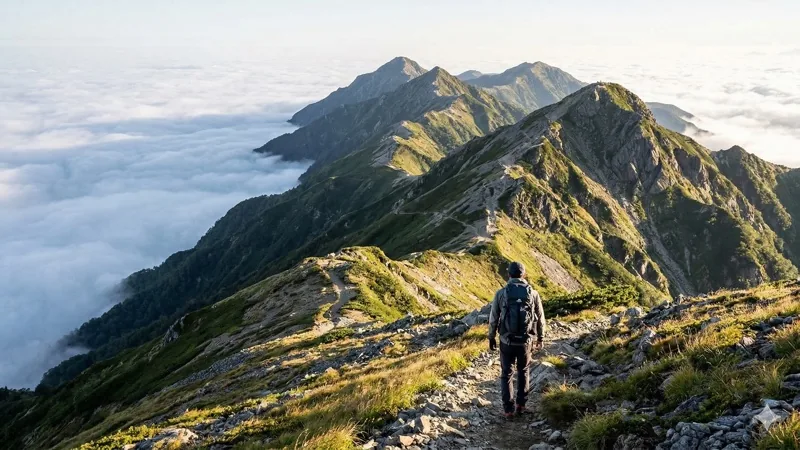
What if, after reaching a summit, you followed the ridge to the next peak? Traverses open up a different way to enjoy the mountains. They also require more planning than a day hike that returns by the same trail. Here’s how a traverse works and what to consider before setting out.
What is a traverse?
A ridge traverse, or simply a traverse, is a hike that links several summits or ridges in succession.
For example, you could start below Peak A, follow the ridgeline over peaks A, B and C, then descend to the trailhead below Peak C. A traverse often starts and finishes in different places, though a loop that links several peaks can finish where it began.
An out-and-back starts at one trailhead, goes up to the summit and returns on the same route. Many day hikes follow this pattern.
Here is how the two compare.
- Out-and-back. You use the same trail in both directions. Having one trailhead makes driving simpler, and you already know what to expect on the return.
- Traverse. You link ridges or several summits and often finish somewhere else. The scenery keeps changing, while escape routes and transport from the finish take more planning.
You might associate traverses with experienced hikers, but there are also short traverses you can finish in a day. Look at the distance, cumulative elevation change, footing and trail conditions, then choose a route that fits your fitness and experience.
What to plan before a traverse
Think through these details in advance, especially if your previous trips have mostly been out-and-backs.
Estimate walking time and the full day’s schedule
Traverses are often longer, so build a margin into your schedule. Times on maps and in guidebooks are walking estimates. Weather, pack weight, how people feel and the state of the trail can all change your pace. Allow separate time for breaks and delays.
Compare your group’s actual times on similar hikes with the published estimates. A record showing that a hike took 1.2 times the estimate or 0.9 times the estimate gives you a starting point. Terrain and bad weather can change that ratio. When hiking with others, plan around the slowest walker.
Check huts and campsites if staying overnight
For an overnight trip, choose a hut or designated campsite. Check opening dates, booking requirements and check-in times. In areas such as Chubusangaku National Park, camping outside designated sites is prohibited. Check current local rules before leaving.
If there are few places to stay, finding a different overnight stop after falling behind is difficult. Save the contact details for your accommodation and decide in advance where you can cut the trip short and descend if you’re running late.
Arrange transport
On an out-and-back, you return to the same trailhead. If your traverse ends somewhere else, arrange transport from the finishing trailhead before setting out.
- Check bus and taxi services and when the last departures leave.
- If using two cars, leave one at each trailhead.
- Ask someone in your hiking group to arrange a lift.
In remote areas, buses may be infrequent or run only in certain seasons. Check what you can do if you miss the last bus.
Identify escape routes
If the weather deteriorates or someone feels unwell, there may be no quick way down from the ridge. Turning back can take time on an out-and-back too. On a traverse you may have walked so far that a different descent is closer.
Use a map to check escape routes at the junctions. Check closures, terrain and transport after each possible descent. Decide when and where to turn back if you’re behind schedule, record it in your hiking plan, and share it with the group and someone staying behind.
A good traverse starts with the plan
The appeal of a traverse is spending time on the ridge as the views change. It takes a little more planning than an out-and-back.
Work out your timing, overnight stops, transport from the finish and escape routes before you leave. On the trail, adjust your plans early if the weather or anyone’s condition changes.
For your first traverse, try a short day route. Seeing different scenery on the way up and down can make a familiar sort of hike feel new. Published times and hut schedules can change with the season or from year to year. Check current information for the area when planning.