
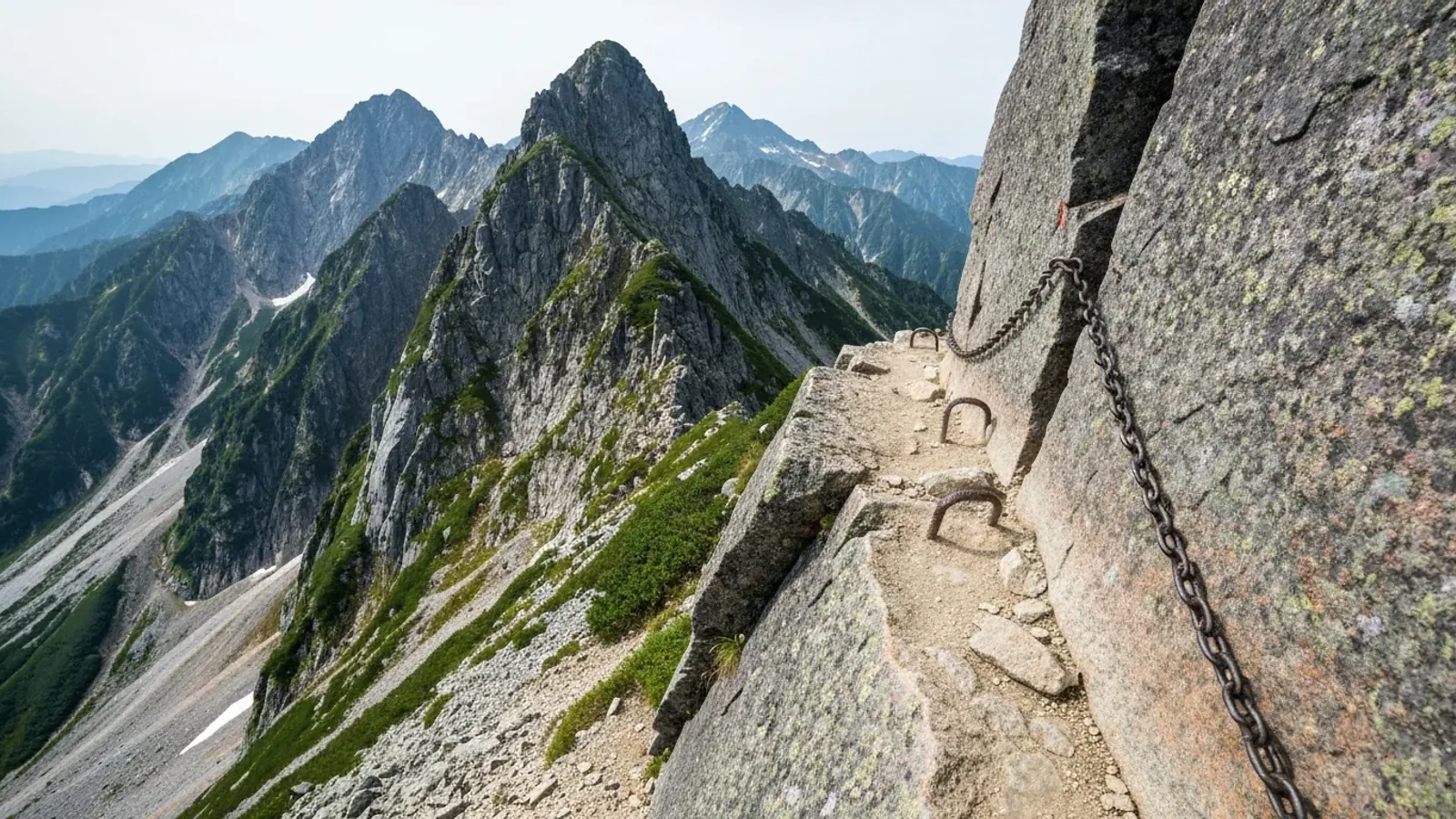
Have you ever felt yourself wobble after moving a hand and a foot together on rock or beside a chain? Three points of contact is a way to move one limb at a time while checking what will hold you. The difficulty and condition of the rock also help you decide whether to go through at all.
What are three points of contact?
On rock and similar terrain, the technique means steadying yourself with three of your hands and feet while moving just one. You can use it on rock, chain-assisted sections and fixed ladders. A contact point is a handhold or foothold that can support you.
Touching three points alone will not hold you if the rock shifts or your feet slip. Check that you are steady before each movement and take one move at a time.
How three points of contact help
Moving one hand or foot at a time makes it easier to stay balanced on your other holds while you look for the next one. Moving a hand and a foot together leaves fewer points of support.
Loose rock, wet rock, ice and strong wind can still lead to a fall. If you cannot find reliable holds, cannot safely reverse the moves or lack the skills or equipment, turn around or choose another route before committing to the difficult section.
In practice: Where and how to take a hold
Choosing holds
- Rock holds and footholds: Look for solid edges or recesses, and check for wet surfaces, grit and loose stones.
- Cracks: Choose a crack where the surrounding rock is solid and you can get a comfortable grip or place a foot.
- Tree roots: Avoid roots that are rotten or move. Prefer solid rock holds and footholds.
- Fixed chains and ropes: Check for damage or looseness before using them as handholds.
Check the hold before you load it
Stay balanced while you look at the next hold and gently test it. If the rock shifts or creaks, or your foot slips, do not use it. Transfer weight gradually even to a hold that feels sound.
The order of movement
Use this sequence when moving with three points of contact.
- Look at the next handhold or foothold.
- Steady yourself on the other three points and move one hand or foot.
- Test the new hold gently and load it gradually if it is stable.
- Once you are balanced, choose the next hand or foot to move.
Common mistakes
1. Moving two points at once
It is easy to move a hand and a foot together when you rush. Wait until the new hold is loaded and your position is stable before moving another limb.
2. Crowding the rock
Getting too close to the rock can make it hard to see your feet. Balance where you can see your footholds and place your foot before transferring weight. A stable position depends on the angle of the rock.
3. Overlooking the foothold below you
On the way down, find your next foothold before shifting weight. Depending on the slope and footholds, facing the rock can make a descent steadier. Turn back before committing to a section if you cannot tell whether you can descend it safely.
On chain-assisted sections and ladders
Use the chain as an aid
Check the chain’s attachments for visible looseness or damage and look for stable footholds. Even with a chain, skip sections with icy rock or beyond your skill level. Stow trekking poles on steep rock so your hands are free.
Three points of contact on ladders
Face the rungs of a fixed ladder and keep three points of contact, taking one rung at a time. Stop in a safe place away from the ladder to take photos or handle equipment. Follow any signs setting a limit on users or specifying how to pass.
Take your time when people are waiting
Wait on stable ground before the section until the person ahead is clear. Watch for loose rock when people are below and leave space in front and behind. Take each move at your own pace when someone approaches from behind.
Three points of contact is a movement technique. It is separate from rope protection that can catch a fall. Learn the moves from a guide or in a practical course before attempting difficult rock.
Summary
On rock, test holds before loading them, move one limb at a time and look for your next foothold when descending. Before leaving, check where the difficult sections are and how hard they are, then decide whether to pass based on the conditions you find.
Practise in a low, stable place with no risk of a fall from height. If you practise with a partner, ask them to watch whether you are steady before moving each hand or foot.