
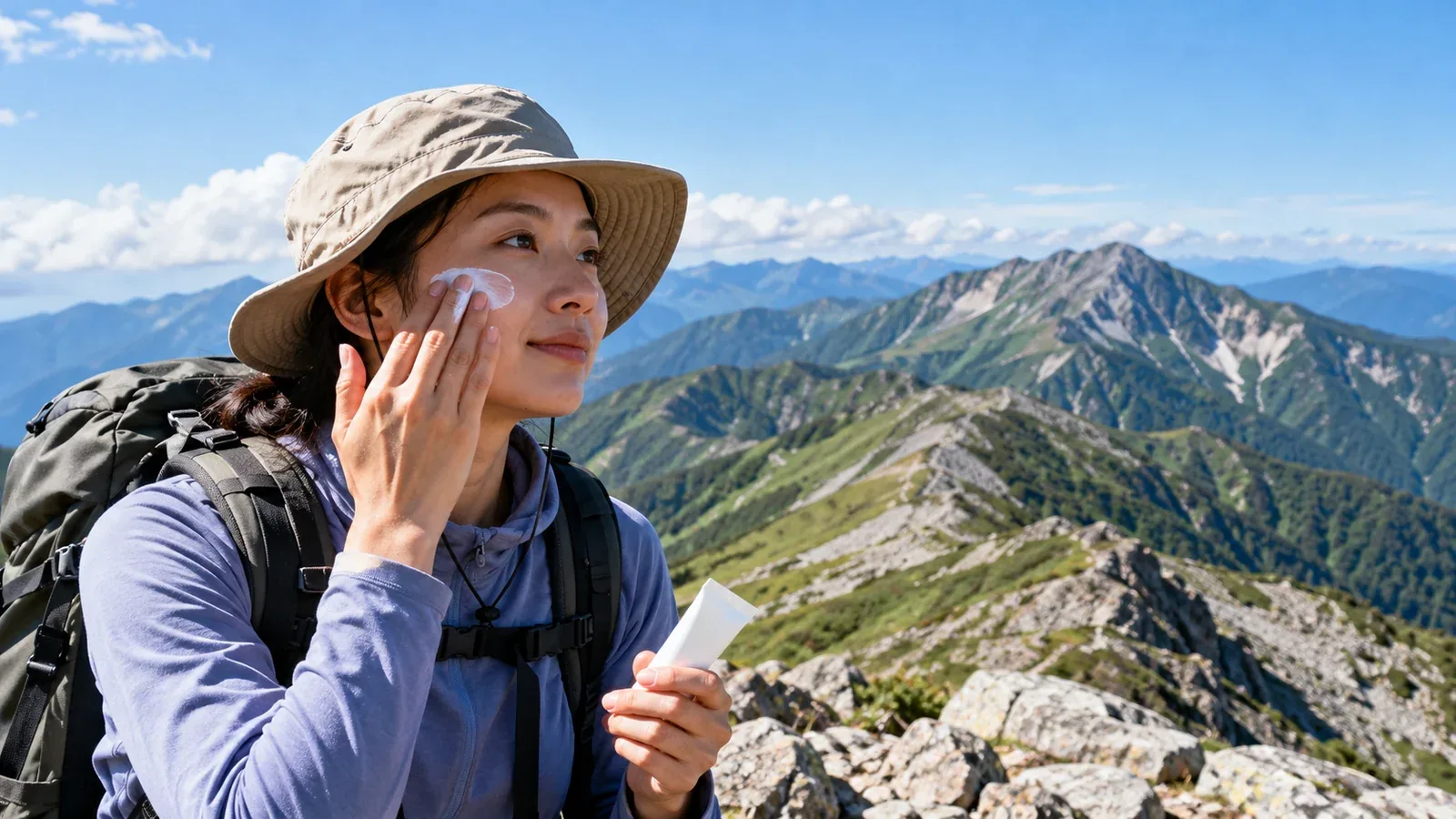
UV radiation tends to be stronger at altitude. Protection matters on ridges with little shade and where snow reflects UV. Wear a brimmed hat, UV-protective clothing and sunglasses, and apply sunscreen to exposed skin.
Sweat, water, clothing and towels can remove sunscreen. Here is what to look for on the label and how to apply it before and during a hike.
Why sunscreen wears off on the trail
Three factors make protection harder to maintain while hiking.
Sweat and water wash it away. Heavy sweating or getting wet can remove the layer you applied. Even with a water-resistant product, reapply as directed.
Friction rubs it away. A hat, neck gaiter or shoulder strap can rub against skin, and towelling off sweat can thin the layer.
Long periods outdoors call for reapplication. SPF and PA are measures from standard tests. The ratings do not tell you how many hours of protection you get outdoors.
Keeping these three things in mind helps you choose a product and plan when to reapply.
What to look for
SPF and PA ratings
For hiking, look for water-resistant sunscreen rated SPF 30 or higher that protects against UVA and UVB. In Japanese labelling, SPF mainly indicates UVB protection and PA indicates UVA protection. SPF 50+ and PA++++ are options for exposed ridges or lingering snow. Keep reapplying and using protective clothing even with a high rating.
Water-resistance labels
Under the Japanese cosmetics industry's voluntary standard, one star indicates the 40-minute immersion test and two stars the 80-minute test. U.S. labels also state 40 or 80 minutes. Those are test conditions. On a hike, follow the instructions and allow for sweat and friction.
Choosing a formulation
- Cream or lotion. These are easy to spread evenly over exposed skin. Use the amount specified on the label.
- Stick. It can make reapplying to small areas easier. Follow the directions and smooth it out to avoid strips of uneven coverage.
- Spray. Wind can carry it away. Avoid inhaling it or spraying it directly onto the face, and spread it evenly as directed.
- Powder. Use it as a supplement. For primary protection, choose a product you can apply evenly in the amount required.
For reapplication, you can use a full application of the same product during a break or use a portable product you can apply evenly. Check the directions and amount even if you switch formulations.
Using the same product on face and body
Check whether the label allows both. Follow the directions around your eyes and keep it out of the eyes. Stop using it if it irritates your skin and ask a doctor or pharmacist if needed.
How much and where to apply
To get the intended protection, use enough and spread it evenly. Follow the product directions. On the face, dab it in several places, such as forehead, nose, cheeks and chin, then spread it. Stretching a small amount into a thin layer makes the labelled protection harder to achieve.
Commonly missed areas include the edges and backs of the ears, tip of the nose, back of the neck, lips, backs of the hands and the ankles between trousers and socks. Use lip balm with sun protection on the lips.
Apply before going outside. The American Academy of Dermatology suggests about 15 minutes beforehand. Follow the timing on the label if provided.
When and how to reapply
Plan to reapply about every two hours outdoors and again after heavy sweating or towelling, following the label. If it has rubbed off, reapply sooner.
- Set a time to reapply. Use a break about every two hours while outdoors or follow the product's timing instructions.
- Check before an exposed stretch. Before hitting a ridge or lingering snow, see whether it is time to reapply or whether sweat or friction has removed the layer.
- Reapply after getting wet or drying off. After heavy sweating, getting wet or using a towel, gently pat off moisture and reapply.
Pat off sweat with a towel without rubbing hard. Keep the sunscreen in an accessible pouch so you can reach it at a break.
Common mistakes and fixes
“It was cloudy, so I skipped it”. UV still gets through clouds, and the level varies with cloud cover. Check the UV Index from a source such as the Japan Meteorological Agency and use shade and clothing too.
“I could not tell which product goes first”. The U.S. CDC advises using separate products, with sunscreen first and insect repellent second. Follow each label and check the reapplication intervals separately.
“I put it in the pack and forgot it”. Keep the product you will use to reapply within reach. Check its location before leaving.
“It got in my eyes and stung”. Check where you apply it and keep it out of the eyes. A hat or sweatband can divert sweat. If it gets into your eyes, follow the directions for rinsing with water and seek medical advice if irritation continues.
Before your next hike
Check the label for how much to apply and when to reapply. Before going outside, cover exposed skin. Keep the sunscreen and a towel for patting sweat within reach. Bring a hat and appropriate clothing for the UV Index, elevation and snow along your route.
References
- Japan Meteorological Agency: altitude and UV radiation
- Japan Meteorological Agency: reflected UV radiation
- Japan Meteorological Agency: clouds and UV radiation
- Japan Ministry of the Environment: UV radiation and health manual
- Japan Cosmetic Industry Association: SPF, PA and water-resistance labelling
- American Academy of Dermatology: choosing sunscreen
- American Academy of Dermatology: applying sunscreen
- American Academy of Dermatology: using stick and spray sunscreens
- U.S. CDC: sunscreen and insect repellent