
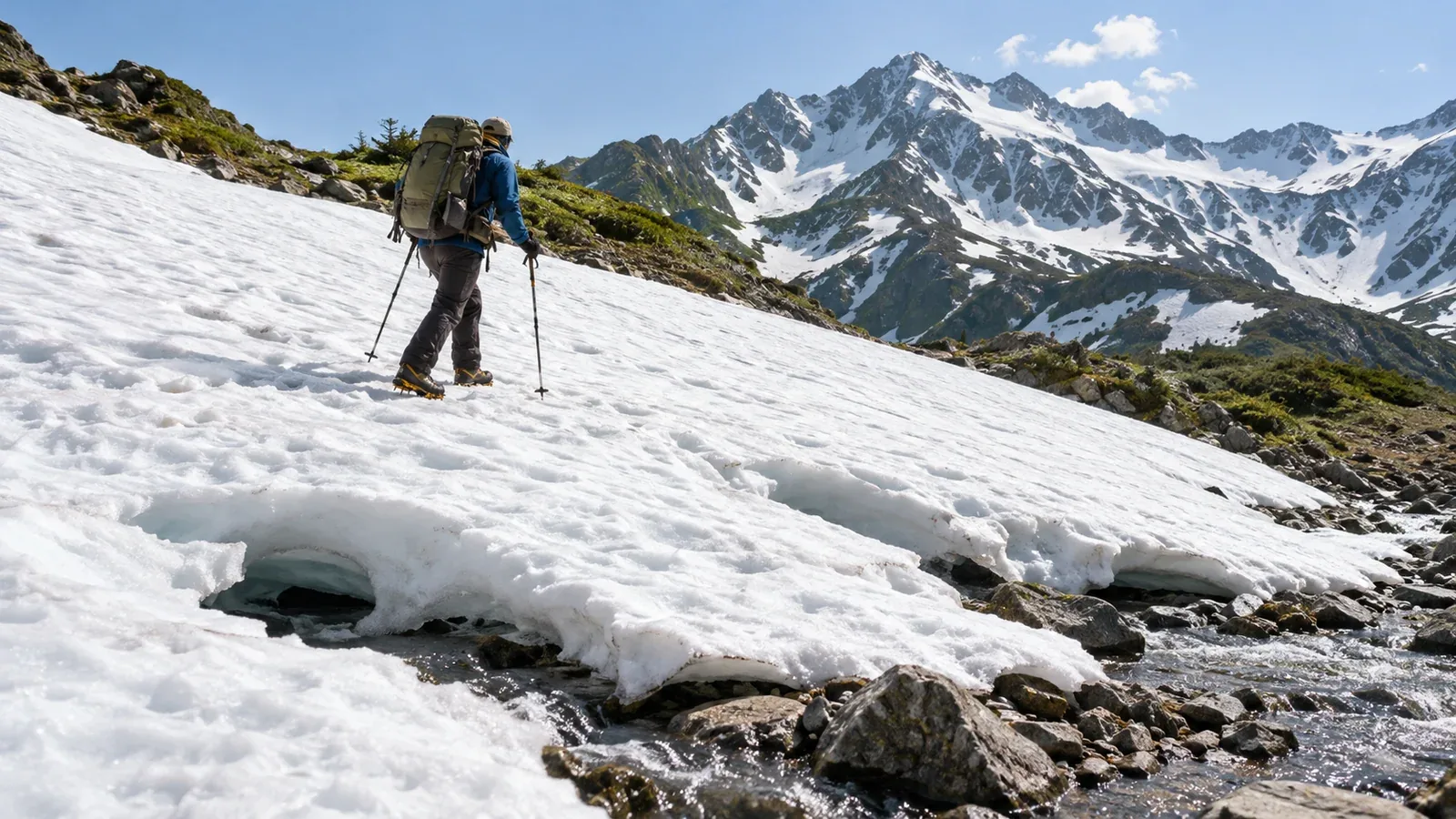
Snow can linger into spring or summer depending on elevation, aspect and the year. Meltwater can hollow out snow bridges, soft snow can hide holes, and cornices can remain above trails and ridges. Rain and warming can also increase wet-snow avalanche activity.
Snow can look solid while water is running underneath or the snow has pulled away from rock. Use the terrain, current reports and what you can see from safe ground to decide whether to change plans.
Snow-filled gullies and stream crossings
Snow can remain in gullies and stream channels after nearby trails have melted out. It may conceal flowing water, voids or steep ground below the crossing. Check the approach, the far side and what a fall would lead into.
Stay off unverified snow bridges
Meltwater can hollow out a snow bridge from underneath. Its surface and tracks don’t tell you whether it will hold, and a fall can trap someone under snow or in moving water. Choose an open, managed crossing, a verified detour or turn back.
These signs are reasons to stay away from a crossing. A bridge can still be weak when none are visible.
- A thin or overhanging lip, a visible opening or the sound of water under the snow
- Cracks, sagging or an area that has already collapsed
- Softening after warming or rain, or fresh signs of meltwater
- A fast current, a constricted channel or a fall that could carry someone under the snow
Slope and surface on a snow crossing
The same snow can be hard and icy after a freeze and softer later, depending on weather and aspect. Hard snow can make a slip difficult to stop. Wet snow can lose support, ball under crampons or release as a wet avalanche. The clock alone does not tell you whether a crossing is safe.
Check the slope, surface, runout and terrain above from safe ground. Use compatible equipment only on terrain you are trained to handle. Choose another route when a crossing exceeds your skills or you can’t confirm a safe way across and back. Check recent local reports.
Breaking through snow into hidden holes
A foot can punch through apparently solid snow into a gap beside a rock, under brush or over water. This can trap a leg, cause injury or start a slide on a slope.
Where and when snow can lose support
Watch for gaps around tree trunks, rocks and buried vegetation. Water and uneven ground can leave cavities beneath the surface, including at the edges of streams and snow patches.
Snow can soften at different times depending on sun, aspect, rain and overnight freezing. The return route can be weaker than it was earlier. Recheck the conditions and keep an alternative.
How to reduce the chance of breaking through
- Stay on an open, marked route and give stream edges and obvious voids a wide margin.
- Watch for sagging snow and changes near rocks and plants. Check from stable ground.
- Tracks and a trekking-pole probe do not establish that a snow bridge or snow roof can hold you. Turn back if support is uncertain.
- Snowshoes can help you float in suitable soft snow. Avoid unsupported snow and steep terrain where they provide inadequate grip.
If you break through
Stop and check for injury and stability before trying to free yourself. Move back toward known stable ground only if you can do so safely. Keep companions off the weak snow and call for rescue if someone is injured, trapped or at risk of falling further. In Japan, call 119 or 110 and give your location and the hazard.
Cornices: recognise and avoid overhanging snow
Wind can build an overhang on the lee side of a ridge. Cornices can persist into the melt season and fail without warning.
Why cornices are dangerous
A cornice can look like an extension of the ridge. The real ground can end well inside the visible snow edge, and the break can extend back onto apparently solid terrain. A collapse can cause a fall or trigger an avalanche below.
Choosing where to walk near a ridge
Cornices typically build on the lee side. Regional wind patterns give context, but terrain and changing winds can affect where snow collects. Plan a route on known ground well clear of both the overhang and what lies below it.
Use these principles around snow-covered ridges.
- Stay well back on known ground. No fixed distance from the visible edge guarantees safety.
- Keep away from the edge if you can’t identify the true ridge. Don’t approach it to look over or probe it.
- Stay out from under a cornice and away from the slopes and runouts it could affect. Warming and rain can increase the hazard.
- Choose a different route if cloud, blowing snow or other conditions prevent you from identifying safe ground.
Cornices can still fail late in the season
A cornice can collapse in cold weather as well as during a thaw. Warmth, rain and changing snow conditions can weaken it. A firm-looking surface or a cold morning cannot establish stability.
What these hazards have in common
Snow-filled gullies, hidden holes and cornices all call for decisions made before you step onto uncertain snow.
Use the terrain and what you know about the snow below the surface
Look for water, cracks, sagging, drifted snow and what lies beneath or above the route. Snow can hide weak areas with no visible clue. Use a known safe route or turn back when you can’t establish safe passage.
Make it easy to turn back
Agree with the group on an alternative and on when to use it. For example, skip a ridge if you can’t identify the true ground or stop short of a crossing if its surface or runout is unsafe. Allow for the return trip and possible warming.
Get current local snow information
Snow varies by year, elevation and aspect. Recent reports from a hut, park office or municipality are more useful than an old trip report. Check weather, warnings, trail closures and local avalanche information, and verify that the report covers your specific route.
Before you go
Ask the local manager about snow crossings, bridges, cornices and trail access. Mark alternatives and a turnaround point on the map. Choose a route within the group’s skills and go with a guide qualified for the conditions if you’re new to travel on spring snow. Nordwand’s guide request tool can help you find one.
Further reading
- Japan Meteorological Agency forecasts and warnings
- National Police Agency mountain incident reports
- Prefectural guidance on spring mountain hazards
- Japan Mountain Guides Association qualification scope
References and sources
- Japan Meteorological Agency · Forecasts
- Japan Meteorological Agency · Warnings and advisories
- National Police Agency · Mountain incident reports
- Nagano Prefecture · Spring slips, falls and avalanches
- Nagano Prefecture · 2026 spring mountain safety book
- Japan Mountain Guides Association · Qualification scope
- Japan Avalanche Network · Avalanche types, including wet snow
- Japan Avalanche Network · Avalanche terrain and cornices
- Mountaineering Scotland · Identifying and avoiding cornices
- U.S. National Park Service · Spring snow hiking hazards
- Japan National Tourism Organization · Emergency numbers