
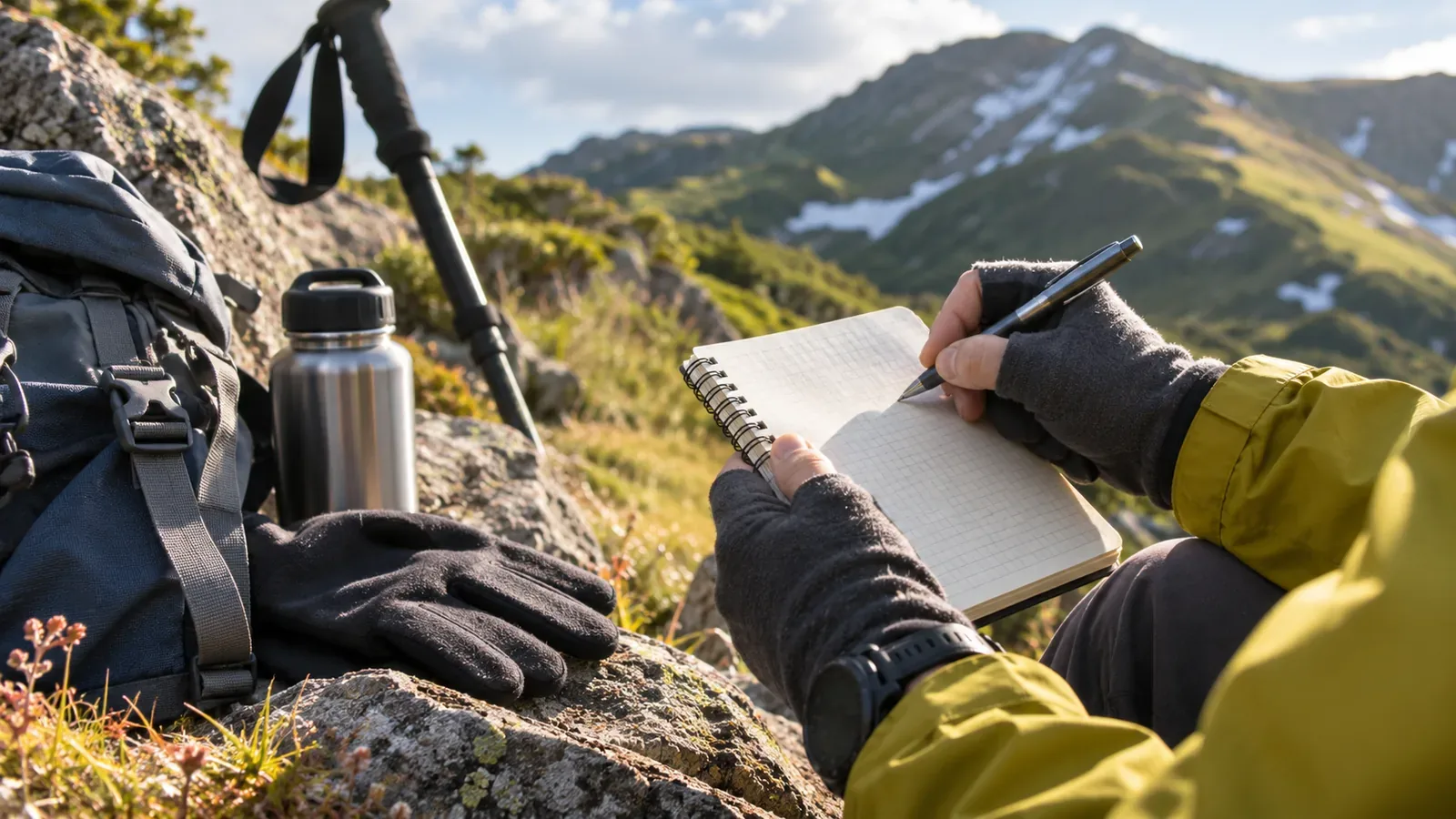
Sunlight notes can help you review your plans when they include where and when you hiked, clouds and ground conditions, and the protection you used. Record any UV information with the place and time it covers. How you felt or how your skin looked later cannot tell you the dose or a safe limit. The editors propose a way to use notes to review the plan.
Keep the factors that affect UV separate
The Japan Meteorological Agency explains that UV is affected by the sun’s elevation, your elevation, clouds, aerosols and ground reflection. In your notes, record what you actually checked: place and time, cloud and the surface underfoot, such as snow. Looking at the sky does not measure ozone or airborne particles. Keep observations separate from published data.
UV is generally stronger around solar noon, during summer in Japan and at high elevations. Clouds and other conditions affect where and when the daily peak occurs. Being at the highest spot at noon does not necessarily put you at the peak. Record time and elevation as two factors among several.
The warmth you feel and the strength of UV also differ. Infrared radiation feels warm, while you cannot sense the UV that causes sunburn. Feeling cool does not establish what the sunlight was like. Keep air temperature and perceived warmth in a separate field. Early in spring, strong UV calls for particular care even when the air is still cool, so those observations can easily diverge.
Use published values as a reference and record how the trail differs
The weather agency’s archive separates UV index observations at stations from nationwide analyses calculated for cells roughly 20 km square. Daily maxima, monthly averages of daily maxima and hourly values also mean different things. Note which data you used. When comparing regional patterns, use matching indicators and coverage.
Forecast and analysis maps already account for a representative elevation in each cell. Where plains and mountains are in the same cell, it is usually the elevation of the plains. Other cells differ. Think about how your route differs from the model and avoid applying a blanket adjustment for elevation or snow.
When planning, check the forecast for the date and hours of the hike. To compare later, look for an analysis for the same place and time. Write your own activity in a separate field. The difference between the map and your exposure is unmeasured. If you notice sunburn, look back for spots you missed or long exposures, without assigning a single cause or taking a day without redness as a safe limit.
What to put in your hike notes
Our editors suggest five fields that are easy to keep up: time and location, sky conditions, ground surface, shade and time spent there, and protection used. These fields help you review what you did. They are not a measurement of every factor affecting UV.
First, note the time and place. Add elevation if known, and note whether you were in a forest or on a ridge. Second, describe the clouds or weather. There is no need to name cloud types you cannot identify. The weather agency explains that considerable UV passes through thin cloud and that certain clouds can raise the index above a cloudless value. Keep your eyes away from the sun while noting the sky.
Third, record the surface you saw, such as snow, soil, rock or water nearby. It helps you think about reflection without measuring a reflectance or dose. Fourth, note whether there was shade and how long you stopped. Scattered and reflected UV reach shaded spots. Adding time in the sun and counting shade at half exposure cannot calculate your dose.
Fifth, note the protection you used and where you noticed any skin changes after getting home. Treat this as a personal observation rather than an assessment or diagnosis. Sunscreen increases protection when exposure is unavoidable and depends on using it correctly. Keep time in the sun short. Record when you applied it so you can review it later, and follow your product’s application and reapplication instructions.
Use the notes to plan for another season
When planning for summer, see whether you spent long periods in open areas when UV was strong. The WHO recommends taking particular care at a UV index of 3 or higher and using shade, clothing, a hat, sunglasses and sunscreen. Consider a different start time or rest spot and check whether it also works with darkness, fatigue and weather.
For early spring, consider whether cool air led you to skip protection. In winter and while snow remains, review what you used on snowy stretches. Japan’s environment ministry warns that snow reflection can add to exposure. Review time, weather and equipment together in every season.
For a practice exercise, pick a past hike and find a reference value for the date from published daily data. Fill in the five fields using what you remember about time, elevation, sky and the surface. Write down what you would change if you did the same hike in another season. You can do this safely at home.
In short: keep the data alongside your observations and review by season
Record published figures separately from where and when you walked, the sky, ground, shade and protection. The figures do not give a consistent low-elevation minimum, and notes cannot reconstruct personal exposure. Use them to improve the equipment, rest spots and itinerary you choose next time. Check current information for every new hike.
References and sources
- Japan Meteorological Agency: What Is the UV Index?
- Japan Meteorological Agency: Guide to UV Information
- Japan Meteorological Agency: UV Data Archive
- Japan Ministry of the Environment: UV and Environmental Health Handbook 2020
- Japan Meteorological Agency: Clouds and Ultraviolet Radiation
- WHO: Radiation — Protecting against Skin Cancer