
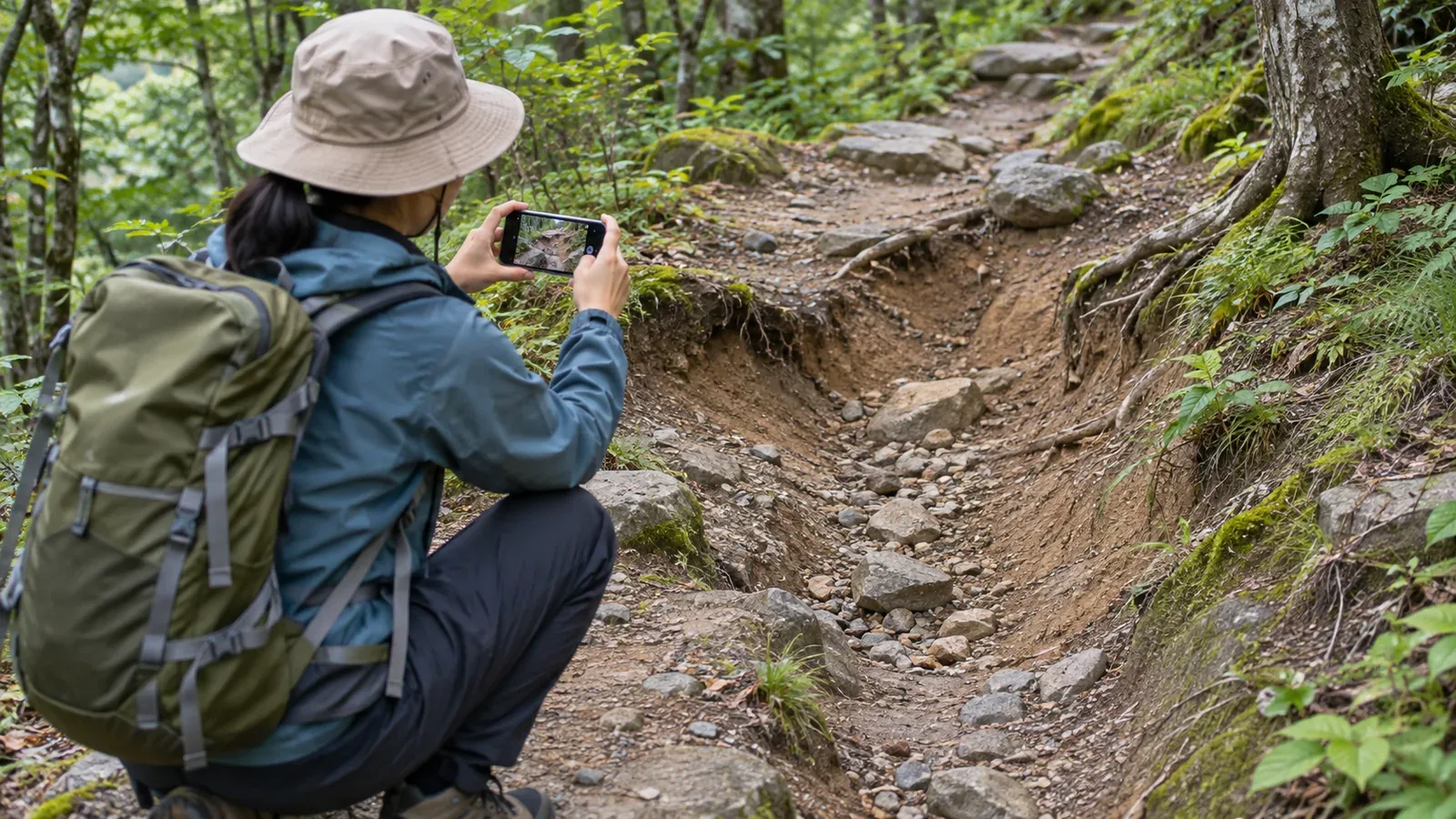
If you find a damaged trail, leave the stones and branches where they are. Record what you saw and tell the trail manager. Repair guidance from Daisetsuzan and examples from other areas explain why crews check drainage and footing and how hikers can report hazards.
How a Well-Meant Fix Can Make the Trail Worse
The Ministry of the Environment’s Daisetsuzan guidance is a technical reference for managers and repair crews. It cautions against diverting water in a way that worsens erosion and against doing more work than necessary. Extensive stonework can harden the path, so the guidance limits it to steps and severely eroded spots. Even experienced crews are selective about where they place stones and how many they use.
The same guidance describes how repeated freezing and thawing and the churning of wet ground by foot traffic during rain or snowmelt can spread mud. When a path becomes a slippery channel or erodes into a deep rut, hikers tend to walk on the raised edge. Plants are damaged, the soil is exposed and erosion spreads.
It can be hard to see in passing where water comes from and where it drains. Adding stones or branches could redirect the water or change where people walk, leading to a new track.
How Trail Crews Document Repairs
Daisetsuzan’s guidance includes a repair record for the location, photos and problems at a damaged spot. Crews can record the site before and after the work to compare what changed.
In Chichibu-Tama-Kai National Park, trails can widen or develop parallel tracks as hikers pass each other. The Ministry of the Environment describes how agencies, local groups and hikers work together to repair paths and clarify where to walk, protecting the vegetation.
When someone adds a stone or branch while passing, the crew may have trouble finding out who put it there, when or why. Leave stones or branches that seem to have been placed there where they are. Note what you saw and report the spot if it concerns you.
Find the Trail Manager or Reporting Contact
Kanagawa Prefecture explains that the Tanzawa–Oyama area has natural park paths maintained by the prefecture, hiking paths and courses maintained by municipalities, and routes with little or no maintenance. Find out who looks after the stretch you’re on, even within the same mountain area.
The Ministry of the Environment’s Northern Alps Trail Program at Mount Norikura invites people to join maintenance events and report trail hazards. If you’d like to help with repairs, look for organized opportunities like these.
It may take time to identify the trail manager. If you come across a damaged stretch, start by finding out whom to tell. Check the official park or local government guidance for the manager or contact for that section.
How to Record and Report What You Saw
Before acting, find out who manages the path, whether you have something to report and where it’s safe to stop. Japan’s national park etiquette recommends checking weather, access, trail conditions and volcano information before leaving. While checking the official trail updates, look for the manager or contact. If no contact is listed, the municipality, park office or a hut may be able to point you in the right direction.
Stop on firm footing without blocking the path before taking notes, photos or using your phone. If there’s nowhere suitable, wait until after the hike and use your map to identify the section or junction. If you can stop, note a location cue such as a junction or sign, take a photo that shows the site as a whole, and describe the problem, such as flowing water, a deep rut or a widening path. Stay on the trail for the photo and leave the stones and branches in place.
After the hike, write a few lines about where you were, what you saw, what it looked like and whether you have a photo. Reporting forms vary, but those details give you a place to start. Ask the office if you’re unsure how to submit them.
Japan’s national park etiquette asks visitors to stay on paths and boardwalks and to leave stones in place. If a fallen tree or washout makes a trail unsafe to pass, stop short of it, turn back and report what you saw after the hike.
Stop, Observe and Report
Trail crews check how water flows, limit their repairs and document what they do. Look up the contact before leaving, stop somewhere safe to record the damage and report it after the hike. Check the current rules and contacts for the area you’re visiting.
References and sources
- Japan’s Ministry of the Environment: Etiquette in National Parks
- Japan’s Ministry of the Environment: Conservation Work in Chichibu-Tama-Kai National Park
- Japan’s Ministry of the Environment: Daisetsuzan National Park Trail Maintenance Guidelines, Chapter 3: Conservation and Restoration Methods (March 2005)
- Kanagawa Prefecture: Natural Park Trail Information
- Japan’s Ministry of the Environment: Northern Alps Trail Program at Mount Norikura