
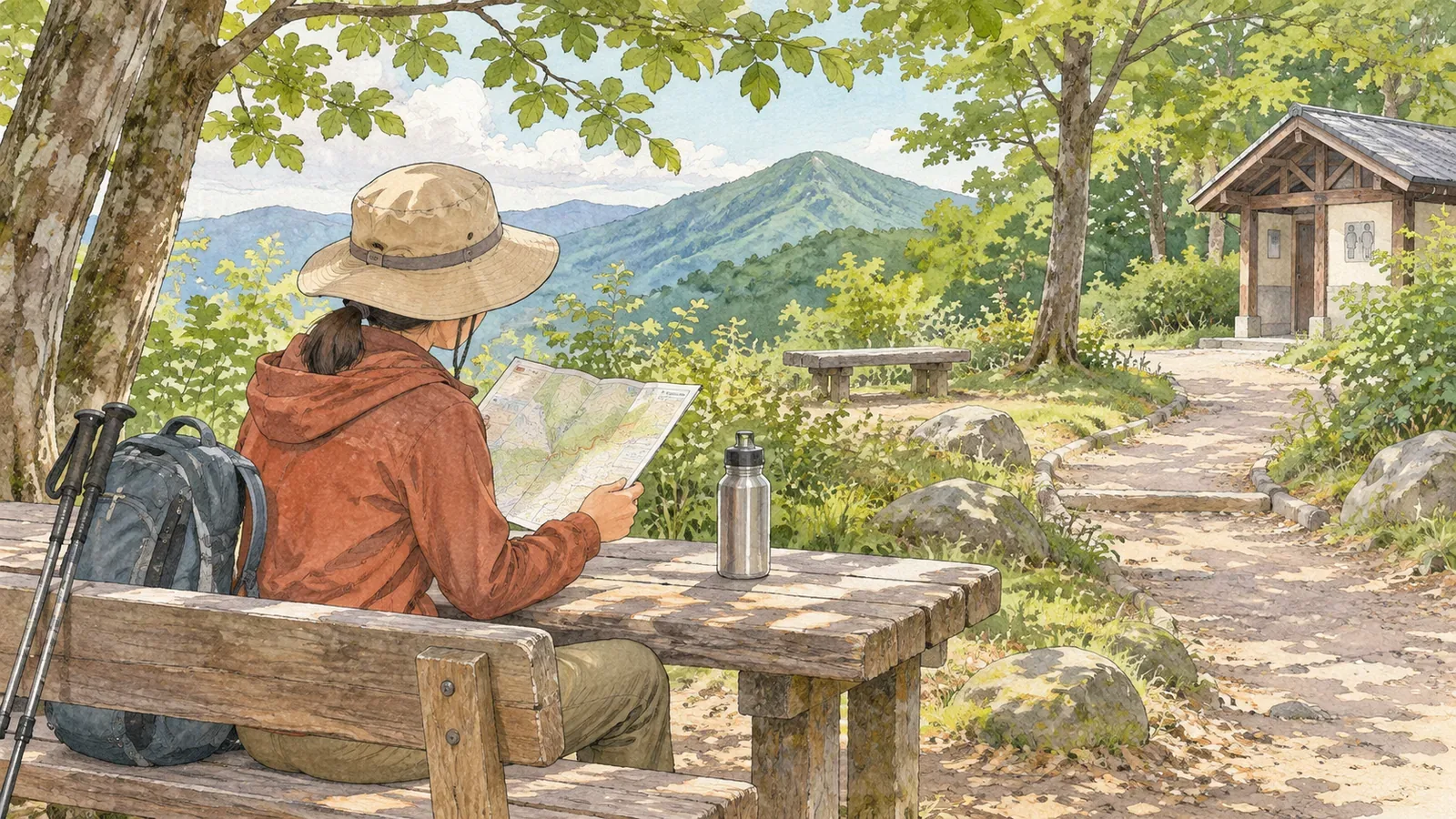
When planning a walk outdoors, it is easy to focus on the distance and sights. Asking where you can rest opens up other ways to plan the outing. You might make a bench with a view your destination or use it as a point to decide whether to turn back. A bench marked on a map can still be difficult to reach or use.
Build the route around places to rest
On the official map of the park or visitor center, look for the entrance, benches, main sights, restrooms and exit. Kamikochi's official FAQ recommends checking where restrooms and rest areas are, since they can be far apart on some routes. You could decide whether to carry on at the first rest area. Allow enough time to get back without committing to walk the whole route.
Once you find a bench, check the distance, slopes and stairs, surface and width of the path to it. Even a short stretch may have a steep slope. If you are coming back the same way, allow for any climbs on the return that were descents on the way out.
If you are unsure whether there are places to rest on the way to the bench, ask the site manager. A question about the distance and steps from the entrance to the first bench is easier to act on than a general question about whether the route has benches. Make a note of any section you still cannot confirm.
Check whether you can use the bench
What people need to rest comfortably varies. Ask directly about seat height, a backrest, armrests, shade or anything else they need. Japan's Ministry of the Environment guidance recommends arranging seats and tables at rest areas so wheelchair users can use them alongside others. Check the site's information for a flat space beside the bench where people can stay together.
Japan's Ministry of Land, Infrastructure, Transport and Tourism cites uneven stone paving in urban parks as a barrier for wheelchair users and older pedestrians. The example shows why you should check the approach and the surface around a bench as well as the bench itself. The guidance covers urban park facilities. Check the conditions on your own route separately.
A bench may have been moved or repaired since an official photo was taken. If the number of benches, shade or access hours matter to your plan, check with the site manager before the visit. Allow for wet seats and have a way to turn back or go somewhere else if you cannot use the bench.
Connect places to rest with things you want to see
A bench can be a destination where you enjoy the view or listen to the sounds around you. If the guide shows a place overlooking water or a forest, check the route and allow time to stay there. Stopping to sit before you turn back can be an enjoyable outing on its own.
At a discussion on universal design in national parks reported by DPI Japan, participants asked for wheelchair users to be able to reach a site's main sights. When choosing where to go, consider which views you can share and with whom, as well as how many rest areas there are.
If you are planning with companions, ask what pace and interval between breaks suit them. Agreeing in advance on how to ask for a change makes it easier for everyone to speak up. Ask the person what kind of help they want before assisting.
Adapt the plan and note what you find
Weather, the surface, crowds and how you feel can all turn out differently from what you expected. If a bench is out of use or the path is harder than expected, turn back or choose somewhere else to rest. Follow any closures and instructions from the site manager.
Check the route to restrooms and transport just as you check the route to a bench. The full itinerary needs to work even after the break. Find out the hours and features of facilities you need, and consider what to do if they are unavailable.
At home, you can record the date, the section you walked, the benches you could use and the condition of the path. If you publish the notes, make clear that they describe your own experience on that date. Tell readers where to find current information so they can make their own decisions.
Make time to rest part of the walk
Start by locating benches and check the slopes, the surface, how easy it is to sit, where the restrooms are and how you will get back. Ask what your companions need and leave room to end early. Time spent resting can also be time spent enjoying nature.
References and sources
- Japan Ministry of Land, Infrastructure, Transport and Tourism: overview of accessibility guidelines for urban parks
- DPI Japan: discussion on universal design in national parks (December 13, 2024)
- Kamikochi official website: frequently asked questions
- Japan Ministry of the Environment: technical guidance for natural park facilities, including information and exhibits for diverse visitors