
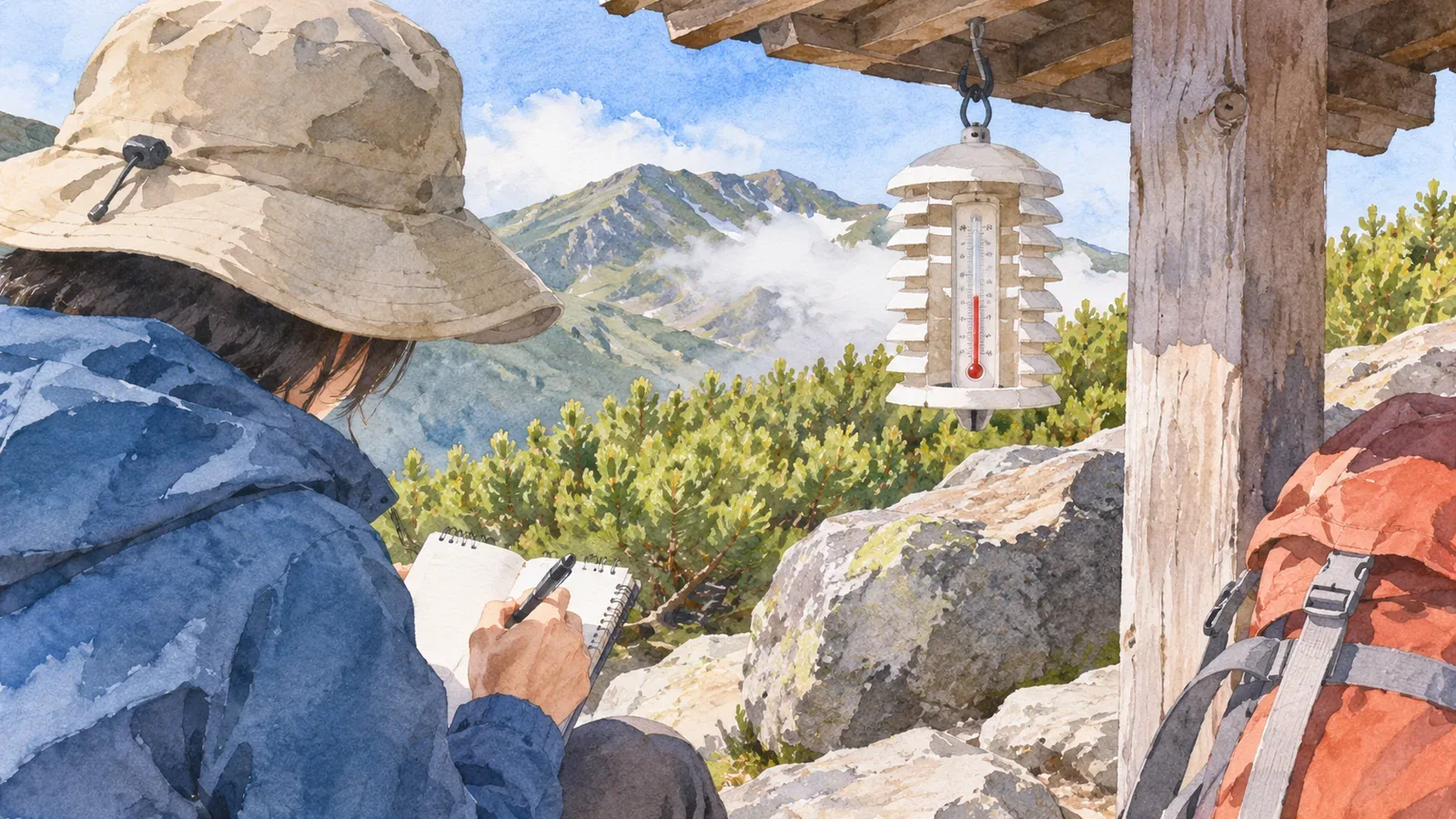
If you share a thermometer reading with other hikers, tell them when, where and how it was taken. A reading at one point does not tell you the current temperature of the whole mountain or what the temperature will be later. Drawing on official observation methods and instrument instructions, we suggest how to write a record worth sharing.
Which conditions official temperature observations keep consistent
The Japan Meteorological Agency’s standard is to use an electric thermometer on a well-ventilated, sunny site, 1.5 m above grass. A ventilated shield keeps direct sunlight off the thermometer, and an electric fan at the top continuously draws outside air in from below. The Okinawa Meteorological Observatory describes a platinum resistance thermometer that uses the change in platinum’s electrical resistance with temperature. A stainless-steel shield protects it from precipitation and solar radiation, while a fan creates a flow of air through the shield.
The JMA’s observation guide describes site conditions and instrument checks that improve the quality of observation data. In a personal temperature log, including where the instrument was and its condition also helps the reader interpret the reading. When explaining how your method differs from official observations, avoid judging an instrument’s reliability by price or appearance alone.
During a hike, the height of the thermometer, its exposure to sun and wind, and contact with your body can all change. Because the setup may differ from official observation conditions, specify that this was the value displayed by your own device. If a condition is unknown, leave it as unknown.
What to include and which claims to avoid
We suggest including the time, location, sun or shade, and instrument condition with the number, and avoiding claims about the entire mountain or a later time. As discussed above, this keeps differences in measuring conditions visible to readers.
Include the date and time of the reading, exact location, sun exposure, device model and placement, and displayed value. Add the time since stopping, moisture and wind if known. For example: “On [date] at [time], in the shade at [rest spot], the thermometer on my shoulder strap showed [value] °C about [minutes] after I stopped.” This is a template for a log, with no actual observation. If you send it later, distinguish the sending time from the observation time.
Avoid three types of claim: “It’s [value] °C on this mountain right now,” which generalizes across an entire mountain or time period; “You’ll be fine with this equipment at that temperature,” which makes someone else’s decision for them; and a prediction of what the temperature will be later. A single reading at one place and time may differ from the conditions where the reader is or when they arrive. Presenting it as grounds for choosing equipment or proceeding could lead them to give up a more cautious option. Share the number as an observation they can factor into their own decision.
What a temperature reading alone cannot tell you
The risk from heat depends on more than air temperature. Japan’s Ministry of Health, Labour and Welfare explains that humidity, wind speed and radiant heat need to be considered along with exertion and clothing characteristics. Its Wet-Bulb Globe Temperature (WBGT) guidance is for workplaces, but illustrates why a single temperature cannot describe the effects of heat on the body. The workplace thresholds should not be treated as safety thresholds for all hikers.
Even the same reading of 12 °C or 25 °C can mean something different depending on the wind and sun. That is why we suggest adding what you observed, such as “There was almost no wind” or “It was in the sun.” Avoid a judgment like “It was cool, so you’ll be fine,” since you do not know the reader’s condition or level of exertion.
Thermometers also take time to respond. The CASIO guide for module 5463 notes that body heat, direct sun and moisture can affect the reading. Take off the watch and put it in a well-ventilated place, wipe moisture off the case and avoid direct sun. The case takes about 20–30 minutes to adjust to the surrounding temperature. This is guidance for that model. Follow your instrument’s instructions and note how long it had been in position when you read it.
Using official information and choosing when to share
The JMA’s Obihiro Weather Station advises hikers to check the forecast for adjacent days and nearby regions as well as the latest forecasts on the day before and the day of a hike. In Japan, prefectural forecasts are usually issued at 05:00, 11:00 and 17:00 Japan time and revised as needed when the weather changes suddenly. A personal reading at a single point cannot replace those forecasts or hazard information. Check for updates when you have a connection and pay attention to changes on the ground.
Share your reading as a local observation at a particular moment. For decisions about what to do next, check the latest forecasts and hazard information alongside the weather on site and the condition of everyone in your group. Mark the date and time clearly so an older observation is not mistaken for current conditions. You can change your plans before an official warning appears.
Stop before reading, logging or messaging. Choose a place with secure footing where you won’t block others. If none is available, wait for the next break or until you’re down from the mountain. Plan for the possibility that you will not have a connection. Before leaving, write out the example format on paper for your own instrument and check whether you can tell if the reading was taken in sun or shade and describe where the device was attached.
Summary: share the reading as an observation with its conditions
Include the date, time, location, instrument and placement, exposure to sun and wind, and whether the instrument was wet. Keep the observation local and give the reader enough information to judge its conditions. Combine personal records, current weather information and what you observe on the ground when deciding what to do.
References and sources
- Japan Meteorological Agency: Observation instruments
- Okinawa Meteorological Observatory: Thermometers and hygrometers
- Japan Meteorological Agency: Guide to better meteorological observations
- CASIO: Operation Guide 5463
- Japan Ministry of Health, Labour and Welfare: Wet-Bulb Globe Temperature (WBGT) in the workplace
- Japan Meteorological Agency, Obihiro Weather Station: Before heading into the mountains
- Japan Meteorological Agency: Weather forecasts