
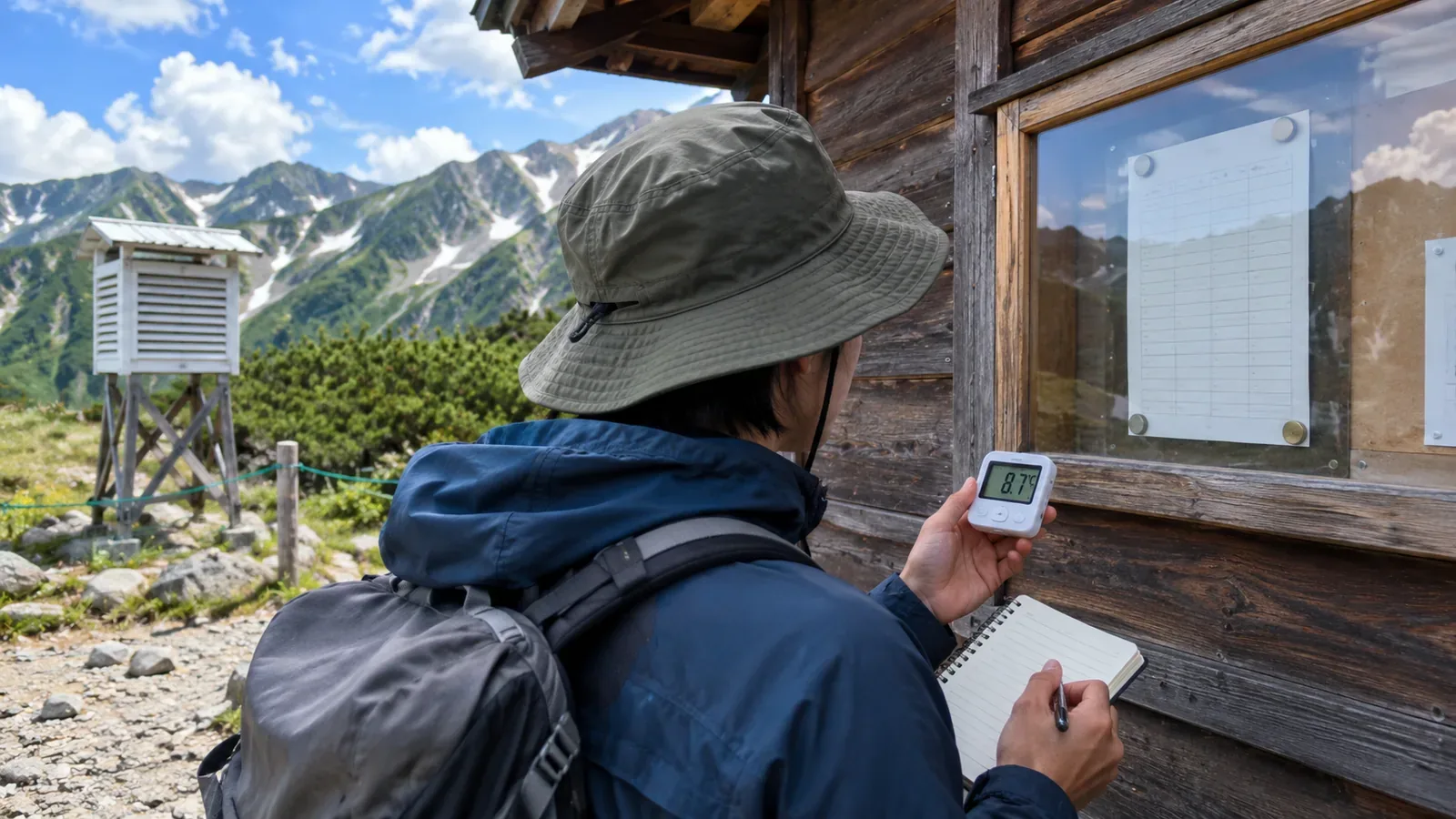
If the hut’s notice and your thermometer give different temperatures, start by finding out when and where each was measured. The difference alone tells you neither which value is right nor why they differ. Use official observation methods and equipment instructions to decide what conditions to record. A posted reading may not be a suitable reference for adjusting your thermometer.
What the Japan Meteorological Agency standardizes
The Japan Meteorological Agency’s standard is to measure air temperature with an electric thermometer 1.5 m above grass at a sunny, well-ventilated site. A ventilated shield keeps off direct sun and a fan at the top draws outside air in from below. The Okinawa Meteorological Observatory explains that the thermometer measures the electrical resistance of platinum and converts it to temperature. The stainless-steel shield protects the instruments from precipitation and sunlight while a fan moves air through it.
Official readings thus control height, shading and airflow. The agency’s guide notes that national and local authorities and transport and power organizations also make observations. Suitable sites and checks on equipment improve data quality. Read the number together with the location and the condition of the instrument.
Treat a temperature posted by a hut as a reading that may have been taken under different conditions from official observations. The agency’s method is a standard for fixed stations. The available information does not establish whether a hut follows it.
Work out what might affect a handheld reading
Instrument manufacturer BARANI DESIGN models the way a sensor lags behind a change in the surrounding temperature. The time constant is the time needed to reach about 63.2% of a sudden change. The errors calculated in the article apply to its chosen setup. They do not set the largest possible difference for a portable thermometer.
Even if you differ by a few degrees from the posted value, sensor lag could contribute. Different instruments and temperature changes can produce different responses. CASIO’s Operation Guide 5463 gives about 20–30 minutes for that watch to reach the surrounding temperature and warns about body heat, sunlight and moisture. The wait applies to this model. Check both lag and placement rather than ranking possible causes from the gap alone.
Three things to check on the notice
With the posted number, check the period, measuring site and instrument. A current temperature means something different from a morning reading or the overnight low. If you cannot find the measurement time, record when you read the board separately. Note the height, sunlight and instrument type if known.
If the conditions are missing, ask when it will not interrupt the hut staff. Mark unavailable details as unknown and leave the cause of the difference open. Leave the hut’s equipment in place and avoid handling it without permission.
Build a comparison record at home and on the trail
Before leaving, check the manual for placement and how long to wait. Two thermometers that agree side by side are not necessarily accurate, and a difference does not prove either is broken. If you move one instrument to observe changes, use it within its limits and record the time and changes in conditions. A steady display alone cannot prove it matches the air temperature.
Record your reading and the time, time since placement, sun, wind, body contact and moisture. CASIO also notes the effect of moisture, but use the wet-weather instructions for your own device. Keep the posted value, measurement time or period and location in a separate field, leaving unknown details marked as such. If conditions differ, keep the two values as separate observations.
Keep the original values if they differ. A single comparison cannot establish how the instrument behaves or give a correction. For decisions on the trail, use official weather information and guidance from hut staff or the land manager.
In short: use the difference to look for possible causes
The weather agency controls height at 1.5 m, sunlight and fan ventilation. The hut and your thermometer may use different conditions. If the values differ, put the time, place, instrument, sun, wind and moisture side by side to see what might have changed. Comparing readings at home and keeping brief notes on hikes can help you learn how your thermometer responds. Mark unknown details as unknown.