
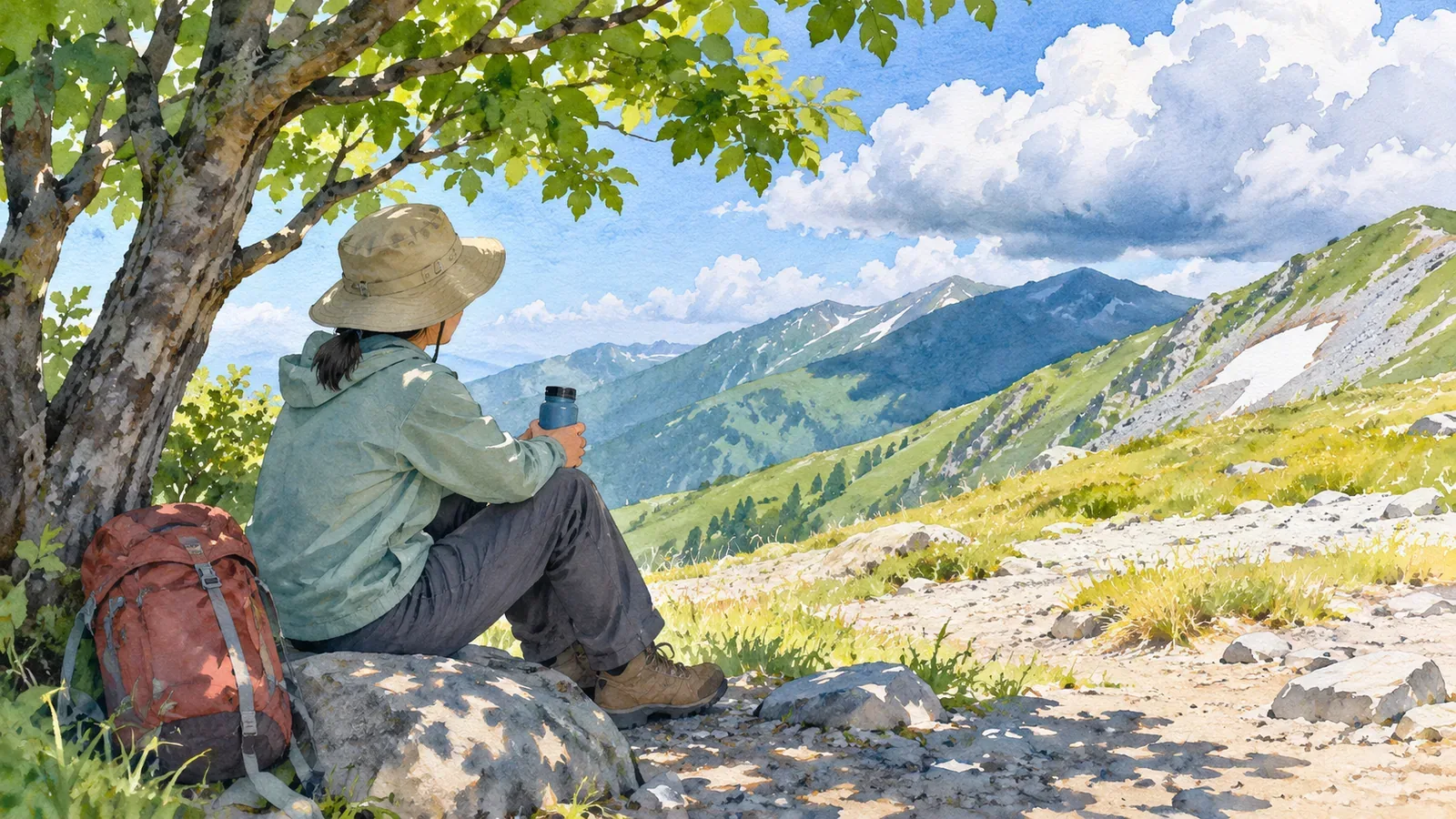
When choosing a break spot in the mountains, first check for stable footing, room for others to pass and conditions suited to how you feel and the weather. Then consider sunlight. Shade reduces direct sun, and some UV still reaches you. Time, elevation, clouds and ground reflection can help you review where to stop and what protection to use.
Use shade to reduce your UV exposure
Japan’s environment ministry explains that scattered and reflected UV reach shade from the air and the ground. Its handbook shows an example of 50% of the exposure in direct sun. This is no rule for every shaded area. Places differ in tree density and the amount of sky visible, so their protection differs too.
Shade helps, and you can keep using clothing and a hat there. Stay on the trail and keep away from cliff edges or beneath rocks where rockfall may occur. If you plan to use the overhang of a building, check that you are allowed to stop there and that you can keep entrances and paths clear.
Coolness tells you little about UV. The handbook explains that infrared radiation produces a feeling of warmth and that you cannot sense the UV that causes sunburn. Strong UV calls for particular care even when early spring temperatures are mild. This applies on a ridge with a cold wind too.
Use time and elevation to decide where shade matters most
UV is generally stronger around solar noon and during summer in Japan. Check the hourly UV index for the date and area and compare it with your itinerary. The WHO recommends taking particular care at 3 or above. Combine clothing, a hat, sunglasses, shade and sunscreen at that level, including when the index is 3–5. There is no need to wait until 6 or 7.
When planning, see whether you can avoid staying in open terrain during the strongest hours. Take the breaks and refueling you need and avoid rushing yourself into fatigue to get out of the sun. Consider changing your start time or destination. If you move to early morning or evening, check whether you can manage the darkness and cold.
Elevation matters too. UV is estimated to increase by 10–12% per 1,000 m of elevation gain. The Japan Meteorological Agency’s UV maps use a representative elevation for cells roughly 20 km square. When plains and mountains share a cell, this generally represents the plains. Allow for the possibility that the forecast based on an elevation near the foot is lower than the UV near the summit. The agency also explains that UV can be stronger than shown where the mountain air is unusually clear.
Consider clouds and reflected UV even when the sun seems weak
The weather agency estimates that under thin cloud the UV index is about 80–90% of its cloudless value on average. Depending on the clouds, it can exceed the cloudless level. Keep your protection even if it is cloudy and cool, and look at both the weather-adjusted and clear-sky forecasts. Neither measures your personal exposure at the rest spot.
Consider ground reflection where there is snow. Japan’s environment ministry explains that fresh snow reflects strongly. That does not establish that shaded snow has the same UV as snow in direct sun. Use the information as a reminder to stay protected in reflective terrain, and combine well-fitting sunglasses with a hat and clothing.
Review the plan on paper and make a one-line note on the trail
The agency calculates its weather-adjusted and clear-sky forecasts for cells roughly 20 km square. Consider the difference between the representative elevation and your route. The value is no summit reading or guaranteed minimum. In past data, distinguish station measurements from calculated values for larger cells and remember that neither records your specific rest spot.
For each possible rest spot, note the expected passage time, terrain and likely shade. Think of a safe alternative in case the spot is crowded or conditions change. Plan to stop when your condition and footing call for it, even if you have not reached shade.
As an exercise, take an itinerary from a past hike and write down the time, elevation and surface at each break. A high spot near solar noon on snow or by water is a good first place to review. The itinerary alone cannot show whether it was shaded. Add what you see on your next hike. The one-line note is an editorial idea for using field observations in the next plan.
Taking a break does not guarantee that you will avoid sunburn. The handbook explains that UV exposure accumulates over the day. Sunscreen increases protection when exposure is unavoidable and depends on correct use. Keep time in the sun short and follow the instructions on the product.
In short: consider sunlight after checking that a rest spot is safe
Give priority to footing, surrounding hazards and how you feel, then consider shade and reflection. Use the forecast and schedule to combine several kinds of protection, without assuming shade halves exposure. Notes on where and when you stopped can help you choose next time. The same spot may be different in another season or weather.
References and sources
- Japan Ministry of the Environment: UV and Environmental Health Handbook 2020
- Japan Meteorological Agency: Guide to UV Information
- WHO: Radiation — Protecting against Skin Cancer
- Japan Meteorological Agency: Clouds and Ultraviolet Radiation
- Japan Meteorological Agency: UV Data Archive
- US National Park Service: Keep Safety In The Picture