
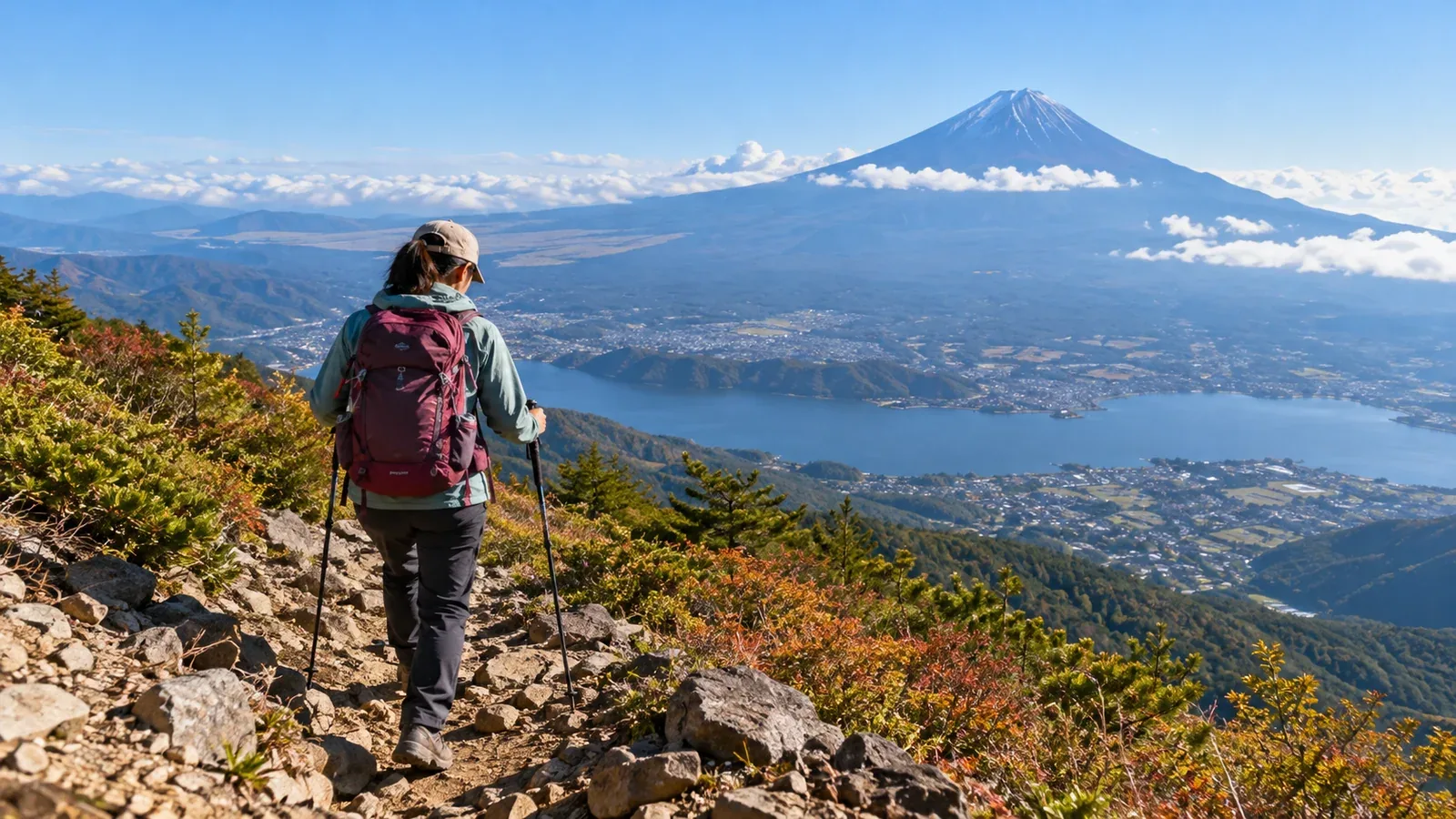
The Shinkansen can get you to a mountain area farther away while it's still morning. You can connect from Shin-Fuji on the Tokaido Shinkansen toward the Fujinomiya trailhead, or from Toyama on the Hokuriku Shinkansen toward Tateyama, depending on the season and services. Include the trip from the station to the trailhead when looking at options for a day hike.
A mountain that seems close by Shinkansen still needs a workable trailhead connection and a route that fits the time you have. This guide shows how to assess the full journey and put the pieces together.
What makes a day hike possible: travel and time on the trail
Estimate the full time from leaving home to getting back, then work out separately when you can hike. Sunrise and sunset vary with place and date, and valleys and wooded stretches can get dark before sunset. Plan for a descent well before dark based on your fitness, route, and the weather.
Even an early first Shinkansen can lead to a late start if the bus or other connection to the trailhead is poor. Check when you arrive at the station, when you reach the trailhead, and how much time remains to complete the descent.
Work out these three parts.
- Shinkansen journey time: departure and arrival times of the first train you can take
- Onward travel and connections: frequency of buses, taxis or local trains, plus transfer waits
- Hiking time and margin for the descent: time up and down, breaks and possible delays, and whether you can get down well before sunset
A Shinkansen timetable can be clear while onward connections are infrequent and waits are long. Check the connections in both directions.
What to look for in a mountain you can reach by Shinkansen
The following conditions help you make the most of the train.
There is a clear connection from the station to the trailhead
Look for a local train or bus connecting the Shinkansen station to the trailhead area. For example, buses run from Nasushiobara Station toward the Nasu Ropeway. Check operating dates for both the bus and ropeway. If you need a taxi, find out whether one is available, what it costs, and how long it takes.
The route fits the time you have
Use a guidebook or hiking map as a baseline, then account for your group's pace, breaks, elevation change, footing, and weather. Even a route listed at five or six hours may not fit if you start late or the last service leaves early. If the margin is tight, choose a shorter route or travel the night before.
There is a service back to the Shinkansen station after the hike
Times for the last bus, local train, or ropeway vary by date and day of the week. Check official operator information and choose a descent deadline that leaves enough time to walk safely.
Shinkansen routes and places to start looking
These stations are starting points for planning. Confirm exact journey times, fares, and bus times with JR, local authorities, or the operators.
Tokaido Shinkansen (Tokyo to Shin-Osaka): buses toward Fujinomiya 5th Station run from Shin-Fuji at certain times of year. Stops and dates vary by Mount Fuji trailhead. Check local trains and buses separately if starting from Shizuoka, Nagoya, or Kyoto.
Tohoku Shinkansen (Tokyo to Shin-Aomori): look into hikes in the areas around Nasu, Zao, Mount Iwate, and Hakkoda. For the Nasu Ropeway area from Nasushiobara, check where the bus terminates and when it runs on your chosen day.
Hokuriku Shinkansen (Tokyo to Tsuruga): Nagano, Joetsumyoko, Toyama, and Kanazawa are possible starting points for the Northern Japanese Alps and Mount Haku area. From Toyama, take the train from Dentetsu Toyama, next to Toyama Station, to Tateyama Station for the Tateyama Kurobe Alpine Route. Leave time for connections and queues in busy periods.
Joetsu Shinkansen (Tokyo to Niigata): for Mount Tanigawa, you can take a bus from Jomo-Kogen Station. If you're using Echigo-Yuzawa, Urasa, or Nagaoka, look up connections to your specific trailhead.
Sanyo and Kyushu Shinkansen: for Miyajima, change at Hiroshima to a local train to Miyajimaguchi, then take the ferry. For the Kuju mountains, Aso, or Kirishima, check the time by rail, bus, or car from the Shinkansen station. For active volcanoes, check Japan Meteorological Agency bulletins and local access restrictions.
Planning the trip
Work backward from the hike to put together a day trip by Shinkansen.
- Check the route time: look up ascent and descent times on a hiking map, then allow for your pace, breaks, and delays.
- Set the time you need to be off the mountain: work from the earliest constraint, such as sunset, parts of the route that get dark sooner, or the last departure, and leave plenty of margin.
- Work back to your trailhead start time: subtract hiking time, breaks, and a margin from your planned finish. Set a turnaround time on the route too.
- Check onward travel: find when you can reach the trailhead or the nearest stop. Use official information from transport operators or local authorities for buses and taxis.
- Choose the Shinkansen: find a train that connects with your onward transport. If you're taking the first train, get everything ready the night before.
- Check the return connections: verify the last service from the trail end and the connection to the Shinkansen. Plan what to do if you're delayed.
A short Shinkansen ride can still leave little hiking time if you reach the trailhead late. On shorter days in particular, make sure you have enough time to descend and reach the return bus. If there's no fallback, choose a shorter route or change the date.
How to budget
Shinkansen fares vary by route, service, seat, and booking method. If the train has an advance fare such as EX Hayatoku, compare it and check change and refund conditions. JR's standard round-trip discount ended in March 2026. Estimate the full cost in both directions using the official booking service.
Include local buses, ropeways, and taxis in the total. Estimating the full cost of the day trip also helps when comparing it with staying in a mountain hut.
What to do next
Find the route time for the hike you want and the nearest Shinkansen station, then use the six steps to check whether a day trip is possible. Confirm sunset and the last service after the hike for the actual date and place. You can also ask people in the Nordwand community who have visited the same area how they got there.
References
- Geospatial Information Authority of Japan: GSI Maps
- National Astronomical Observatory of Japan: sunrise and sunset
- Yamanashi Prefecture: guidelines for safe hiking
- Japan Meteorological Agency: volcano information
- JR East: train timetables
- JR Central: end of the round-trip discount
- Smart EX: booking guide
- Official Mount Fuji climbing website: access to trailheads
- Nasu Tourism Association: access to Nasu Ropeway
- Tateyama Kurobe Alpine Route: getting there
- Mount Tanigawa Information Center: getting there
- JR West Miyajima Ferry: getting there