
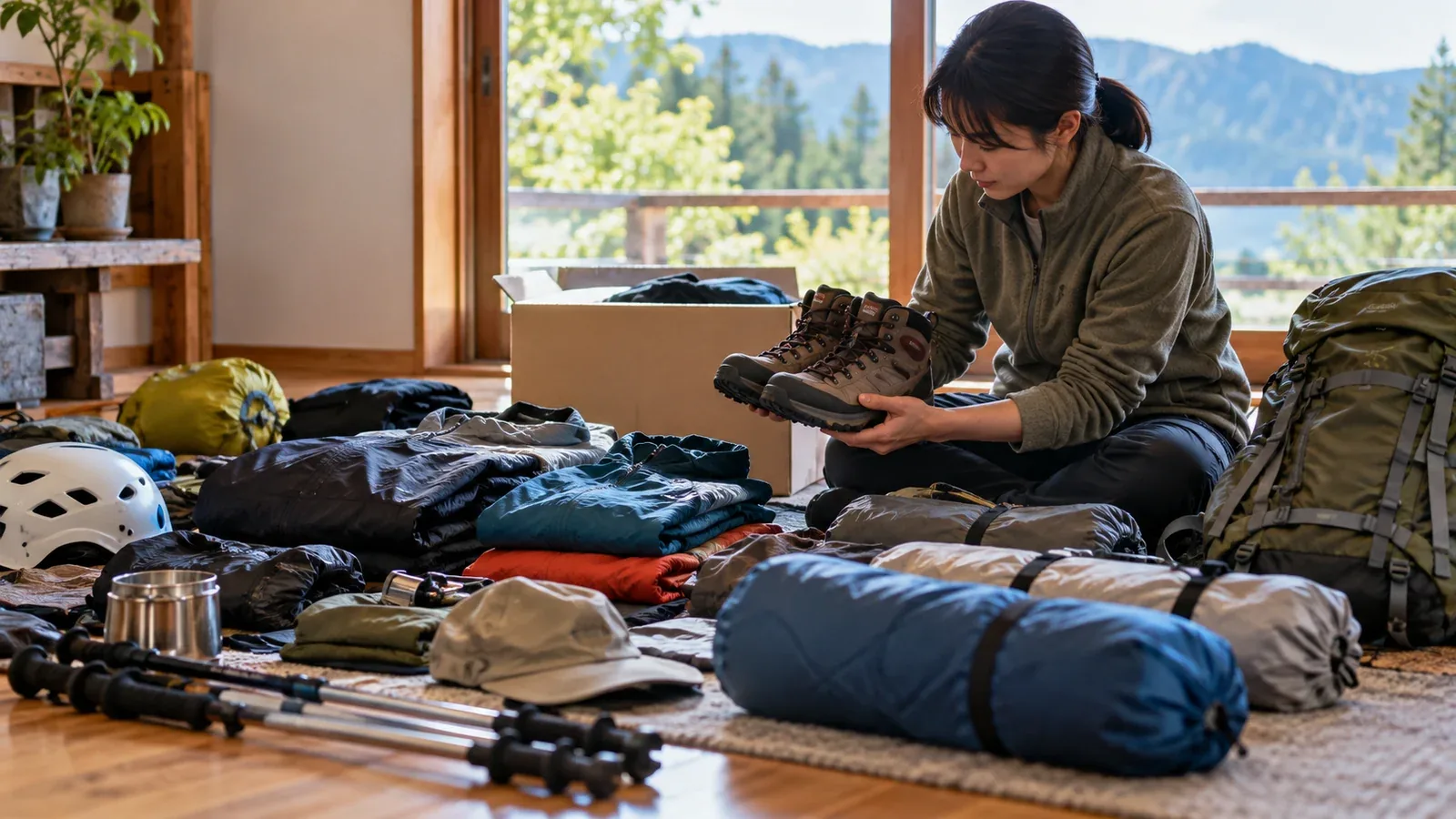
If you hike regularly, unused gear slowly piles up. You may have boots you have outgrown, a pack you replaced with a lighter one, or a tent you no longer take out. It feels wasteful to discard them, but finding space for them can be hard.
Whether to discard, sell, give away, or donate an item depends on its condition, safety, and materials. This guide explains the order of the checks and the practical steps for each option.
Check the functions that affect safety before parting with hiking gear. Harnesses, helmets, and crampons may be unfit for continued use because of their history or impacts, even if they look fine.
Start by identifying safety-critical gear
Think about your gear in two groups before deciding what to do with it.
Safety-critical gear: Harnesses, carabiners, ropes, and slings used to prevent or arrest falls, helmets that protect the head, and crampons and ice axes for snow and ice. Inspection and retirement criteria depend on what each item does.
Other gear: General clothing, backpacks, sleeping bags, tents, cookware, poles, lights, and accessories. Check the item's function before passing it on, including waterproofing, warmth, locks, or lighting as applicable.
Material, history, impacts, and storage conditions all matter for safety-critical gear. Some products have a retirement date based on manufacture, but age alone cannot determine fitness. Check the manufacturer's inspection and retirement criteria for each item.
Do not give away, sell, or donate gear with an unknown history or gear retired under the manufacturer's criteria. When discarding it, follow the manufacturer's guidance to prevent reuse, then follow local waste sorting rules.
Use the condition to decide whether to sell, give away, donate, or discard
For items outside the safety-critical group, use these checks to assess the condition.
When to sell or give away
- No holes, tears, broken zippers, or broken frames
- No major loss of waterproofing or water repellency in clothing or tents
- No uneven clumping of down or synthetic fill in sleeping bags
- Pole locks hold and operate normally
- Boot soles are intact and midsoles are not collapsing
If an item meets these checks and works properly, consider a resale app, outdoor consignment shop, or giving it to someone you know. Disclose wear and past repairs, and check the shop's or service's acceptance criteria.
Which items to donate
You can donate clean, working clothing or packs if a recipient needs them. Check what the following organizations are asking for.
- Nonprofits and aid organizations: Some accept clothing and warm layers. Check official information for eligible items, sizes, condition, and shipping costs.
- Local reuse events and flea markets: Ask the organizer which items they accept and how to bring them.
- Schools and clubs: Ask the person in charge whether a mountaineering club or other group needs the item.
Pass on only items the recipient needs, in the condition they require.
What to check before disposal or collection
If you are disposing of household items in Japan, consult your municipality's sorting guide. Item names, material and size categories, and collection methods vary. Check by item as follows.
- Clothing, backpacks, and sleeping bags: Check the materials and size, then see whether textile collection accepts the item or it belongs with another municipal category.
- Metal cookware and tent poles: Check the municipality's item name and size thresholds for metal or bulky waste.
- Tent bodies and mixed-material gear: Follow municipal guidance for fabric and accessories. Separate only the parts that can be removed safely if the instructions call for it.
- Gas canisters and fuel containers: Ask the local collection service how to handle them, including containers with fuel left in them. Avoid ignition sources and do not puncture or otherwise process them on your own.
- Disposable batteries and headlamps: Ask the municipality or collection service how to separate the batteries and device. Do not force out a battery that cannot be removed.
- Lithium-ion batteries and devices with built-in cells: Keep them out of ordinary combustible waste and similar streams because they can start fires. Check the municipality's designated collection method. Ask the collection service about damaged or swollen batteries.
Manufacturer and retailer take-back programs
If a manufacturer or retailer has a take-back or recycling program, check its official site for eligible items, condition, and collection locations. For instance, Montbell's program accepts its synthetic-fill sleeping bags and excludes down products.
Deciding what to do with gear that is still in good condition
It is easy to keep equipment in case you use it again. Ask yourself these questions to decide.
- Have you used it in the past two or three seasons? If not, you are unlikely to use it in the future.
- Why did you replace it? If the replacement is lighter or works better, occasions to use the older item may be rare.
- Can you keep it in good condition in storage? Long-term compression can reduce the loft and performance of sleeping bags and down clothing. Simply keeping an item can contribute to deterioration.
If you have not used it for a while and have no future use for it, consider giving it away, donating it, or taking it to a collection point while it is still in good condition.
What to do next
Sort your gear by whether it is safety-critical and whether it still works. Keep items that meet the manufacturer's retirement criteria from being reused. For working items, disclose their condition and consider giving them away or donating them. Confirm official acceptance rules before sending items to a donation or collection program. You can find an outdoor shop for advice through Nordwand's partner directory.