
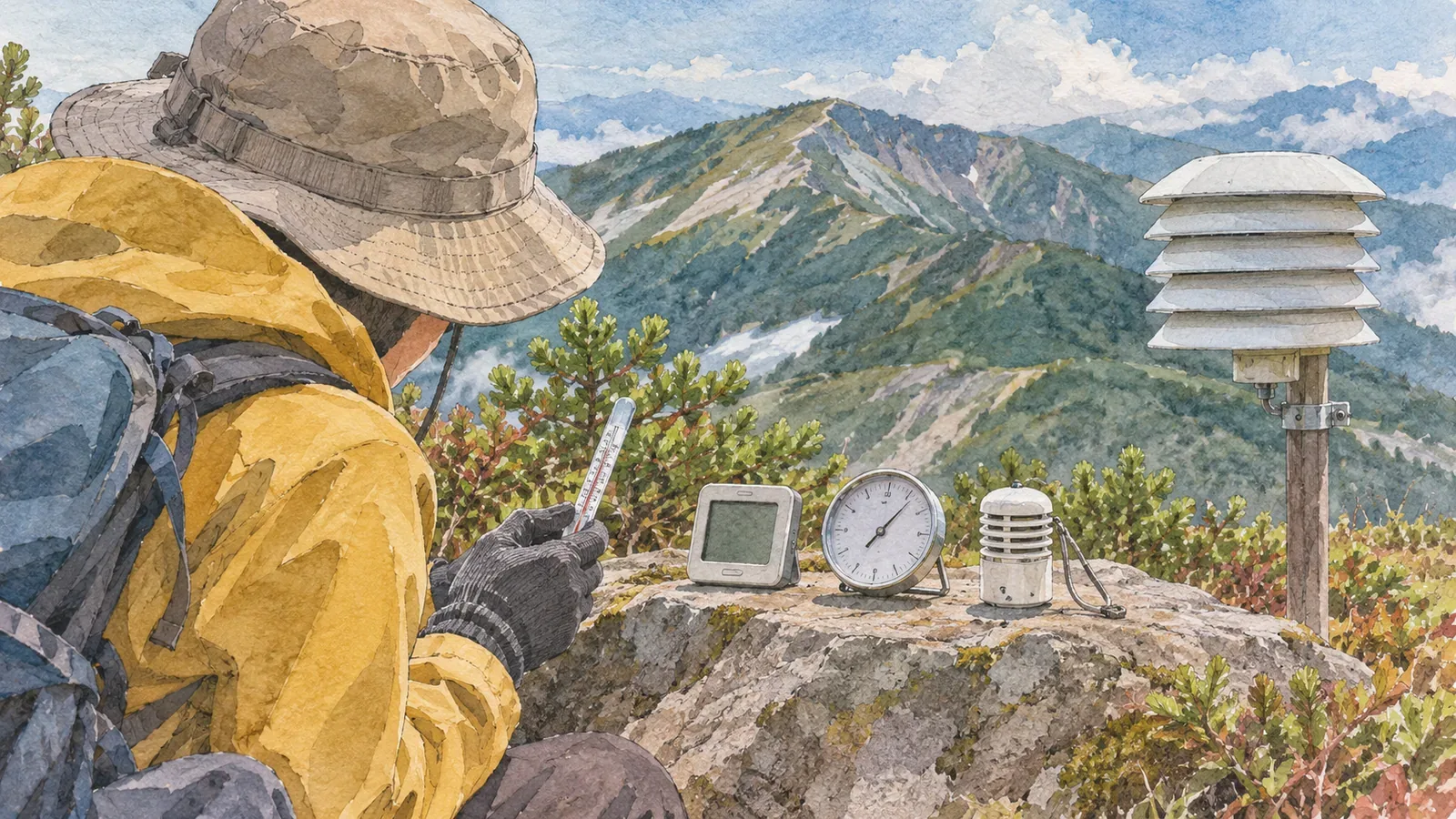
When thermometers show different values, first compare where, when and how they were placed, the sun and wind conditions, and the device instructions. A discrepancy alone tells you little about which reading is closer to the actual temperature. Here we use official observation methods and manufacturers’ instructions to outline a pre-hike comparison and a way to log readings on the mountain. Comparing instruments on its own cannot establish their accuracy.
Which conditions are standardized in official temperature observations?
The Japan Meteorological Agency’s standard is to use an electric thermometer at a well-ventilated, sunny site and measure 1.5 m above grass. A ventilated shield protects the thermometer from direct sun, and an electric fan at the top continuously draws in outside air from below.
The Okinawa Meteorological Observatory describes a platinum resistance sensor. Platinum’s electrical resistance varies with temperature, so the measured resistance can be converted to a temperature. The stainless-steel shield protects against precipitation and solar radiation, and a fan creates airflow inside.
Official observations take account of height, shielding from sun and rain, and air exchange as well as the sensor itself. The JMA’s observation guide also identifies site conditions and instrument checks as factors in data quality. In a personal log, recording where and how you measured gives you a basis for interpreting discrepancies.
A thermometer clipped to a pack and an instrument worn on the wrist will not both meet those conditions. This is our inference from comparing them with the official setup. The references do not establish the actual error of any individual instrument.
Four factors to consider when readings differ
It helps to group possible causes into four categories: shielding from sun and rain, airflow, response speed and placement. The first three come from the official setup—its shield, fan and sensor—and the fourth from the principle behind its standard 1.5 m measurement height.
A device in direct sun may read higher because of the radiation it absorbs. In stagnant air, an instrument can lag behind changes outside its immediate surroundings. Response speed depends on the sensor and is discussed in the next section. Placement refers to positions such as the back of a pack, a pocket, the wrist or near the ground, which are exposed to different amounts of heat from your body, gear or the ground.
Check the manual for each device’s measuring range, accuracy, display increment and refresh interval. CASIO’s guide for module 5463, for example, distinguishes the time it takes for the first temperature reading to appear from the time the watch takes to adjust to its surroundings once removed from the wrist. A value appearing on screen does not mean the device has caught up with ambient temperature.
How different response times affect the readings
BARANI DESIGN describes a model in which a sensor follows a sudden temperature change gradually. It defines the time constant as the time needed to reach approximately 63.2% of the change. In that article, reaching about 99.3% takes five times as long. Manufacturers may define response time differently, so check what the specification for your device actually measures.
In a model that considers lag alone, the reading is lower during a rise in temperature and higher during a fall. In the field, solar radiation and body heat can affect it too. This model alone cannot explain the size or direction of every discrepancy. The worked examples do not show the maximum error possible for a portable instrument.
CASIO says body heat, direct sun and moisture can affect the temperature shown by module 5463. Remove the watch and leave it in a well-ventilated place, wipe moisture off the case and keep it out of direct sunlight. The case takes about 20–30 minutes to reach the surrounding temperature. That guidance applies to this watch; consult each device’s own instructions before choosing how long to wait.
If readings that differ just after you stop begin to converge, different response times could be a factor. Agreement does not establish that both are correct, and persistent differences do not establish a fault. Record the placement conditions and state of the instruments. If a large discrepancy persists, follow the checks described in the manual or the manufacturer’s guidance.
Comparing instruments before you leave and recording readings on the mountain
A side-by-side comparison before leaving is our suggestion for getting familiar with how the instruments work and how their displays change. It does not calibrate the instruments or establish what causes an error. If you use several devices, choose conditions within the temperature range and moisture limits specified for each.
1. Put the instruments side by side indoors in a place that meets their instructions. Record the models, when you set them down, when you read them and what they display. Even stable readings can be affected by rounding and placement. Record the difference as observed under those particular conditions.
2. For instruments rated for outdoor use, log how their readings change in a safe place away from direct sun and body heat. Match height, airflow and nearby sources of heat as far as practical. Avoid using strong wind, air from heating or cooling equipment, or cooling methods the manual does not specify to speed up the measurement.
3. In the mountains, take only the readings you need, from a safe rest spot. Note the time, location, sunlight, wind, moisture, placement and how long the instrument had been there. Skip the reading if waiting would make you cold or delay the hike. If you log a value immediately after moving, mark it as a reading that was still changing.
Do not take the mean of two readings as the true value or adjust one to match the other. Adjustment requires a reliable reference and the manufacturer’s procedure. Use temperature as one piece of information alongside the forecast, conditions around you and how everyone is feeling when deciding whether to continue.
Summary: record the conditions before judging which reading is right
When readings differ, compare the conditions and specifications and record any cause you cannot determine as unknown. Official observation sets requirements for height, shielding and airflow. Portable devices have their own intended uses and handling conditions. Agreement between readings alone does not prove accuracy.
Before your next hike, read the manuals and make room in your log for the device model and placement conditions. Use the results of a comparison to review how you use the instruments, without treating the difference as a fixed correction. Keep checks in the mountains brief enough to stay warm and keep moving when needed.