
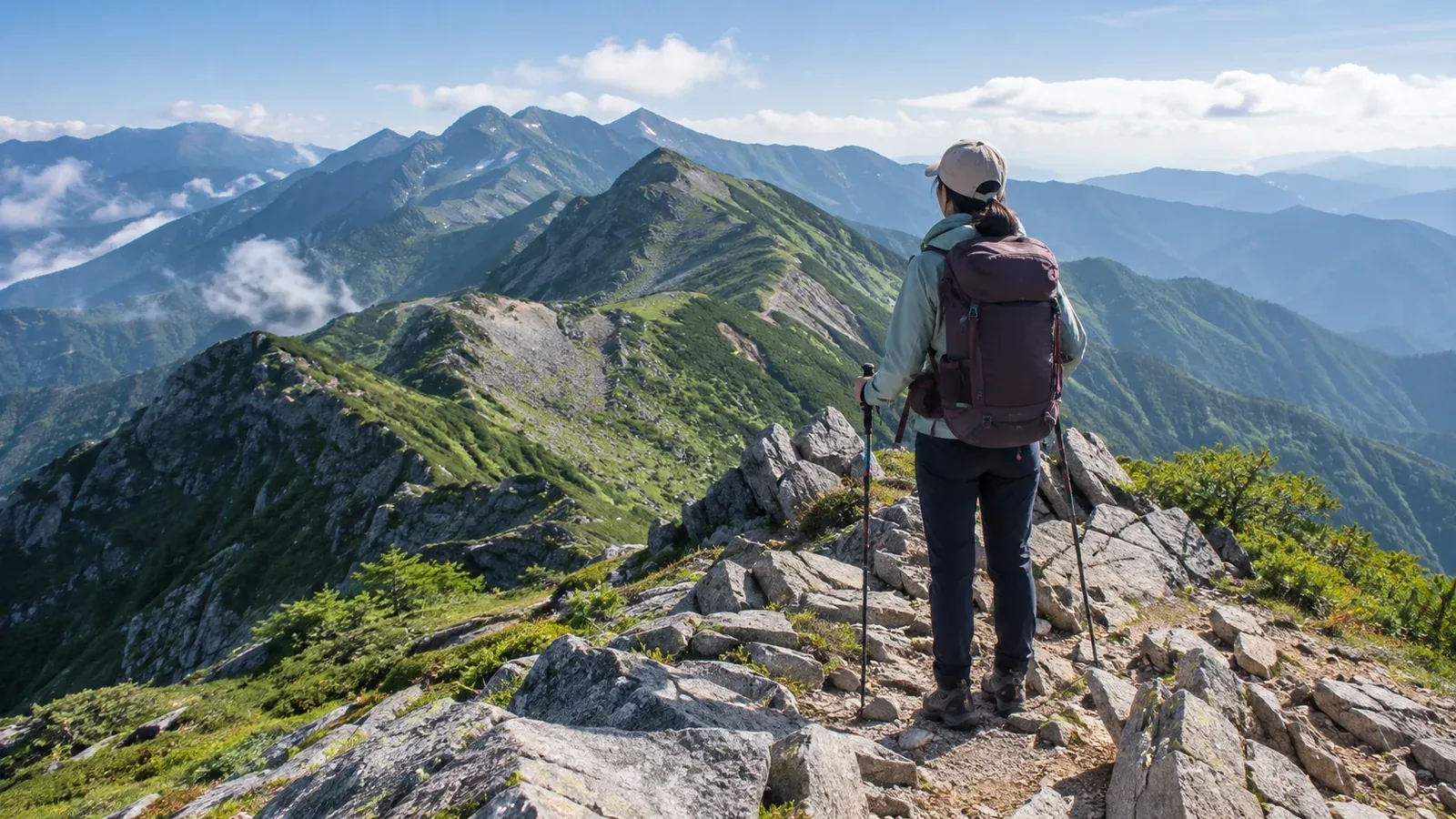
What's the difference between a hike and a mountain climb? It's a common question when you're getting started. The terms have no legal or industry-wide definitions. Think of them as a continuum shaped by the kind and scale of risk, the skills and gear you need, and how harsh the setting is.
Understanding how people use the terms helps you judge the preparation your plans call for. Here's what the names usually mean and how to assess a particular route.
How people use the terms hiking, trekking and climbing
Hiking often means following a maintained path on a day outing in the hills or on a relatively low mountain. Signs are usually clear, the risk of losing the trail is low, and it's often easy to get down if the weather changes. In some contexts it means a trail you can walk in athletic shoes or light sneakers.
Trekking can mean a multi-day walk through mountain country. In Japan, it is also used for a day route along a ridge or across high ground. It often suggests a longer or more demanding walk, depending on who uses it.
The Japanese term “tozan” is the broadest. It covers trips aimed at a summit, from maintained summer trails to rock, fixed chains, snow and routes off the regular trails. In its broadest sense, it can include hiking and trekking.
The terms overlap. You can picture them as nested, with hiking within trekking within the broader category of mountain travel, or as categories whose boundaries shift with the speaker and the situation.
Assess your route by the risks it involves
The risks of your own plan are what matter for preparation. Look at four areas.
Losing the trail
Can you stay on route using signs, a map and a GPS app? A maintained sightseeing path is generally easy to follow. A wooded ridge or a trail with many junctions may be much harder.
Technical difficulty
Will you need skills beyond walking to get through rock, fixed chains, steep slopes or stream crossings? On fixed chains, you need upper-body strength and the ability to keep three points of contact with your hands and feet.
Weather and exposure
It usually gets colder and windier higher up, and the weather changes faster. Above treeline, shelter from wind and rain can be scarce.
Getting down or turning back
How quickly can you reach safety if something goes wrong? Near a summit or on a ridge, it can take much longer to retreat.
Rate each area low, medium or high for your plan. Use that assessment to decide what equipment and skills you need.
When to prepare for a full mountain outing
Plan for a more demanding outing if any of the following are on your route.
- Above treeline. Ridges can expose you to strong wind, cold and poor visibility.
- Rock, fixed chains or steep slopes. Check whether you need skills and equipment for exposed terrain, and pick a route that fits your experience.
- Around 2,000 m or higher. Use this as a prompt to check altitude and ascent plans. Elevation, rate of ascent and acclimatization all affect altitude-illness risk. If you have health concerns, ask a healthcare professional before a high-altitude trip.
- At least four hours round trip. Fatigue, fading daylight and changes in weather are more likely to overlap.
- Several days out or a night in a tent or hut. You need to know how to manage cold, food, water and equipment.
A maintained trail below about 1,000 m, under two hours round trip in stable weather, may call for lighter hiking preparation. Use these as guides. Season, weather and fitness can change the risks considerably on the same mountain.
What a “beginner-friendly” label assumes
Tourism sites and guidebooks often describe a mountain as suitable for beginners and leave out the conditions. A summer morning in clear weather with suitable shoes and rainwear is very different from a rainy autumn afternoon on the same trail.
When you see a beginner label, check three things.
- Which season is assumed? Snow, ice and shorter days in autumn, winter and early spring call for different gear and skills from summer.
- Does the description account for the weather deteriorating? Check whether it assumes a clear day.
- What equipment is assumed? Advice that sneakers are fine is often specific to one route and season.
Get into the habit of asking when the advice applies, what gear it assumes and what weather it's based on.
When to file a hiking plan and consider mountain insurance
Filing a hiking plan is recommended even on low mountains below treeline. It helps narrow the search area if something happens on a maintained trail as well as on rougher ground. Depending on the area, file with prefectural police, at a trailhead box or online. Check the prefectural police website for details.
Consider mountain insurance when planning a mountain outing. Ordinary accident policies may exclude rescue costs such as a helicopter. Check the policy terms to see what it covers and whether you need separate coverage.
What to do next
If you're unsure where your trip falls, assess the risks of losing the trail, technical terrain, changing weather and getting down. Give yourself a wider margin if any of those concern you. Ask an experienced hiker in Nordwand's Base Camp or consult a certified guide if you'd like help checking the details.
References
- National Police Agency, overview of mountain incidents.
- Geospatial Information Authority of Japan, topographic maps.
- Prefectural police mountain safety pages.