
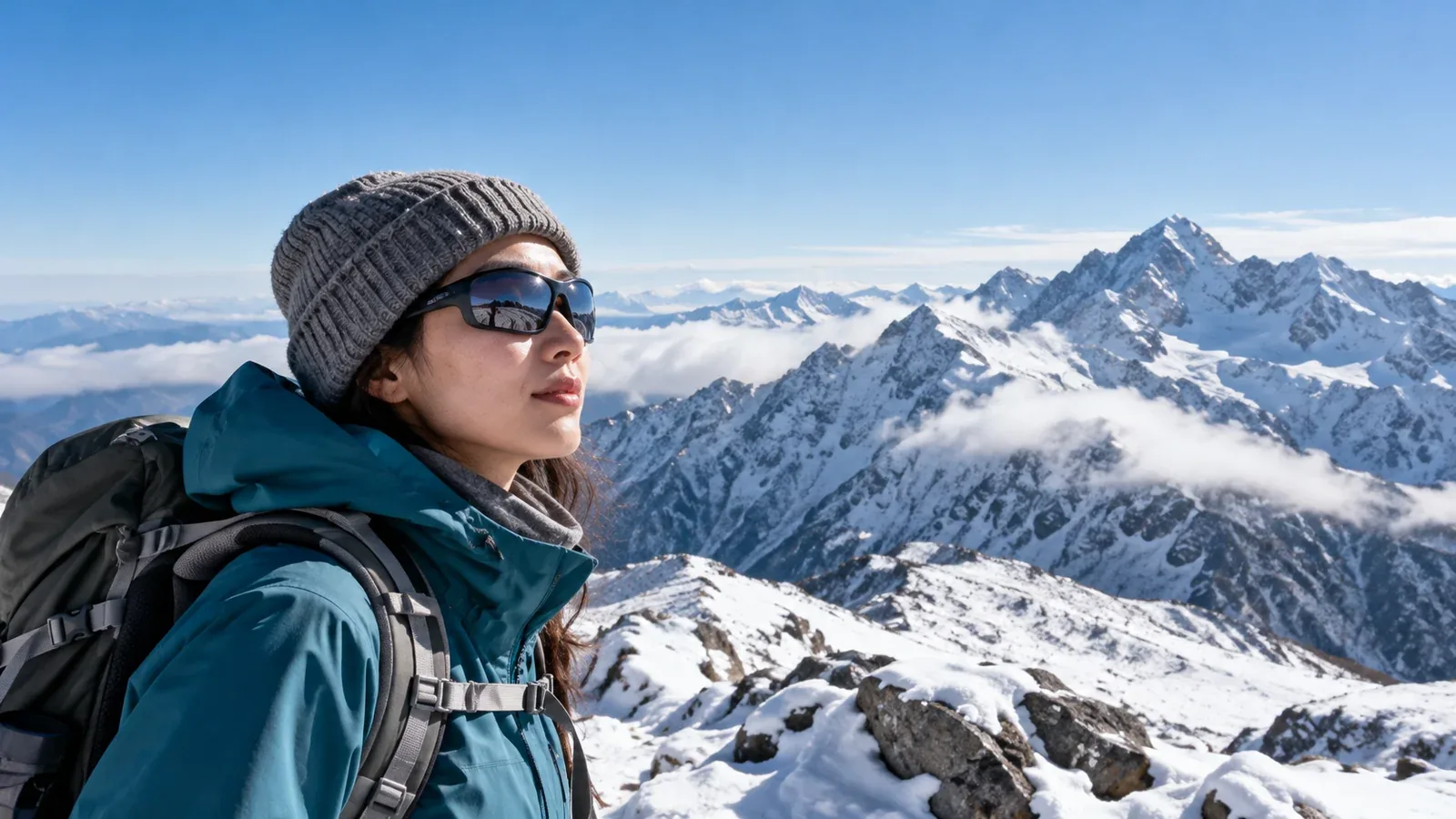
At high elevation and on snow, protect your eyes from both direct and reflected UV. Snow blindness is inflammation of the corneal surface from UV reflected by snow or ice. Symptoms can take several hours to appear. If you have severe pain or difficulty seeing, stop in a safe place and seek medical advice.
This guide covers UV protection, visible light transmission, polarization, fit, and fogging. Priorities change with conditions.
Check UV protection first
Look for clear manufacturer claims such as 100% UVA and UVB protection or UV400. UV400 refers to protection up to wavelengths of 400 nm. Check this separately from how dark the lens looks.
The Japan Meteorological Agency describes a general increase in the UV index of about 10% per 1,000 m of elevation. Clouds and reflection change the actual value. On snow or ice, consider UV from below and from the sides. Try a close-fitting frame or side shields to check whether they reduce gaps.
Dark tint and polarization do not tell you how much UV a lens blocks. Check the manufacturer's UV protection and intended use as well as the tint and price.
Choose visible light transmission for the conditions
Visible light transmission (VLT) is the percentage of visible light a lens lets through. Lower values block more light. Higher values give a brighter view.
Choose for the brightness of the route. Here are some starting points.
- Snowfields, glaciers, and strong reflected light: consider a darker lens designed for intense glare. Category 4 lenses, at about 3–8% VLT, should not be worn while driving.
- Sunny ridges and open trails: choose a tint that reduces glare but still lets you see your footing in shade.
- Woodland and overcast conditions: consider a lens that lets in more visible light and check UV protection too.
- Dusk and dim places: use clear or light lenses that don't darken your view, and have your headlamp ready before dark.
If you want one pair, choose for the conditions you encounter most. If the route has both bright snow and dark woods, consider different lenses or a photochromic lens suited to both.
Interchangeable lenses let you use one frame in sun or cloud. Consider how easily you can change lenses where the weather changes quickly.
When polarized lenses help
Polarized lenses reduce glare from water and some wet surfaces. On snow or ice, reducing reflections can sometimes make changes in the surface or the shine of ice harder to see.
Keep these points in mind.
- A phone or GPS screen can look darker through polarized lenses at certain angles. Test your own devices.
- Polarization and UV protection are separate properties. Check the UV specification regardless of polarization.
- Where reflections help you read rock or ice, try non-polarized lenses as well.
Polarization can help when glare from water is a problem. On snow, make sure you can still see ice and irregularities while reducing glare.
Fit and keeping the glasses in place
On ridges, sudden movements, sweat, and wind can come together. Glasses that feel fine in town can shift on steep descents or when worn with a helmet.
Check the following for fit.
- Temple shape and pressure: move your head and check that the frame stays put without pressing behind the ears or at the temples.
- Nose-pad adjustment: with adjustable pads, check the fit at the nose, keep the lashes clear of the lenses, and look for large gaps below or at the sides.
- Helmet compatibility: try them with the helmet. The arms should not press hard or interfere with a correctly fitted helmet.
- Retainer strap: a compatible strap can help prevent dropping the glasses. Check that the glasses still sit steadily with it attached.
A curved wraparound frame can block light and wind from the sides. Depending on your face shape, there may still be gaps beside the nose. Try it on to check.
Fogging and cloudy weather
There are two issues: condensation from breath or sweat fogging the lens, and low light or bad weather outdoors.
Preventing the lenses from fogging
Lenses can fog when you stop, move between warm and cold places, or wear a mask. Poor visibility makes it easier to trip or misstep. Start with these steps.
- Try a shape that allows air to flow between the lens and your face while keeping the side coverage you need.
- Check for an anti-fog coating. If you use an anti-fog product, choose one compatible with the lenses and coatings.
- If fog prevents you from seeing your footing, stop somewhere safe and ventilate the lens or clean it as the maker allows.
Choosing lenses in poor light
Under cloud, low-VLT lenses can make your footing darker and hide steps or roots. Consider a higher-VLT lens or a photochromic lens that changes its transmission with the light.
Photochromic lenses adjust gradually. Temperature, light, and the model affect the tint range and how quickly it changes. Check the specifications.
Materials and price
Frame and lens materials affect weight, durability, and price.
- Frame materials: options include nylon-based plastics and metals. Look at weight, flex, and pressure on your face as well as the material name.
- Lens materials: options include polycarbonate, other plastics, and glass. Weight, scratch resistance, and impact resistance vary by product. Check intended use and test information.
Compare UV protection, tint, fit, and the availability of replacement lenses or repairs for your budget and how often you hike.
What to do next
Once you know the area and season, check lens brightness and UV protection and try the glasses with your helmet. If considering polarization, look at your phone or GPS through the lenses. If you're new to snowy or high mountains, you can consult a certified guide through Nordwand or ask people who hike in the same area.
References
- American Academy of Ophthalmology: snow blindness and UV-related photokeratitis
- Japan Meteorological Agency: elevation and UV
- International Organization for Standardization: ISO 12312-1 for general-use sunglasses
- Julbo: high-mountain sunglasses and visible light transmission
- Australian Competition and Consumer Commission: lens categories and use guidance
- Transitions Optical: how photochromic lenses work and the effect of temperature