
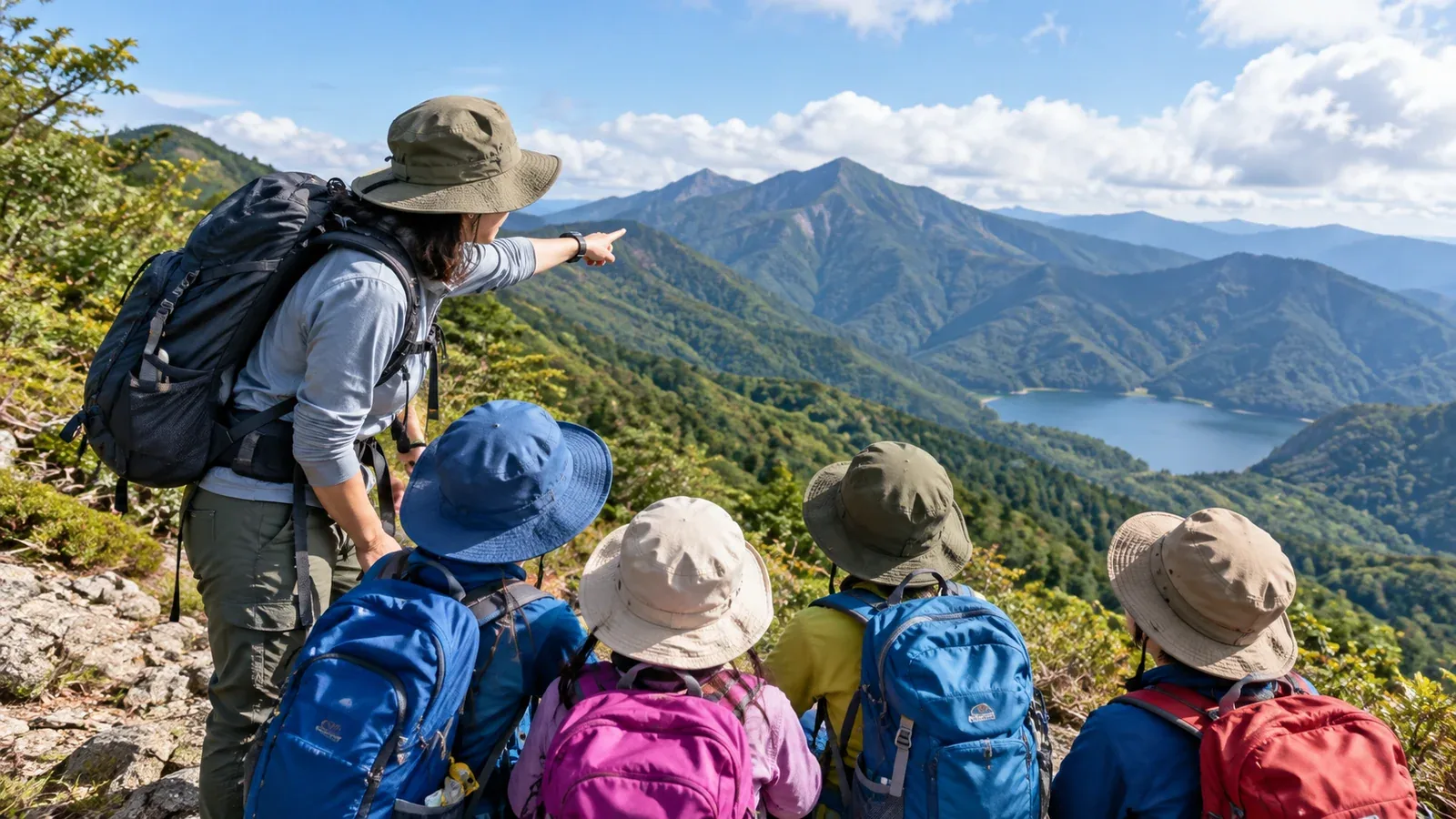
If you want to teach children in the mountains, you may think first of becoming a hiking guide. There are other ways to work with children outdoors, including school programs, outdoor education, nature park programs and outdoor schools run by nonprofits or businesses. Each has different roles and qualification requirements.
This article looks at work where hiking and children’s education meet. If you already hike and want to teach, it can help you choose a direction, understand relevant qualifications and find training.
How does teaching hiking differ from teaching in the mountains?
The two approaches have different learning goals.
Teaching hiking means passing on the skills needed to travel in the mountains, including technique, route-finding and risk management. Guiding adults who want to learn to hike is one example.
Teaching in the mountains uses the outdoors to help children develop curiosity, judgment and the ability to work together. The learning happens along the way. Identifying plants, following a stream toward its source or using the stars to learn directions can help children understand and engage with nature.
Deciding which kind of work interests you will help you choose what training to pursue.
Qualifications and roles
Nature Experience Activity Leader (NEAL)
The Nature Experience Activities division of Japan’s national committee for certifying experiential activity leaders administers the scheme. Training covers leading outdoor experiences safely and supporting participants’ learning. Check NEAL and its training providers for the content of field sessions and registration requirements.
Nature school educators and interpreters
Interpretation helps visitors understand the meaning and connections of nature and culture through experience. It is used in visitor centers and nature schools, among other settings. The Japan Interpretation Association and others offer training. Check the requirements of individual employers for interpretation jobs.
Mountaineering and sport climbing coaching qualifications
The Japan Sport Association (JSPO) and the Japan Mountaineering and Sport Climbing Association (JMSCA) are involved in coach training for alpine climbing and sport climbing. Check which qualification matches the activity and participants you want to teach. Guiding credentials and requirements for working in schools serve different roles.
Outdoor education and camp leadership qualifications
The Camping Association of Japan’s Camp Instructor and Camp Director qualifications cover teaching and running camps. They can help with overnight programs and outdoor living skills. If you’ll teach hiking techniques or lead a hike, check the experience and skills that activity requires.
You can combine training and qualifications to suit the work you want to do, such as facilitating outdoor experiences and teaching hiking skills.
Where you can work
There are four broad settings to consider.
1. Public or private schools. Elementary, middle and high schools run outdoor and residential programs. Organizing them as a teacher and helping as a visiting instructor have different requirements. Ask the school or education board about the role and credentials.
2. Nature schools and outdoor education nonprofits. These organizations run short and extended programs for children. You can work as a member of staff or take on individual programs. Check pay and contract terms with the organization.
3. National or prefectural nature parks and visitor centers. Operators may hire staff to interpret nature and plan children’s programs. The ministry’s Active Rangers have a separate role assisting conservation officers. Check each listing for the length of employment and duties.
4. Outdoor businesses and mountain huts. Some visitor farms, outdoor resorts and mountain huts run programs for children. A hiking guide qualification can be useful for some of this work.
Safety when taking children into the mountains
Leading children calls for different planning from taking adults on a hike. These points are worth checking.
Notice heat and cold early. Plan for clothing adjustments, frequent rests and drinking water. Children may not be able to explain that they are too hot or cold. Leaders should check how they are doing and reconsider the plan early if weather or health changes.
Show children how to turn back. Leaders can show, in what they say and do, how turning back is a considered decision. If reaching the summit becomes too important, the group may turn back too late.
Coordinate with families, schools and insurers. Share the route and emergency contacts with families and the school. Explain why you’re asking for safety-related information such as allergies or medical history and share it only with those who need it. Check how far school accident benefits or the organizer’s insurance cover the planned activity.
Decide how many leaders you need and assign roles. Consider the ages and size of the group, the route difficulty and whether the group could split in an emergency. Check the school’s or organizer’s rules and decide in advance who leads, who brings up the rear, who handles communications and who provides first aid.
Choosing your first qualification
Use these questions to decide where to start.
- Do you want to teach techniques or help children learn from experience? For technical instruction, look for a coaching qualification that fits the activity. For facilitating experiences, look at NEAL or interpretation training.
- Do you want to work with schools or with outdoor schools and nonprofits? Check school requirements for teachers and visiting instructors. At a nature school or nonprofit, you can get to know the work by observing or helping staff.
- Are you already confident in your hiking skills? If so, you may start with education and facilitation. If you want more practice in the mountains, you can work on both areas together.
Qualifications can open doors. Working with children is where you build the experience to improve the quality of your teaching.
What to do next
Compare the training offered by NEAL and the Camping Association of Japan and see which matches what you want to learn. A visit or a volunteer role at a local nature school or nonprofit is another way to get to know the work. Nordwand’s community can help you meet hikers and guides who run programs for children.
References
- Nature experience activity leader scheme (NEAL)
- Camp leadership qualifications (Camping Association of Japan)
- Interpretation training (Japan Interpretation Association)
- Mountaineering (Alpine Climbing) Coach 1 qualification (Japan Sport Association)
- Safety in activities outside school (Ministry of Education, Culture, Sports, Science and Technology)
- External specialists in schools (Ministry of Education, Culture, Sports, Science and Technology)
- Heat index and heat illness prevention (Ministry of the Environment)
- Scope of school accident benefits (Japan Sport Council)
- Active Ranger duties (Ministry of the Environment)