
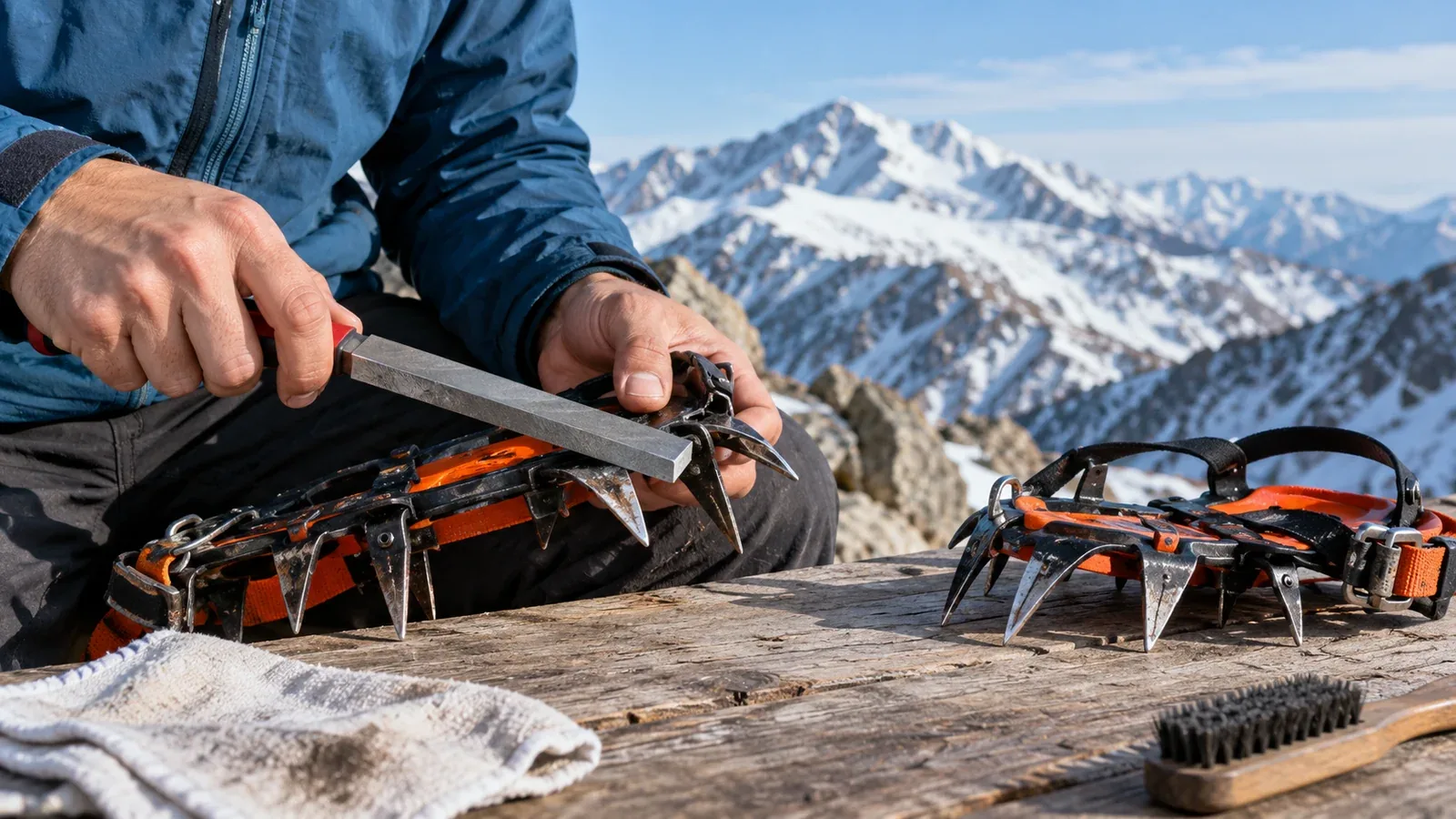
Crampon points bite into snow or ice for grip underfoot. Wear and damage reduce that grip. Inspect the points and bindings before each outing, even if the crampons worked well last season.
Filing off too much metal shortens the point and changes its shape. If the manufacturer allows sharpening, file the specified surfaces only as much as needed to preserve the original profile.
Inspect crampons before every use and clean and dry them afterward, in addition to checking them at the start and end of the season. Follow the product instructions for how often to carry out a detailed inspection.
Check the points before sharpening
Inspect each point under good light. Check sharpness by sight, since touching the tip can cause injury.
There are three things to look for.
- Rounded tips: Compare the tip with the product diagram or original shape.
- Damage to points or frame: Look for cracks, chips, bending, or corrosion.
- Point length: Compare corresponding points on the left and right crampons, and check the manual for any wear limit. Filing cannot restore length to a heavily worn point.
Stop using crampons with cracks, chips, deformation, severe corrosion, or faulty bindings. Avoid filing the damage or bending the part back. Ask the manufacturer about inspection or replacing the part with an approved spare.
What you need and how to file the points
If the model instructions allow sharpening, use the specified hand file for metal. Avoid power grinders, which can overheat and weaken the metal.
Support the crampon on a stable workbench so it does not move. Check the product instructions for how to hold it and which parts can be removed.
Follow these steps.
- Check which surfaces to file: The surfaces may differ between front points and downward points. Refer to the model's diagram.
- Follow the original profile: Apply the file only to the specified surfaces, keeping the original angles and shape.
- File a little at a time: Work by hand and inspect by sight as you go. Remove only what is needed.
- Work on worn points only: Leave undamaged points alone, even if their lengths differ.
- Check the result: Remove the metal filings. If a burr remains, follow the product instructions for removing it.
Wear work gloves and safety glasses to protect your hands and eyes against points and metal filings.
When to sharpen at home and when to contact the manufacturer
Sharpen at home only if the manufacturer permits it, the points are lightly worn, and you can preserve the original profile. Stop using the crampons and contact the maker or retailer if you see any of the following.
- Wear has reached the manual's limit or the original profile cannot be preserved.
- Corresponding left and right points differ markedly in length.
- The front points are heavily worn and noticeably shorter.
- Bolts or hardware are loose or deformed and cannot be secured as instructed.
Mountaineering crampons and light-duty crampons can differ in point shape, materials, and which surfaces can be sharpened. Some have replaceable front points. Follow the instructions for your model.
Cleaning and preventing corrosion after use
Remove mud and dirt and dry the crampons thoroughly after every use. Moisture and salt left on the crampons in storage can speed up corrosion.
Follow these cleaning steps.
- Rinse away mud and salt with water according to the manufacturer's instructions.
- Use a soft brush to remove dirt from the frame and connecting parts.
- Wipe off water with a dry cloth and let the crampons dry completely in a well-ventilated place, away from direct sun and heat sources.
- Use a rust inhibitor only if specified, applying the recommended product to the specified areas.
Inspect the straps, linking bars, binding hardware, and anti-balling plates as well. Look for cracks, fraying, deformation, or looseness, and stop using the crampons if any part is damaged. Replace serviceable parts only with the manufacturer's approved spares and follow its instructions.
Storing crampons until the next season
Once completely dry, store the crampons in a crampon case or protective pouch that covers the points. Keep the points covered in transit to protect the rest of your gear.
Store them in a dry place out of direct sun, away from heaters, and protected from heat and humidity. Avoid leaving them for long in places that become very hot, such as a car in summer.
Repeat the inspection before the next use. If you find rust or corrosion, follow the product instructions. If you are unsure whether the damage affects strength, stop using the crampons and contact the manufacturer.
What to do next
Wash and completely dry the crampons when you get home. Inspect the bindings as well as the points. Before your next trip, make sure the crampons attach properly to the boots you plan to wear. Ask the manufacturer or retailer about inspection and replacement if you are unsure. You can find an outdoor retailer through Nordwand's partner directory.