
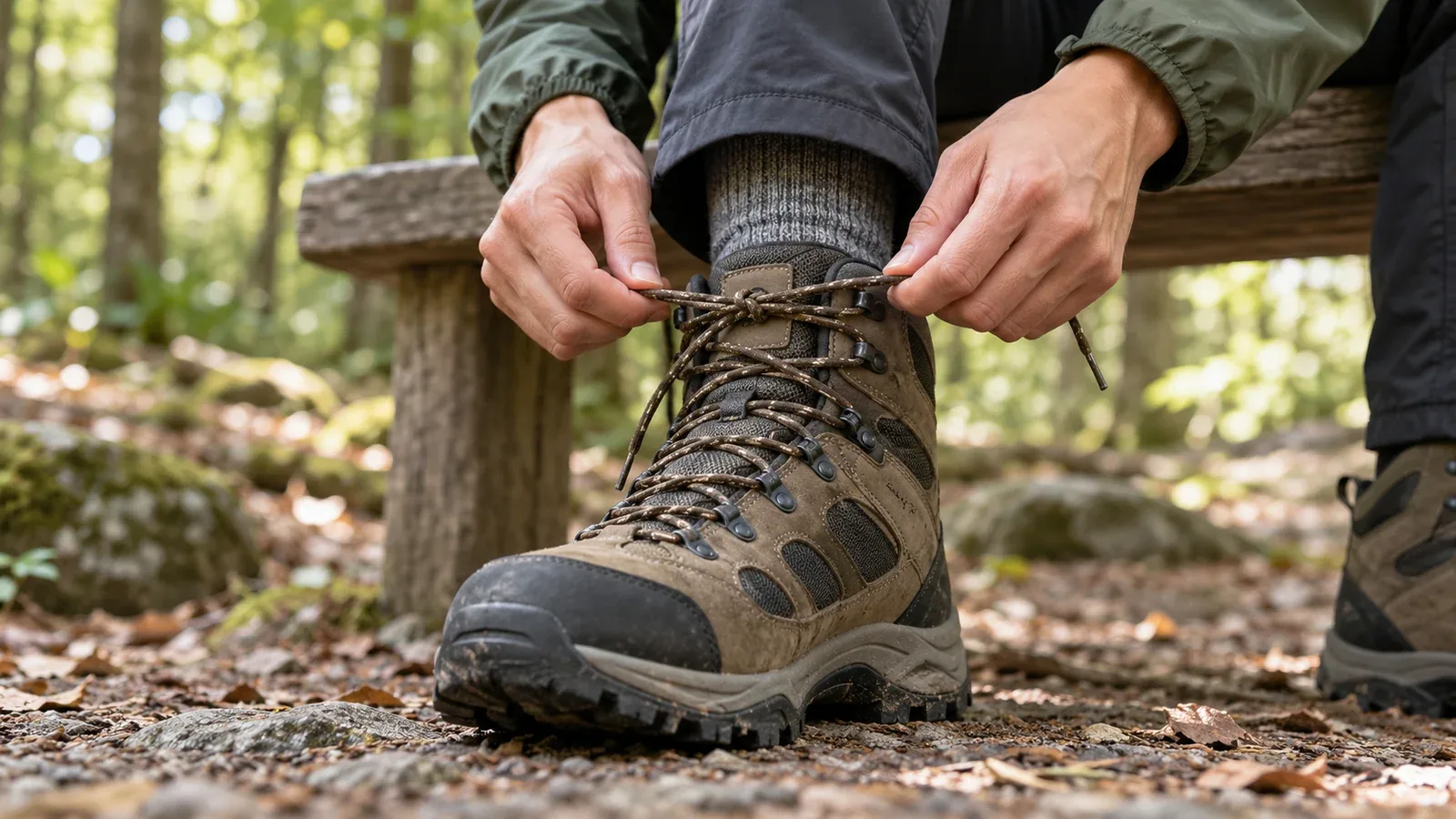
You may notice a toenail darkening after a hike. Repeatedly hitting your toes against the front of your boot can cause blood to collect under the nail. Check the size and shape of the boot as well as how the laces hold your foot.
Laces help keep your foot stable inside the boot. If your foot slides forward on descents, see whether your heel sits securely at the back and whether your instep lifts. If your toes still hit the front after adjusting the laces, reassess the size and shape.
Here is how to check the fit and adjust the laces to help keep your toes clear on descents.
Why your toenails can hurt on a descent
Even in boots that feel fine on level ground, your feet can slide forward when you walk downhill.
Repeated toe impacts on a descent can hurt or cause bleeding under a nail. Nail color can change for other reasons too. Seek medical advice if the nail turns black or purple or the pain is severe.
A secure but comfortable hold around the heel and instep can limit forward movement. Leave enough room to move your toes.
What to check before adjusting the laces
Start with three checks to get the most out of the lacing.
Boot size: check that the toes have room and clear the front in a downhill motion. Some manufacturers suggest around 1 cm with hiking socks on. If the heel lifts or the toes hit, try other widths and shapes.
Sock thickness: changing thickness changes room in the boot. Try on the socks you'll use and check for sliding or pressure on the toes or instep.
Condition of the laces: before leaving, check for cuts, fraying, or laces that are too short. Look for damaged hooks and eyelets too.
Basic lacing: seat the heel and leave toe room
Seat the heel at the back and tighten the laces from the toes through the instep to the ankle. Center the tongue over the instep.
Steps
- Start at the eyelets nearest the toes. Take up slack evenly at each row and leave enough room to move your toes.
- Secure the instep comfortably. Snug the laces enough to limit heel lift, without causing pain or numbness.
- Check the hooks near the ankle. Use a lacing path that suits the boot, and check that the laces stay in the hooks and your ankle can still move.
Adjusting tension separately in boots with hooks
If you want to take up slack over the instep while leaving room at the toes, use the area around the hooks to set different tensions.
- If the boot has hooks where the instep bends, wrap the two laces around each other twice and pull them snug. Run the laces to the next hooks to hold the tension at the knot.
- If you feel strong pressure at one spot over the instep, run each lace straight to the next row on the same side at that spot. Cross them again above it to secure the other rows while relieving pressure there.
Hook and eyelet layouts vary by model. Check the manufacturer's guidance and test the lacing by walking somewhere safe before using it on a hike.
A knot that stays tied helps prevent trips
Loose laces or long loops that snag can make you trip. Stop in a safe, out-of-the-way place to adjust them.
A double knot is made by tying the two loops again after a regular bow. It is less likely to come undone. Tuck away extra loops and ends to keep them from snagging.
Consider replacing damaged laces or hooks. Choose replacement laces similar in shape and length to the originals and follow any specifications from the manufacturer.
Check the laces before going downhill
Laces may loosen as you walk and swelling can change how tight they feel. Before a long descent, stop somewhere safe and check the fit and lace tension.
If the instep or toe rows are loose, loosen the laces and adjust them again from the toes up. That helps you see what shifts or feels squeezed when you walk.
After adjusting, take a few steps and check whether the foot slides forward. Loosen the laces if you feel pain or numbness. If the toes keep hitting the front, check the boot fit before tightening further.
Match the lacing to the boot
Hiking boots come in different cuff heights, with different positions for hooks and eyelets. Whether your boots have hooks at the top or eyelets only, use a lacing path that suits the boot and check that the heel stays seated.
Understand how the hooks and eyelets on your boot are laid out before adjusting the laces. Insole fit also affects how much your foot can slide. If the insole doesn't suit you, ask at a specialist footwear or outdoor shop.
What to do next
Before your next hike, re-lace the boots with the socks you'll wear and try them on flat ground and a gentle, safe slope. Check that the heel stays in place, your toes clear the front, and you don't feel pain or numbness. Consider replacing frayed or damaged laces. You can use Nordwand's partner shop search to find a nearby outdoor shop and ask for help.