
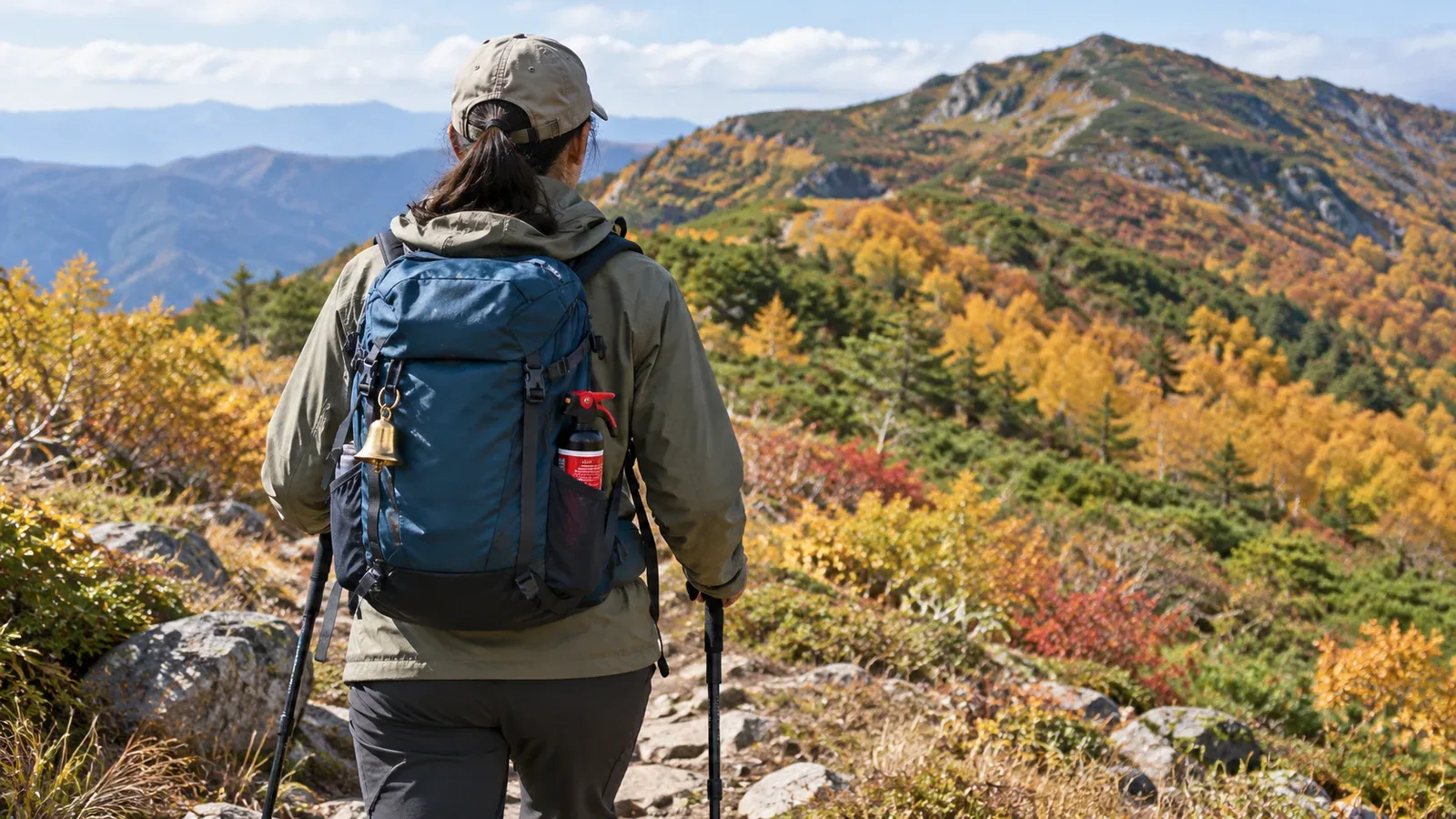
A bear bell helps announce your presence. Bear spray is emergency equipment for an approaching or charging bear. With either, start by checking sightings and closures at your destination and taking steps to avoid a surprise encounter.
Brown bears live in Hokkaido, and Asian black bears live in Honshu and Shikoku. Sightings vary by place and time. Check current information from local authorities or visitor centres before you go, in any season.
This guide covers what each tool does, its limits, how to choose it and how to act before relying on equipment.
A bear bell helps announce your presence
To reduce close surprise encounters, use your voice or other sound before you know a bear is nearby, especially where visibility is poor. A bell is one way to make that sound.
Even if the bell rings, you cannot tell whether a bear heard it or moved away. Watch your surroundings and talk with your companions or clap as needed near streams and blind corners. Once you see a bear, avoid shouting and sudden movements.
Pay particular attention in the following situations.
- Rivers and streams. The sound of water can make a bell or voice harder to hear.
- Strong wind and rain. Wind and rain make other sounds harder to hear.
- Poor visibility. Slow down and look around near dense brush and blind corners.
- Tracks, droppings and other signs. If you find fresh signs, leave quietly instead of continuing farther.
How far a bell carries depends on terrain and background noise. Combine it with voices or clapping. Consider taking a different route if there is poor visibility or a recent sighting.
What to check when choosing a bell. Make sure it rings while you walk, attaches securely to the outside of your pack and can be muted when needed, such as on public transport. The advertised volume alone does not tell you how far the sound will carry.
Bear spray for an approaching or charging bear
Bear spray is an aerosol with capsaicin and related compounds derived from peppers. It irritates the eyes and nose to deter a bear that is closing in. Products differ. Japan’s Ministry of the Environment publishes recommended criteria for ingredient labelling, spray range and duration, spray pattern, safety mechanisms and expiration dates.
Choose a product labelled for use against bears. Read the instructions for when and how to use it. Spraying people, clothes, tents or gear in advance offers no protection and can expose people to the irritant.
Spray is an emergency measure when an approaching bear comes within the product’s effective range. Follow the product instructions and local guidance. Do not move closer to use it. Strong wind and cold affect how far spray reaches, and a headwind can blow it back onto you or your group.
What to check before carrying and using it
- Safety mechanism. Secure it during travel and learn in advance how to release it when needed.
- Access. Attach it where you can reach it, such as on your chest or hip, using the recommended holster. Keep it out of the main pack compartment.
- Expiration date and condition. Replace expired spray. Avoid relying on a partly used canister so you have enough spray. Keep it away from heat and store it as directed.
- Air travel. Japan’s transport ministry says bear spray cannot go in either cabin or checked baggage. If you need it, arrange to buy or rent it after landing.
- Practice. Learn how to draw it and release the safety before the hike. To practise spraying, use a training canister without active irritants and follow its instructions.
Avoiding encounters and preparing for emergencies
The bell and the spray help in different situations.
- Bear bell. It helps announce your presence before you know a bear is nearby. Water, wind and other noise can make it harder to hear.
- Bear spray. It is for an emergency when a bear closes in. The range varies by product and is affected by wind and temperature.
Whatever you carry, heed sightings and trail restrictions and stay aware of your surroundings.
Spray is an additional precaution in case a bear closes in despite your efforts to keep a safe distance.
What to do before relying on gear
Start with how you plan and behave on the trail.
Walk in a group. Avoid going alone where possible and stay together. Talking or calling out announces your presence.
Manage food and rubbish. Keep both sealed and attended. At camp, follow designated storage rules and carry out or dispose of rubbish as required.
Take care at dawn, dusk and where visibility is poor. If local advice flags those times or places, plan around them. Watch especially carefully near streams, brush and blind corners.
Check local information before leaving. Look for sightings and closures from authorities, parks or visitor centres and on trailhead notices. Change your route if needed.
If you see a bear, keep away and leave the camera alone. Watch its movements while quietly increasing the distance. Avoid turning your back to run or shouting. Read the local park or authority’s guidance before visiting for more detail.
Before your next hike
Check alerts and trail conditions shortly before leaving. If you use a bell, check that it rings and is secure. If you carry spray, check the date, safety and where you can reach it. Nordwand’s Base Camp can help you hear from other hikers. Use official local information when deciding whether to take a route.
References
- Japan Ministry of the Environment: bear safety in national parks
- Japan Ministry of the Environment: prefectural bear sightings and public guidance
- Japan Ministry of the Environment: recommended performance criteria for bear spray
- Japan Consumer Affairs Agency: preparing to carry bear spray
- Japan transport ministry: cabin and checked baggage restrictions
- U.S. National Park Service: hiking in bear country and the limits of bells