
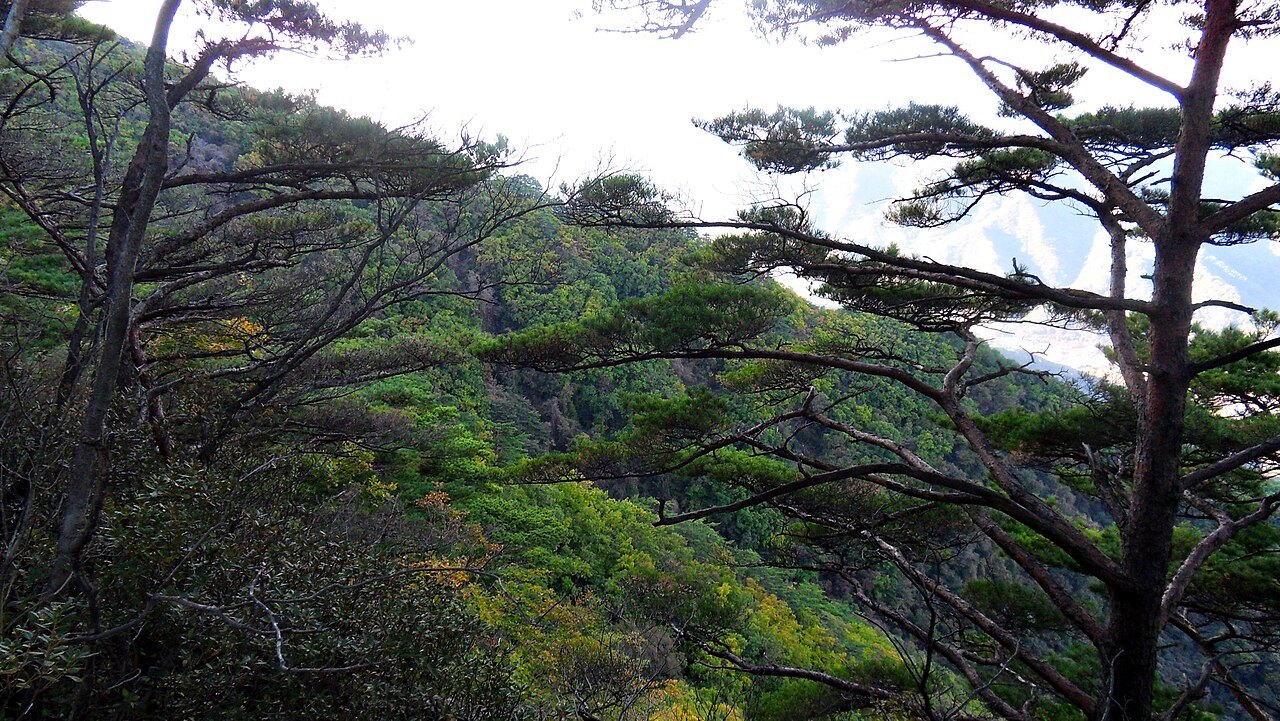
Yeongbong and the granite cliffs
Woraksan National Park lies in the central section of the Baekdu-daegan range, between Sobaeksan and Songnisan. The area encompassing Yeongbong, the main summit of Woraksan, along with surrounding peaks such as Mansubong and Doraksan, was designated a national park in 1984. The sheer rock walls rising around Yeongbong, together with Chungju Lake, are the defining features of this landscape.
According to the geological account provided by the Academy of Korean Studies, magma intruded into existing rock layers across this area during the Cretaceous period, forming granite. Over a long period of weathering, weaker sections were eroded away, leaving the harder rock masses that define the landscape today.
The Buddha carved into the cliff of Deokjugol
Along the Deokjugol trail leading up toward Yeongbong stands the Rock-carved Standing Buddha of Deokjusa, Jecheon. This image was carved into the cliff face with the head rendered in high relief and the body and robe folds simplified toward the base. The city of Jecheon interprets this statue within the broader movement toward large-scale Buddhist image production in the early Goryeo period.
A story is also told that Princess Deokju of the late Silla period entered these mountains and created the image. The legend passes on the origin of the temple's name, while the sculptural style offers clues for estimating the actual date of its making.
Traces of an old road at Haneuljae and Mireukdaeonji
Haneuljae, on the southern edge of the national park, is a pass connecting Chungju and Mungyeong. At Chungju Mireukdaeonji, to the northwest of the pass, there remain a stone standing Buddha, a five-story stone pagoda, and a turtle-shaped pedestal that once supported a stele. People built a temple at this crossing point over the ridge, and the stone structures left at the temple site show that this mountain range has long served as a space for both travel and religious devotion.