
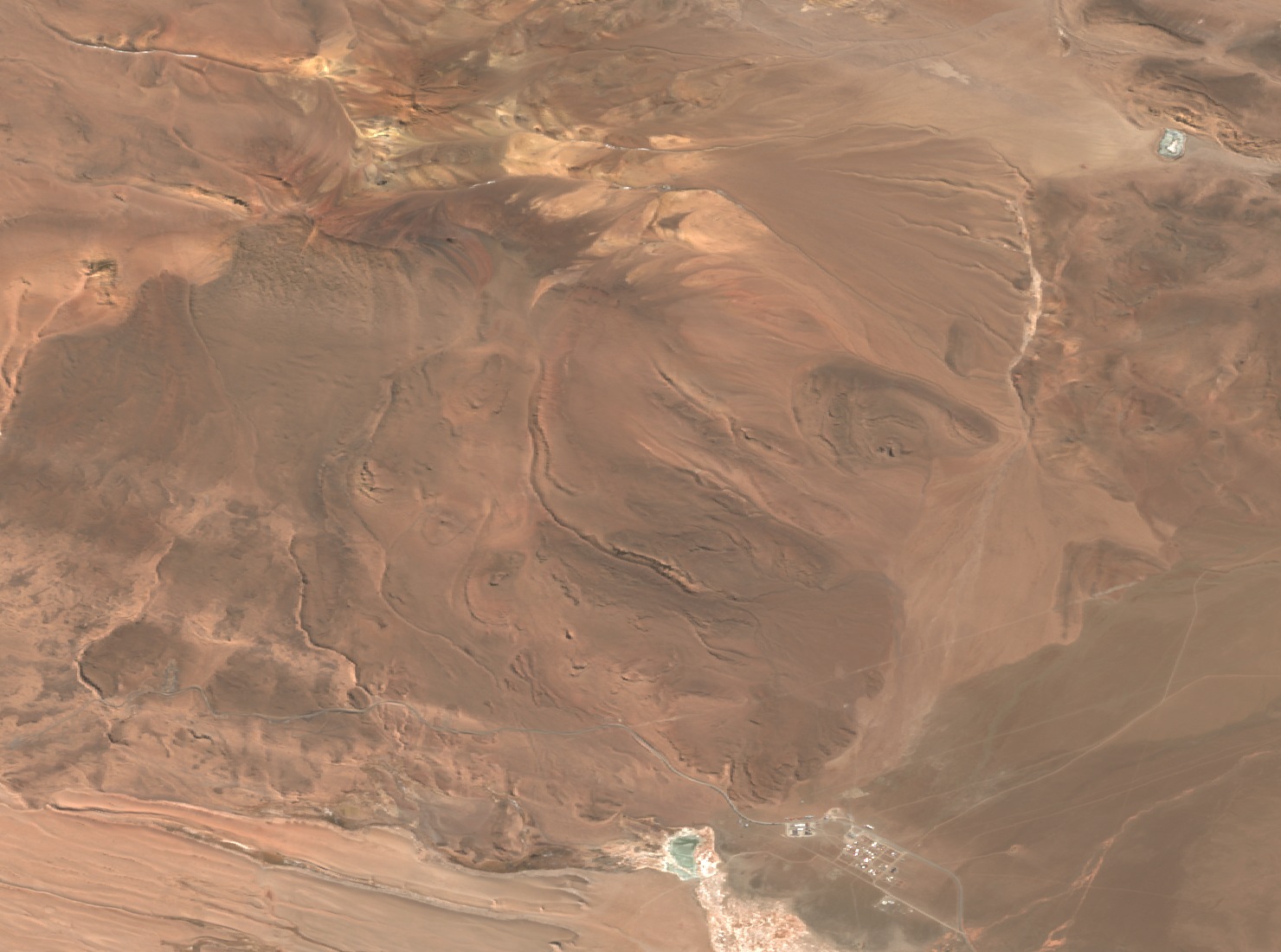
The substrate on which the edifice was built
SEGEMAR mapped the Guachalajte Porphyry in the vicinity of the Jama crater, a pre-existing unit that forms part of the complex's basement. Overlying these porphyries is the Guachalajte Ignimbrite, with pumice and crystals of quartz, plagioclase, and biotite in a tuffaceous matrix. The two flows that make it up together reach a thickness of approximately 20 m. The Susques Geological Sheet identifies it as the substrate on which both Jama and the volcano Poquis, further north, were built.
Two lava units in the volcanic edifice
The Susques Geological Sheet distinguishes two superimposed lava units in the complex. The lower one is a brown dacite with plagioclase and a basal breccia whose blocks reach up to 50 cm. The upper one is a greenish-grey andesite with reddish discoloration and vitreous texture. A potassium–argon date on biotite from that upper unit yielded 5.8 ± 4 million years. SEGEMAR places the complex between the late Miocene and the Pliocene.
The international pass and road infrastructure
To the south of the volcanic edifice lies the Jama international pass, opened in 1991. Work on the former Provincial Route 16, today part of the National Route 52 corridor, began in 1970 under the Jujuy Provincial Roads Directorate. Paving of the Argentine section was completed in 2005 according to records from the Ministry of Foreign Affairs and the Government of Jujuy. On the Chilean side, the pass connects with CH-27, linking the province of Jujuy with the region of Antofagasta.