
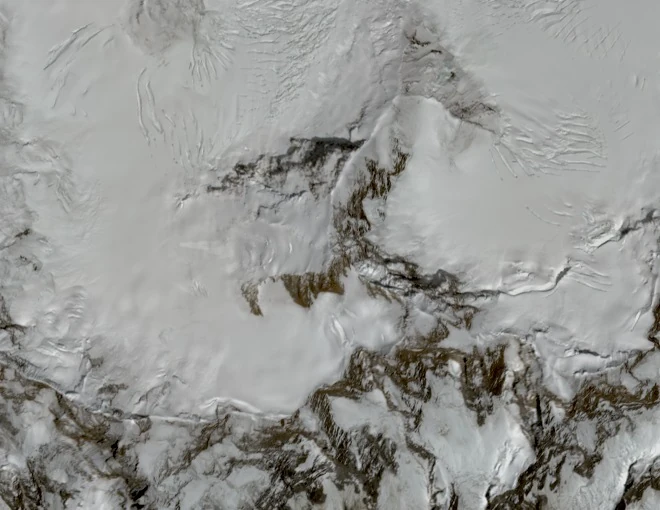
Ridge and Glacial Setting
Pumari Chhish Main anchors a ridge above the Hispar Glacier basin, with the Kunyang and Yazghil glaciers lying to the north. Tom Livingstone published an annotated panorama in the American Alpine Journal that distinguishes the Main, South, and East summits from one another. Cameron Wake and Mike Searle used field observations and earlier maps to document a rapid advance of the Pumarikish Glacier in 1989, noting surface thickening and roughening characteristic of a surge. Their conclusions apply specifically to that study period.
First Ascent via the North Ridge, 1979
The Hokkaido Alpine Association expedition led by Takao Sasaki made the first documented ascent of Pumari Chhish Main on 15 July 1979. Sasaki's firsthand account in the American Alpine Journal describes an approach via camps on the Kunyang Glacier, a crossing to the upper Yazghil Glacier, and an ascent of the north ridge with approximately 7,500 feet of fixed rope placed on the route. A second summit party from the same expedition reached the top on 17 July 1979.
South Summit and Separate Records
Pumari Chhish South received its first ascent on 12 June 2007, when Yannick Graziani and Christian Trommsdorff reached that distinct peak, documented in Trommsdorff's account published in the American Alpine Journal. That ascent is catalogued independently and does not constitute a new route on the main peak. Pumari Chhish East likewise holds its own separate record in the climbing literature, and all three summits are treated as individual entries.