
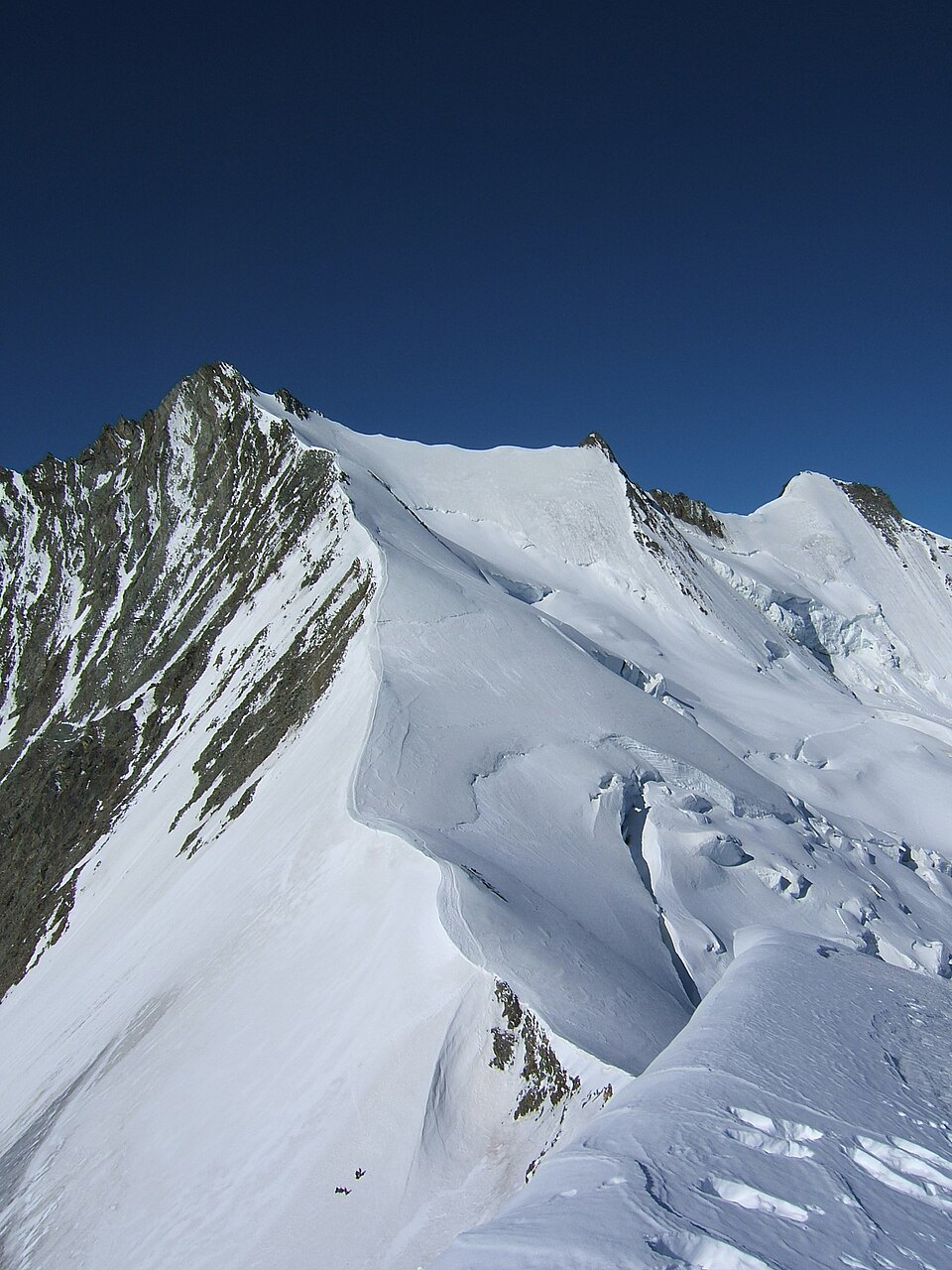
The Name: The Needle Hole
Although the Nadelhorn, viewed from the north, most resembles a needle among the Mischabel summits, the name does not, according to received interpretation, refer to the shape of the peak. The name derives from an oval hole known as the "Nadelloch" (needle hole), which the SAC and local tourism organisations explain is located near the highest point. This distinction between outward appearance and the actual origin of the name is instructive for understanding local toponymy.
First Ascent for Triangulation
On 16 September 1858, a local party consisting of Franz Andenmatten, Baptiste Epiney, Aloys Supersaxo, and J. Zimmermann climbed the Nadelhorn. The stated purpose of the ascent is noteworthy: the goal was to erect a trigonometric signal. The Nadelhorn was therefore not opened up in the course of a sporting or exploratory venture, but in the service of geodetic national surveying – a context characteristic of many first ascents of Valais peaks during that era.
Position in the Mischabel Group
The Nadelhorn lies between the Lenzspitze and the Mischabel on one side, and the Nadelgrat on the other. The surrounding glaciers leave a lasting imprint on the high-alpine terrain of the massif. The Mischabel group itself ranks second among Swiss Alpine massifs after the Monte Rosa group, lending the Nadelhorn, as part of this massif, its own distinct alpinistic significance.