
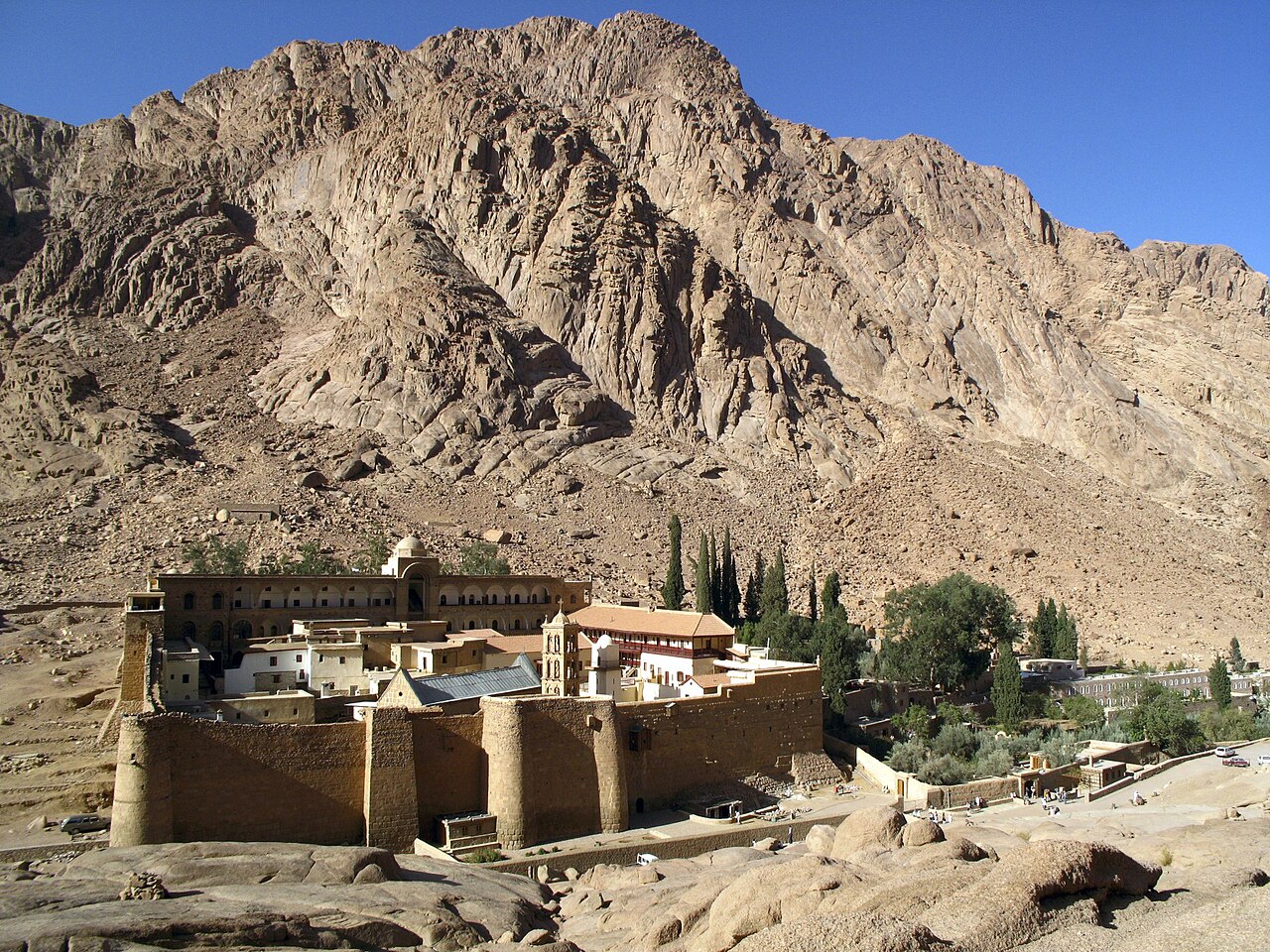
Granite Foundations of a Sacred Peak
The geology of the Jebel Musa area has been examined through study of the Katharina pluton, a granitic intrusion investigated by researchers at Ben-Gurion University for its vertical variation in composition. The broader Gebel Mussa region is characterised by this granitic basement, whose exposed surfaces and bold landforms define the southern Sinai terrain. Jebel Musa reaches approximately 2,285 metres and is a distinct peak from Mount Catherine, the higher neighbouring summit within the same massif.
Saint Catherine's Monastery and the Built Sacred Landscape
At the foot of the mountain stands Saint Catherine's Monastery, built near a site identified in Christian tradition as the Burning Bush by order of the Byzantine emperor Justinian I between 548 and 565 CE. The Egypt Ministry of Tourism and Antiquities records its Church of the Transfiguration among the monastery's principal documented structures.
The monastery has functioned continuously since its foundation, making it one of the longest-occupied Christian monastic sites in the world. UNESCO's 2002 inscription encompasses the Saint Catherine Area as a whole, recognising the monastery complex and the summit together as components of a single sacred landscape.
Three Traditions and the Mountain's Identity
The Arabic name Jebel Musa, meaning Mountain of Moses, and the Greek Hagia Koryphe, documented in SOAS University of London research, reflect the overlapping religious and linguistic traditions that have shaped this mountain's identity. Judaism, Christianity, and Islam each hold the site sacred through the figure of Moses and the association with Mount Horeb, the place of divine revelation described in scripture. That traditional identification, sustained across all three traditions for more than a millennium, defines the mountain's enduring significance.