
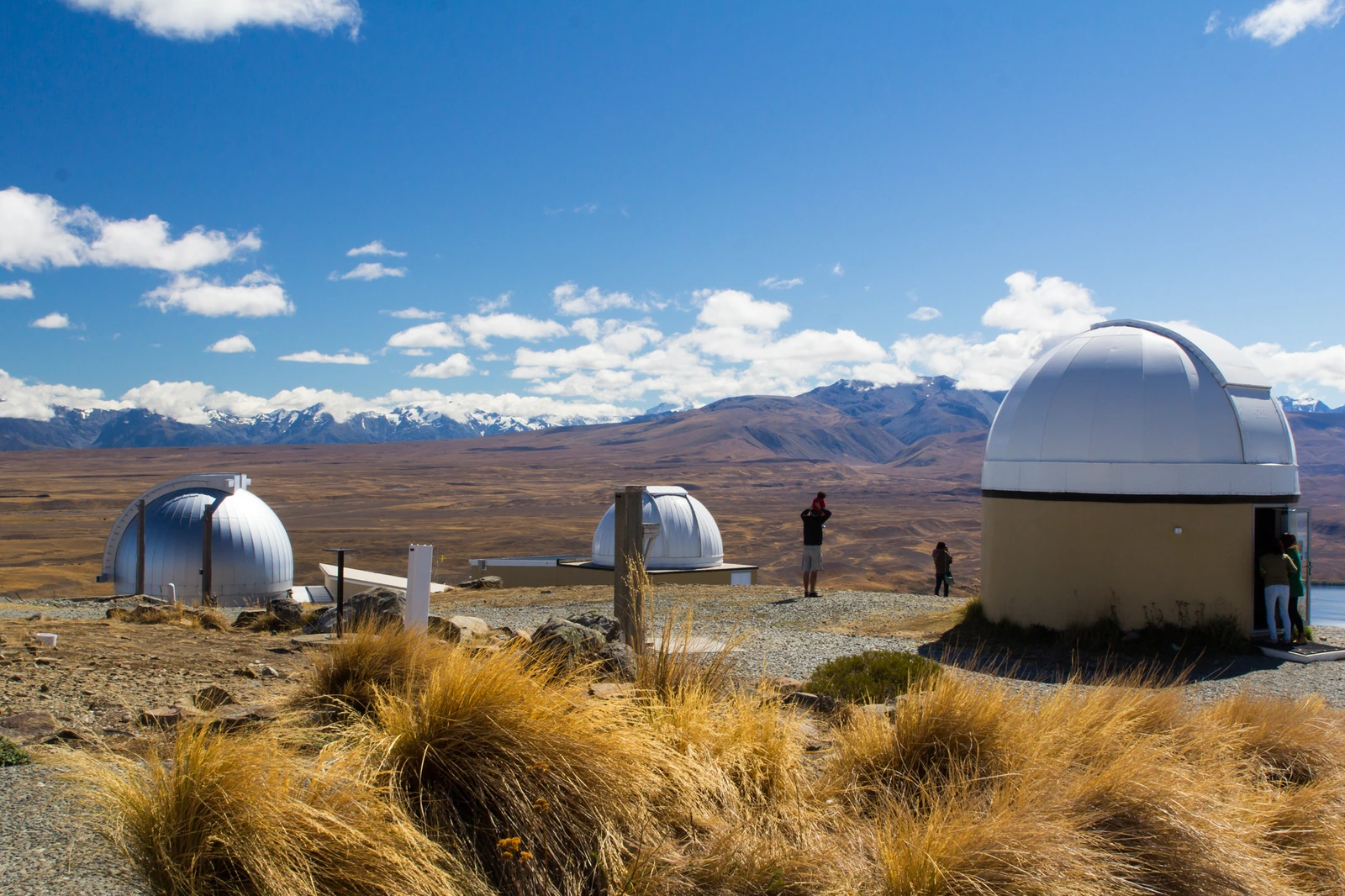
A Name Rooted in Settlement and Place
According to the New Zealand Geographical Names database (LINZ), the English name commemorates John Hay, who took up land in the district in 1857. Reed and Dowling's Place Names of New Zealand (2010) records the Māori name as Ōtehīwai, a name the authors associate with observation of the landscape. The University of Canterbury uses the combined form Ōtehīwai Mt John as the official name for its research station on the summit.
Optical Astronomy at the Summit
The University of Canterbury established its observatory on the summit in 1965. The station has since been used for optical studies of stars, exoplanets, and small solar-system bodies. Optical telescopes work by collecting faint light from distant objects; artificial light on the ground scatters through the atmosphere and raises the sky's background brightness, reducing a telescope's ability to detect dim targets. Controlling that stray light is therefore a practical requirement for the work conducted at the site.
The Dark Sky Reserve
A local ordinance limiting artificial light in the area dates to 1981, according to the University of Canterbury Press history Mt John: The First 50 Years. The summit now lies within the Aoraki Mackenzie International Dark Sky Reserve, a designation that formalises the protection of the night environment across the wider basin. The reserve boundary encompasses the observatory site, connecting those earlier local light controls to a broader regional framework oriented toward preserving the conditions on which optical research depends.