
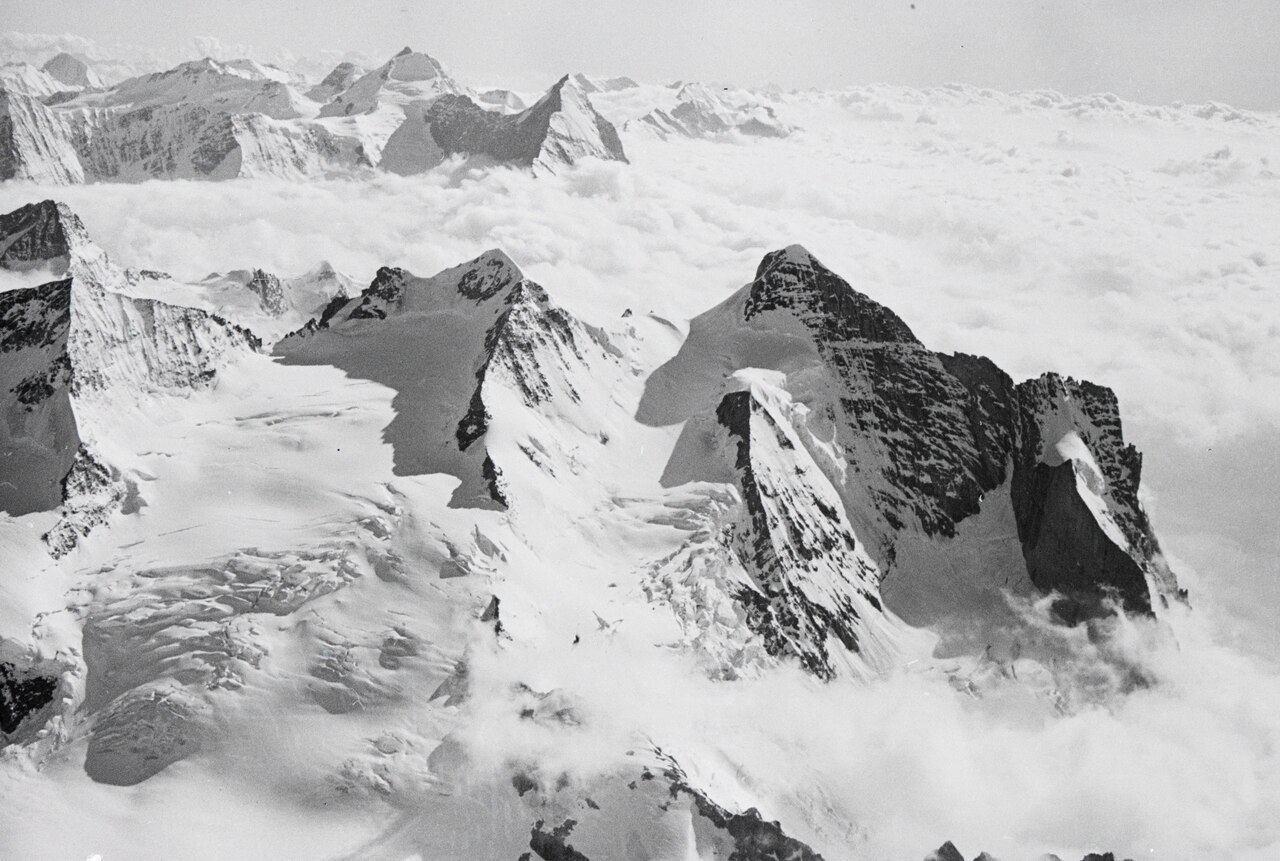
A Summit Distinct Within Its Group
The Wetterhörner are not a single peak but three summits carrying individual names and separate climbing histories: Rosenhorn, Mittelhorn, and Wetterhorn. At 3,701 metres according to the Swiss Alpine Club's historical overview, Mittelhorn is the highest of the three, a fact that the common practice of collapsing the group under the name Wetterhorn has routinely obscured. The conflation is longstanding and not merely a casual error — the dominant summit name in the literature often refers to the lower, more westerly peak rather than to Mittelhorn itself, which sits at the centre of the massif.
The First Ascent of 9 July 1845
The documented first ascent of Mittelhorn took place on 9 July 1845, with Johann Jaun among the party. This followed the recorded first ascents of both Rosenhorn and the peak known simply as Wetterhorn, which had been completed the previous year in 1844, making the summer of 1844 to 1845 a concentrated period in the early climbing history of this corner of the Bernese Oberland. The sequence reflects the systematic attention that guides and their companions were directing toward the Wetterhorn group during the mid-nineteenth century, working through the individual summits in close succession rather than treating the massif as a single objective.
Approach by the Lauteraar Glacier
The Swiss Alpine Club archive preserves an account of the 1845 ascent that describes the party approaching from the Grimsel area, crossing the Lauteraar Glacier to reach the mountain. This line of approach places Mittelhorn squarely within the broader geography of glacier research that dominated scientific and exploratory travel in the region during this period. The Lauteraar Glacier was a known corridor for natural historians and surveyors working the high terrain of the central Bernese Oberland, and its use as an approach to Mittelhorn illustrates how early climbing routes were often shaped by, and ran parallel to, the access lines established for scientific purposes rather than standing apart from them.