
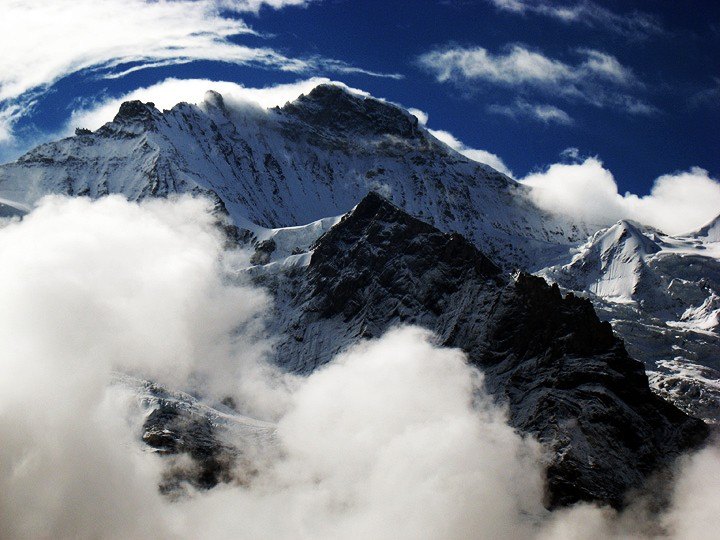
Form and location
The Jungfrau reaches an elevation of 4,158 m (13,642 ft) and lies on the border between the southern part of Canton Bern and the northern part of Canton Valais. Together with the Eiger and the Mönch it forms a connected mountain ridge regarded as the most distinctive silhouette in the Swiss Alps. To the south of the summit extends the Aletsch Glacier — the longest glacier in the Alps — which, together with the Jungfrau, forms part of the UNESCO World Heritage Site Jungfrau-Aletsch, inscribed on the list in 2001.
First ascent and early access
On 3 August 1811, the Meyer brothers from Aarau reached the summit for the first time, together with two chamois hunters from Valais. The ascent followed a long route across the glaciers and high passes of the Bernese Alps. A more direct route on the north side was not opened until 1865 — more than half a century after the first ascent. The long period during which the summit was considered unreachable is reflected in its cultural legacy.
After the first ascent by Johann Rudolf Meyer, contemporaries jokingly circulated the name "Mme Meyer" — an ironic allusion to the previously so unapproachable summit. Before that, the late-eighteenth and early-nineteenth-century Romantic movement had invoked the Jungfrau as a "goddess" or "priestess." The name itself — "the Jungfrau" (the virgin) — was consciously imbued with connotations of feminine untouchedness during this era.
The Jungfrau Railway and the Jungfraujoch
With the construction of the Jungfrau Railway at the beginning of the twentieth century, the character of the region changed fundamentally. The railway connects Kleine Scheidegg with the Jungfraujoch, the saddle between the Mönch and the Jungfrau, and turned the area into one of the most visited places in the Alps. The Jungfraujoch lies well below the actual summit and forms the high-alpine starting point for tours into the surrounding glacier area.
Romantic reception and interpretation of the name
In the eighteenth and nineteenth centuries, the Jungfrau was a preferred projection site for European Romanticism. Its summit, long considered inaccessible, was repeatedly evoked in literature and painting as a "goddess" or "priestess." This symbolic charge stood in deliberate contrast to the actual topographic reality: a summit of rock and ice that was certainly hard to reach, but by no means transcendent in nature. The jokingly intended renaming to "Mme Meyer" after 1811 marks the break between Romantic projection and alpine practice.