
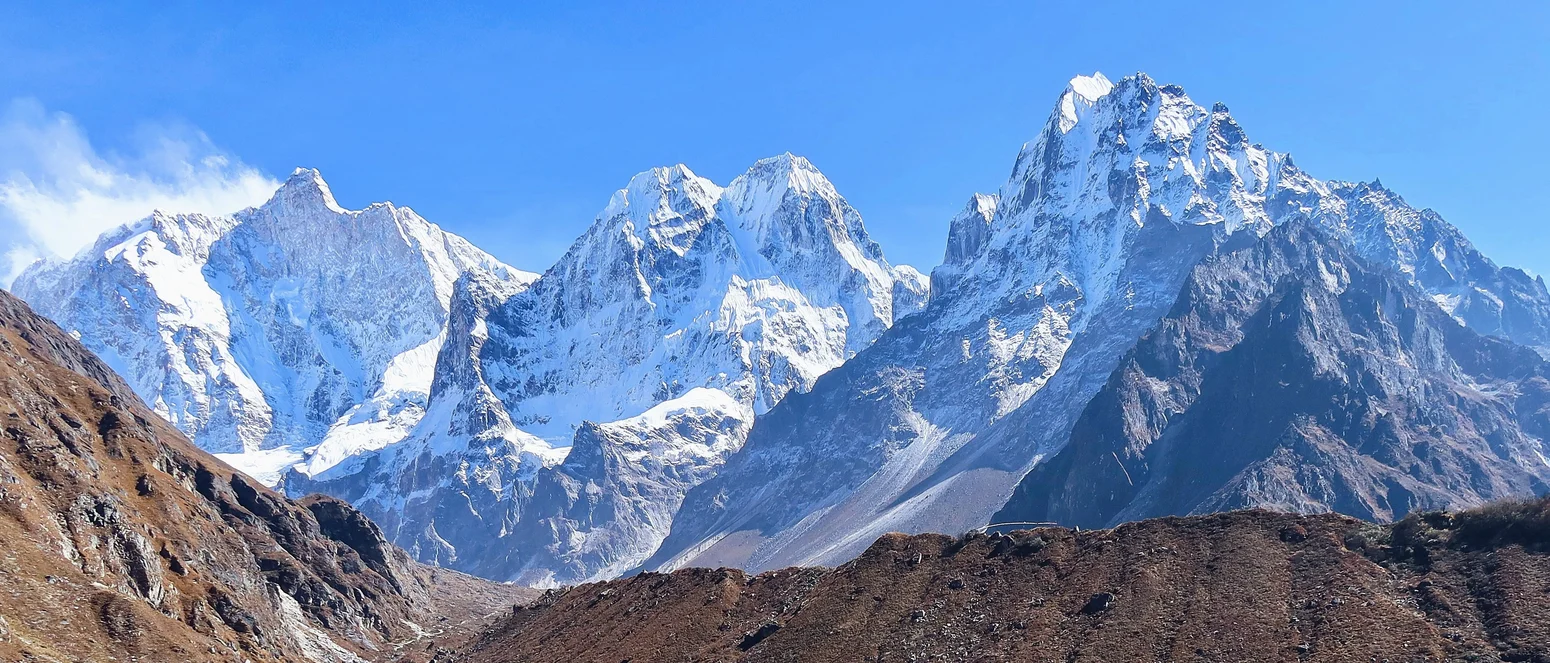
Naming and Survey Record
The Nepal government's official designation is Kumbhakarna, a name that appears alongside the widely used mountaineering name Jannu. The elevation figure accepted by the Nepal Department of Tourism and published in its Facts and Figures 2025 is 7,710 m; the Himalayan Database carries a one-metre variance at 7,711 m. Both figures refer to Jannu’s main summit.
The 1962 French First Ascent
The first ascent was achieved by a French expedition led by Lionel Terray, approaching the mountain via the Yamatari glacier and committing to the south ridge as the route to the summit. The Himalayan Database records the first summit team — reaching the top in April 1962 — as René Desmaison, Paul Keller, Robert Paragot, and Gyalzen Mitchung Sherpa, with a second party following. Where publication records and the database differ by a single day for certain team entries, the month and year stand as the reliable chronological anchor. Terray's account, published in the Himalayan Journal, documents the character of terrain that had turned back earlier reconnaissance: a mountain that forced the expedition to find a line through sustained technical difficulty at altitude.
The North Face and the Round Trip Ticket
Jannu's north face had attracted serious attention well before 2023: a Russian expedition in 2004 established a route on the wall, though by a different line than what would come later. On 7–12 October 2023, Matt Cornell, Jackson Marvell, and Alan Rousseau climbed a new route on the north face in alpine style, naming it Round Trip Ticket. The line measures approximately 2,700 m and was completed over six days. Alan Rousseau's account, published in the American Alpine Journal, distinguishes this route explicitly from the 2004 Russian line, establishing Round Trip Ticket as an independent addition to the face rather than a variation on prior work.
Character of the Mountain
Jannu's position within the Kangchenjunga Himal places it in a remote mountain group. The Yamatari approach used by the 1962 French expedition established a corridor into the peak's southern aspect via the south ridge, while the north face — the theater of both the 2004 Russian ascent and the 2023 Round Trip Ticket — presents a different architectural challenge: a near-vertical to overhanging wall of ice and mixed ground that demands sustained technical climbing at altitude.