
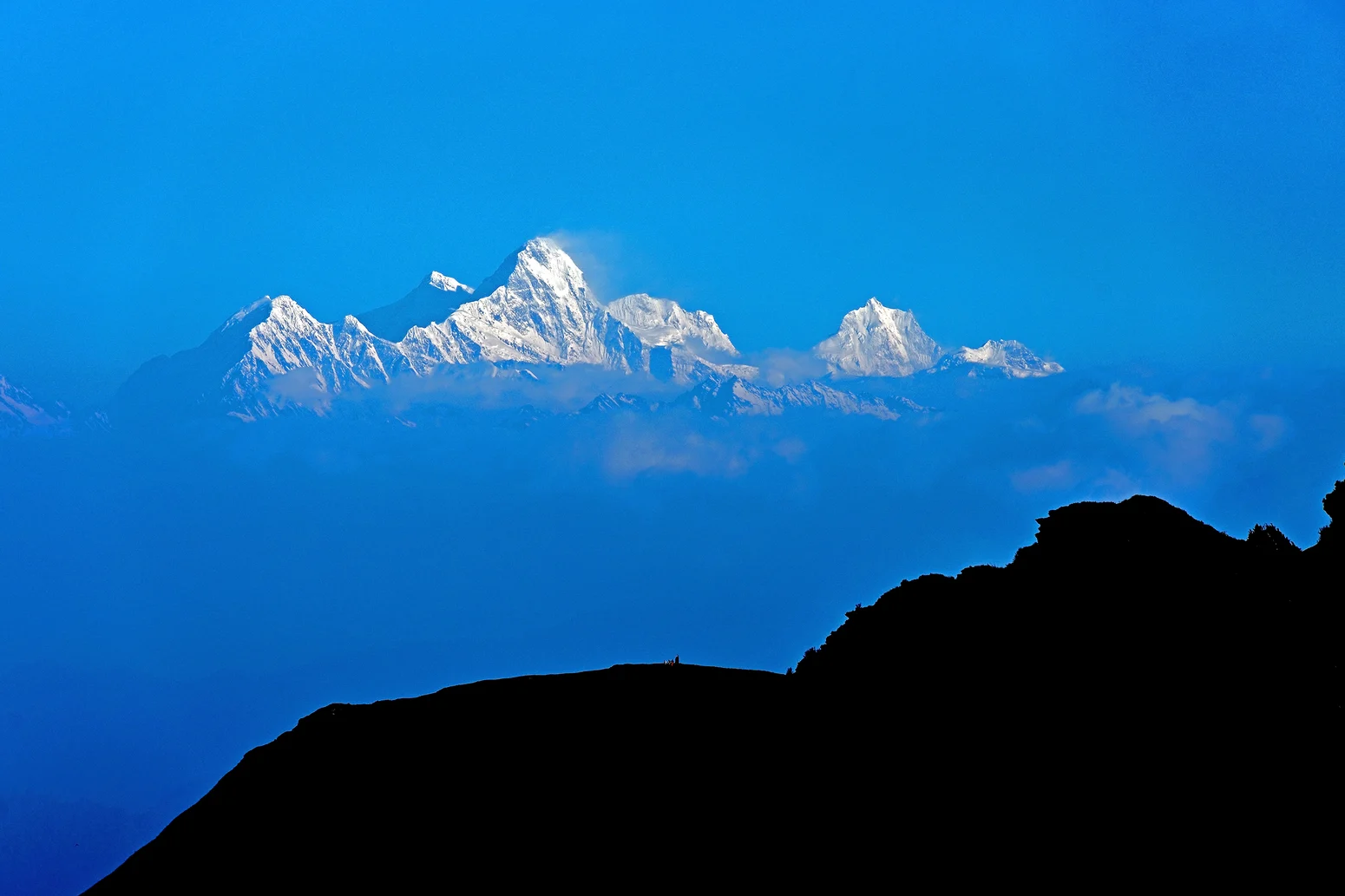
A Peak With More Than One Name
The nomenclature around Himalchuli rewards careful reading. Nepal's Department of Tourism registers the 7,893 m main summit as Himal Chuli East, listing North and West as separate peaks. The Himalayan Database includes Main as a synonym for that same high point.
That layering of names reflects the broader complexity of the Mansiri Himal, a range where Manaslu dominates the literature but its neighbours carry their own accumulated histories. Understanding which summit a source means requires checking its approach, its elevation, and whether it cites a government register or an expedition's own internal naming.
The 1960 Keio University Ascent
The first ascent of Himalchuli was made on 24 May 1960 by Hisashi Tanabe and Masahiro Harada, members of a Japanese expedition led by Jiro Yamada of Keio University. The team had carried out a reconnaissance of the approaches in spring 1959 before mounting the full attempt. By the time the summit pair moved for the top, the expedition had established Camp VI on the broad col situated between the main and west peaks. Tanabe and Harada used supplemental oxygen on the ascent and cut steps on a steep ice wall to reach the summit. Two further members, Hideki Miyashita and Kimimasa Nakazawa, repeated the climb the following day, 25 May.
The route taken by the Keio University team came from the southwest, a line dictated by the terrain accessible from that side of the massif. The placement of Camp VI on the col between summits shows how the expedition read the mountain's upper geography — using the depression between the main and west peaks as a staging point rather than committing to a direct line from below. The American Alpine Journal's report of this expedition remains the primary narrative record of the ascent.
Approaching From the North: The 2007 Ukrainian Expedition
Nearly five decades after the first ascent, a Ukrainian expedition in 2007 reached the main summit by an entirely different avenue — the Lidanda Glacier on the northern side of the mountain, ascending the northeastern face toward the northwest ridge. This approach is documented in the American Alpine Journal. On 19 May, six climbers, led by Mstislav Gorbenko and Sergey Pugachev, reached the summit, establishing a distinct line from the 1960 southwest route.
The existence of these two routes — one from the southwest recorded in 1960, one from the north recorded in 2007 — illustrates how the same summit can be approached from fundamentally different aspects. Both routes reached the same 7,893 m main summit, registered by Nepal as Himal Chuli East. A climber reading expedition accounts must track not only the summit name but the glacier and aspect, since different sources attach different route descriptions to what is nominally the same mountain.
Standing in the Mansiri Himal
At 7,893 metres, Himalchuli sits within reach of the eight-thousanders in elevation but falls just below that symbolic threshold — a position it shares with a number of Himalayan peaks that receive less sustained attention than their slightly taller neighbours. Its location southeast of Manaslu places it within a part of the Mansiri Himal that sees expedition traffic oriented primarily toward the higher peak, which gives Himalchuli a character shaped as much by adjacency as by its own summit height.
The 1959 reconnaissance, the 1960 ascent via the southwest, and the 2007 approach via Lidanda Glacier together sketch a mountain whose documented history accrued from different directions. In 1978, another team reached the main summit and, separately, Himalchuli West — a distinct peak listed by Nepal's register. Each expedition engaged with a different face or feature of the massif, and the American Alpine Journal records these efforts as separate undertakings rather than variations on a single objective.