
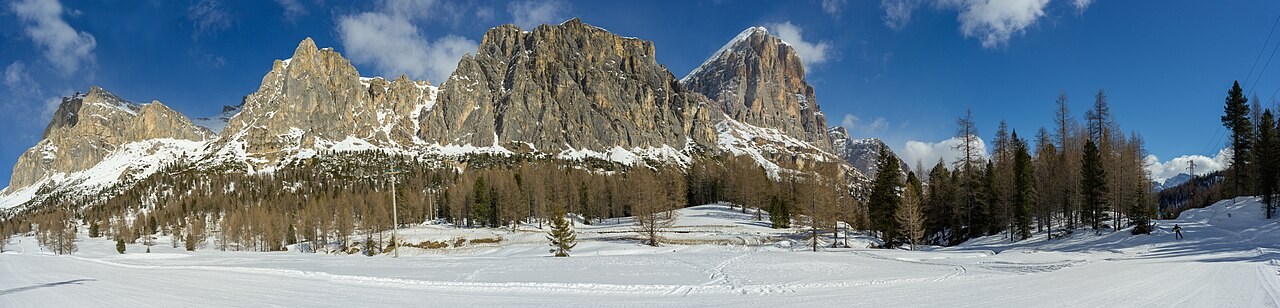
The pyramid of the Falzarego
Col dei Bos belongs to the Dolomite group that towers over the Passo Falzarego, an orographic hub between the Val Badia and the Conca di Cortina d'Ampezzo. The mountain has a particularly pronounced pyramidal form: its flanks converge toward an angular summit that the Lagazuoi website gives as 2,559 metres. It is the southern face, the steepest, that has concentrated both the military events of the twentieth century and the development of contemporary mountaineering infrastructure, creating a chronological layering that defines the character of the place.
The Falzarego sector in the Great War
During the First World War the Passo Falzarego sector was the scene of military operations involving the alpine formations of both sides. At the foot of the south face of Col dei Bos survive the ruins of a field hospital, a structure that attests to the presence of a logistical infrastructure directly beneath the contested walls. According to sources linked to the territory of Cortina, these remains are physically separate from the modern via ferrata and represent a distinct material testimony, not incorporated into the subsequent mountaineering installation.
The Ferrata degli Alpini and the chronological contrast
The Ferrata degli Alpini was built in 2008, nearly ninety years after the end of the conflict that had marked this face. The infrastructure — cables, stemples and fixed anchors — runs up the south face of the pyramid following a contemporary mountaineering logic entirely independent of the wartime traces below. The result is an explicit chronological contrast: the ruins of the field hospital belong to an era in which the mountain was an operational theatre, while the 2008 via ferrata returns it to civilian and sporting use. The two systems coexist on the same face without physically overlapping, yet inevitably enter into dialogue for anyone who observes the place in its entirety.