
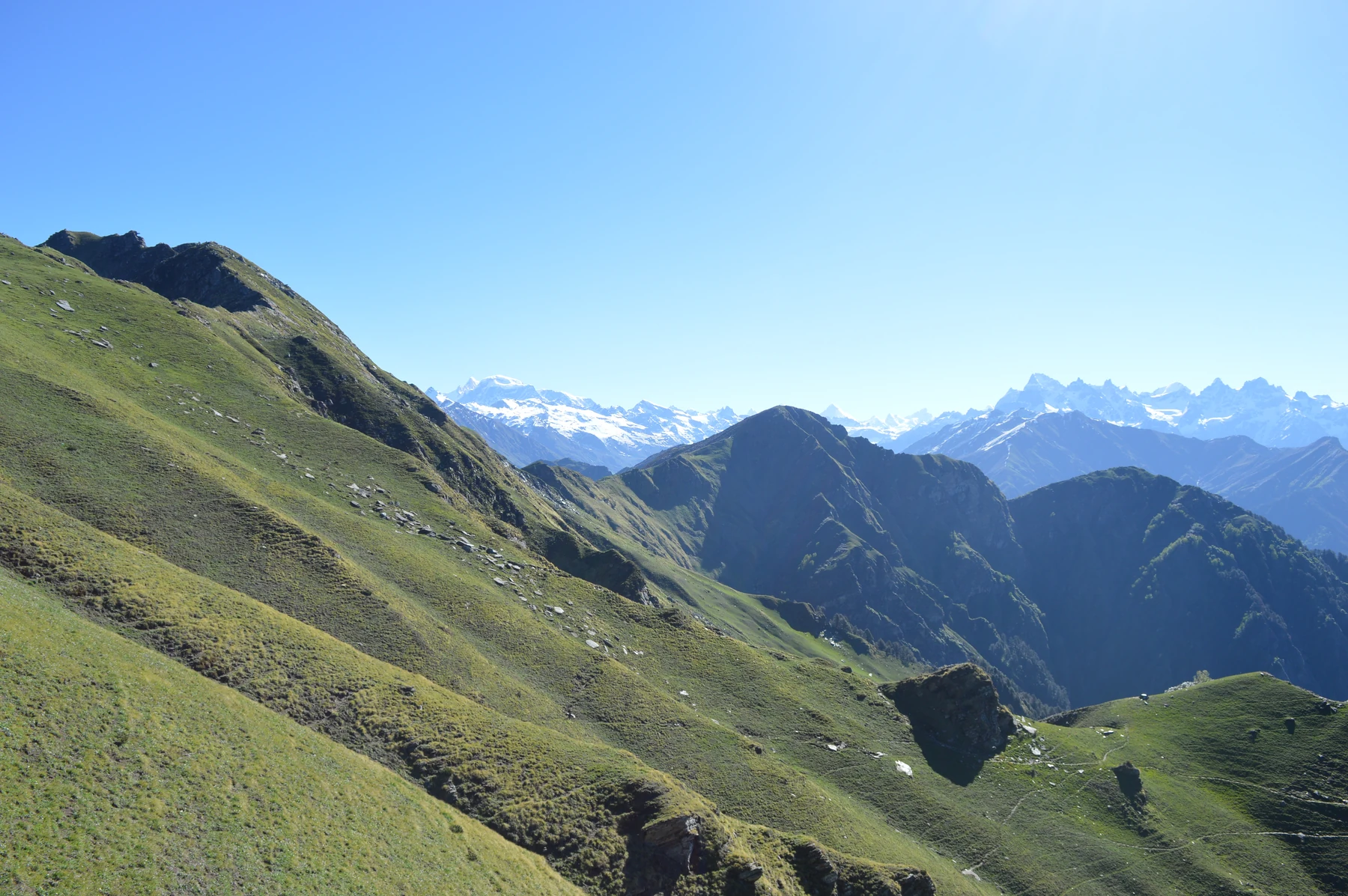
Terrain and the Ridge Crossing
Open grass slopes crown the Chanderkhani ridge, above the forested approach from the Kullu Valley. Cultural centre documentation identifies a separate crossing called Rashol Pass, where a route leads to Malana from the Parvati side.
H. Lee Shuttleworth's 1922 account describes his approach from Nagar climbing through deodar, spruce, and fir forest to Chandra Kanni, the early spelling he used. Below lay Malana in a narrow tributary valley of the Parvati.
The 1964 Himalayan Journal Account
Gordon Jones recorded in the Himalayan Journal a September 1964 traverse beginning from Patli Kuhl toward Nagar and Rumsu, with a camp beneath the pass accompanied by Ladakhi porters Wangyal, Ang Chook, and Lama Tashi. On 22 September the party crossed the main pass and noted flowers and views of Deo Tibba, White Sail, and Ali Ratni Tibba before descending into forest toward the Malana stream.
Jones also described a separate minor pass south of Chanderkhani and a rounded hill 12,540 feet (approximately 3,822 m) high south of their camp.
Jamlu Traditions Associated with the Pass
In 1924 Hugh Whistler recorded a local story about Jamlu and Naroi, who came from Spiti carrying a basket of deities. According to the story, a strong wind at the pass scattered the deities across Kullu and Saraj when the basket opened.
The Kullu Dussehra festival's account of Devta Jamlu traces his route as legend from Tibet through Spiti, over Hamta Pass into the Beas valley, then across Chanderkhani to Malana. The Indira Gandhi National Centre for the Arts documents the village's architecture and religious practices associated with Jamlu.