
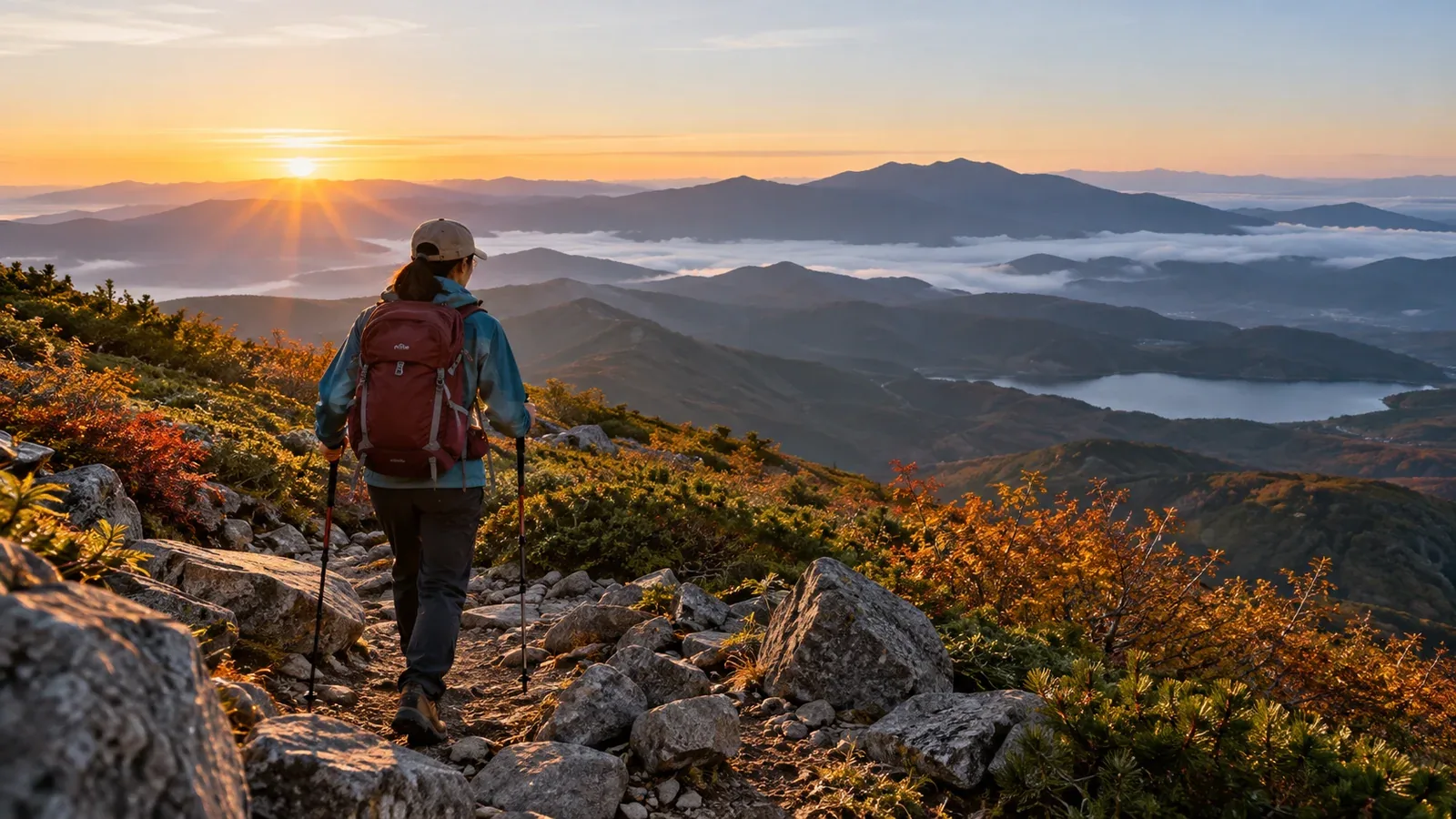
Decide when to hike before settling on where. Season, day of the week and starting time can change how difficult, safe and comfortable the same trail feels. Even with suitable gear, bad timing can make an outing challenging for a beginner.
Here's how to choose a season, day and start time, and what to watch out for as you plan your first hike.
Choose a season with forgiving conditions
May through early June and September through early October can be good times to look for a first hike on many lower trails. Conditions vary by region, elevation and recent weather.
In May and early June, snow has often receded on lower trails and some regions get dry days before the rainy season. Snow and ice can remain higher up or in shaded areas.
In September and early October, summer heat eases in many areas and some mountains start to show autumn color. Check for typhoons, rain and cold at higher elevations.
Seasons that make a first outing harder
- High summer (July–August). Heat illness on low mountains and more frequent afternoon thunderstorms.
- Rainy season (often June–July in much of Japan). Dates vary by region. Prolonged rain can bring mud and poor visibility.
- Winter (December–March). Snow, ice and early sunsets, even on low mountains.
These seasons add several challenges at once. Start by getting some experience in favorable conditions and work up gradually.
Lingering snow and the dates trails open and close vary with region and elevation. Always check official information from local governments, mountain huts or trailhead managers.
Choose a quieter day
A weekday may give you more space to walk at your own pace and reduce delays from crowds and parking.
Popular trails can get backed up on weekends and holidays. Waiting on narrow rock sections or steep slopes equipped with fixed chains can add to fatigue. Full parking lots can also delay your arrival at the trailhead and push back your start.
On weekdays it's easier to walk at your own pace. That makes it easier to manage energy. If you haven't yet learned what pace you can sustain, leave room to stop and rest when you need it.
Watch for the first and last days of a holiday weekend
Crowds during a long weekend depend on the trail, weather and local events. Check hut hours and transport schedules, which can vary by day, and allow time for delays.
Plan the start and finish times together
It's easy for beginners to overlook what time to start.
Work backward from two hours before sunset
Finish in daylight. Descending after dark quickly increases the risk of losing the trail, falling and getting cold.
Plan in four steps.
- Look up sunset for the location and date, for example with the National Astronomical Observatory of Japan.
- Set a target finish time around two hours before sunset, allowing more margin where needed.
- Use 1.2–1.5 times the published walking time as a starting estimate, adjusting for your pace and adding breaks and a buffer.
- Work backward from your target finish time to set a departure and turnaround time.
If sunset is at 5 p.m., aim to finish by 3 p.m. For a published four-hour round trip, five to six hours of walking gives a 9–10 a.m. start before allowing for stops or delays. If the timing is tight, choose a shorter route or a day with more daylight.
Early starts have their own hazards
Early mornings can bring low temperatures, dew and frost. Usable light varies with terrain, tree cover and weather. Plan your first outing to start in daylight and carry a headlamp even on a day hike.
Avoid an afternoon start
In summer, thunderstorms often form in the afternoon. Lightning on a ridge or near the summit can be life-threatening. An afternoon start also makes it more likely you'll still be descending in the evening. Aim to leave in the morning and finish around midday or early afternoon.
Keep checking the forecast until you leave
Even after you pick a date, be ready to change it if the forecast worsens. If you're unsure about going, postpone.
Check the Japan Meteorological Agency’s regional forecast and advisories. Look at a mountain forecast too, if available. Conditions at elevation can be very different from those in the foothills. Check the day before and again that morning.
Consider postponing if any of these apply.
- Rain forecast during your hike, especially heavy or persistent rain. A 50% chance describes likelihood for the forecast area and time period, while expected amounts tell you about intensity and duration.
- A strong-wind or thunderstorm advisory.
- Heavy rain before the hike may have flooded or washed out part of the trail.
Forecasts can change at the last minute. Check again before leaving that morning.
What to check once you've picked a day
Confirm these details before you go.
- Trailhead access, closures and restrictions through official notices from municipalities, huts or the Forestry Agency.
- Transit and parking through operators or local tourism and mountain offices.
- Weather on the day from the Japan Meteorological Agency or a mountain weather service.
- Sunset and whether your plan still fits the available daylight.
Skipping checks can contribute to incidents. Checking current conditions is part of preparing for a hike.
What to do next
Pick a weekday in the next month. Compare that day's sunset with the published time for a trail you're considering, then adjust your start or route length if necessary. Nordwand's Base Camp can help you find nearby hikers if you'd like company.
References
- Japan Meteorological Agency, forecasts, advisories and warnings.
- National Police Agency, overview of mountain incidents.
- Geospatial Information Authority of Japan, hiking and topographic maps.
- Forestry Agency, trail and national forest access information.
References and sources
- Sunrise and sunset calculator · National Astronomical Observatory of Japan (Japanese)
- Regional rainy seasons · Japan Meteorological Agency (Japanese)
- Understanding the forecast and chance of rain · Japan Meteorological Agency (Japanese)
- Regional forecasts and advisories · Japan Meteorological Agency (Japanese)
- Mountain incident statistics · National Police Agency (Japanese)