
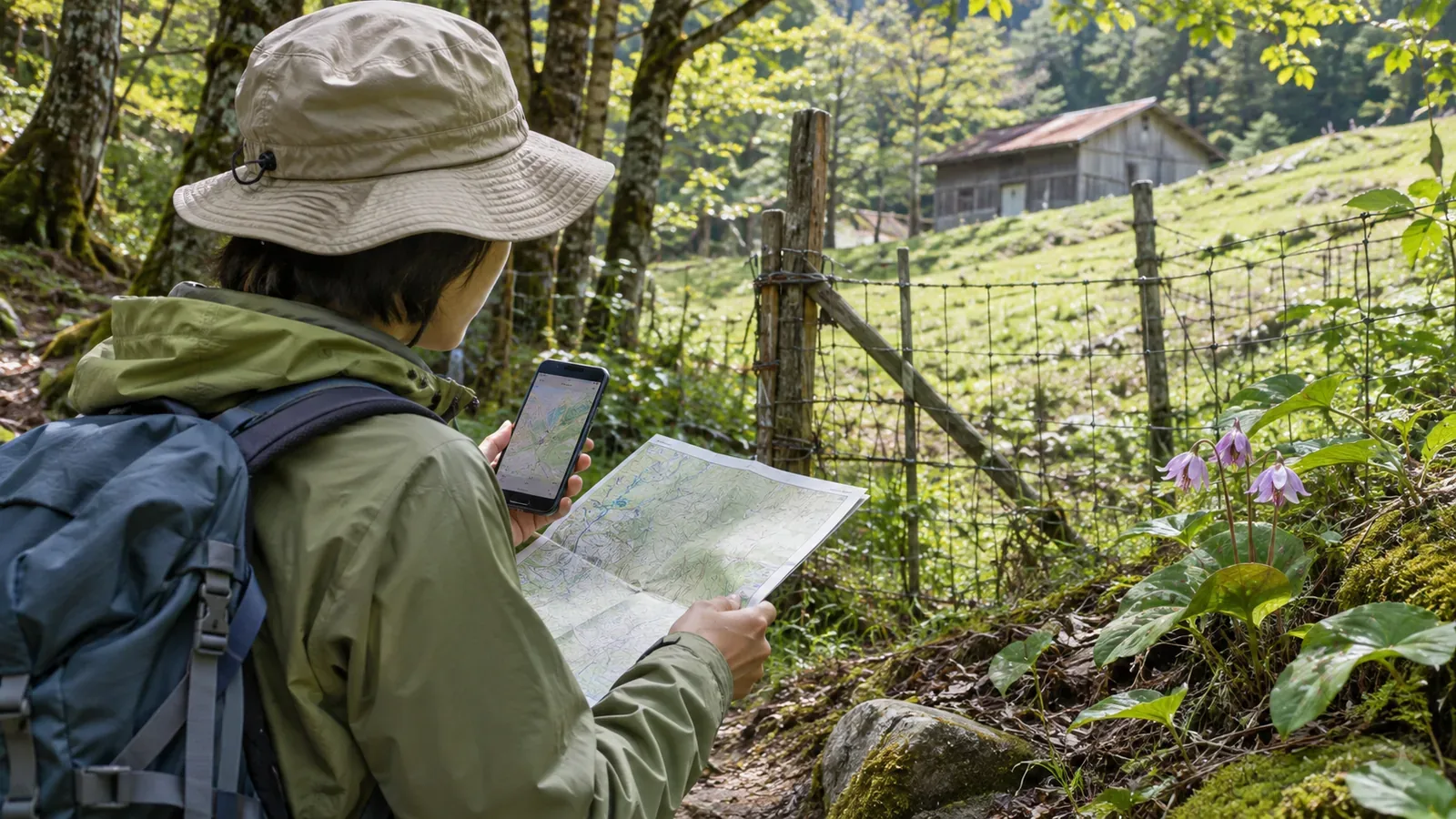
You may want to tell someone about a rare plant or a quiet spot you found in the mountains. Sharing an exact location can affect the people who use the land and the species that live there. Decide separately what to keep in your own records and what location information to publish.
Consider the effect of revealing an exact location
A March 2026 discussion paper from Japan’s Ministry of the Environment notes that sharing the exact locations of rare species can encourage overcollection, while the same information can support conservation and help people plan development with care. The discussion considers how widely to share information based on its precision and purpose. If you want to pass on information for conservation, consult the land manager or a conservation organisation directly.
The Biodiversity Center of Japan says that the survey data for designated plant communities on its public Ikimono Map excludes communities that require sensitive handling for conservation. The Ministry of the Environment’s list of nationally designated rare wild species provides information about designations under Japan’s species conservation law. Decide separately whether identifying or naming a designated species requires sharing exactly where you found it.
For private land, consider the land users’ wishes and the conditions for access, separately from any wildlife information. Seeing a place from a path open to visitors does not mean anyone can enter it. Before posting a location, check why it needs to be shared and what conditions the manager sets.
Look for clues in photos and maps
Even if you leave the location out of the text, a photo’s location metadata, buildings in the background, signposts or terrain can reveal the spot. Japan’s Personal Information Protection Commission warns that location metadata can identify a person and that a photo can contain information about others. Review the image and caption together before posting.
Map numbers, photo timestamps and a detailed route can identify a location when combined, even when none reveals it by itself. Keep your detailed private record separate from any map you share and omit coordinates or directions that do not serve the purpose of the post. Check for remaining clues even after removing the location metadata.
How much detail to obscure depends on the species or site and the region. Follow any publication guidance from the conservation organisation or land manager. If you are unsure, you can leave out the exact location. An existing public post alone is not a reason to share the details again.
Share what matters without identifying the site
You can convey what makes local nature special through authorised exhibits, conservation work, seasonal scenery and visitor guidance. For each image or passage, ask whether it needs to identify a particular specimen or property.
Before publishing the names, affiliations or photos of residents or conservation workers you spoke with, explain the purpose and intended audience and check what they are comfortable sharing. Speaking to you does not automatically mean agreeing to publication. If you do not have permission, build the article without those details.
On site, stay on paths open to visitors and follow the manager’s guidance. Keep out of private land and restricted areas unless you have permission. Do not make leaving the trail or collecting a rare species part of the record you set out to make.
Make it possible to review after publication
Before posting, go through the text, photos, attached maps and image metadata together. Use separate filenames or folders so you do not attach your private record by mistake. If you share only with friends, still discuss how far they may forward or repost it.
If a land manager or someone affected asks you to remove a location after publication, check what they mean and promptly consider the appropriate response. Look for the same information in the images and related posts as well as the article itself.
After removing photo geotags, check whether distinctive signs, houses or the sequence in which the photos were taken could still narrow down the location. Refer to the land manager or conservation organisation’s guidance for that region and the particular species or place.
Decide separately what to record and what to share
When keeping a mountain record, ask whether it needs to reveal the exact location of private land or rare species. Review the text, photos and maps together, and consult the manager if you are unsure.
References and sources
- Japan Ministry of the Environment: Handling information on where rare species grow and live
- Biodiversity Center of Japan: Launch of the Ikimono Map
- Japan Ministry of the Environment: List of nationally designated rare wild plants and animals
- Personal Information Protection Commission: Examples and precautions for handling personal information