
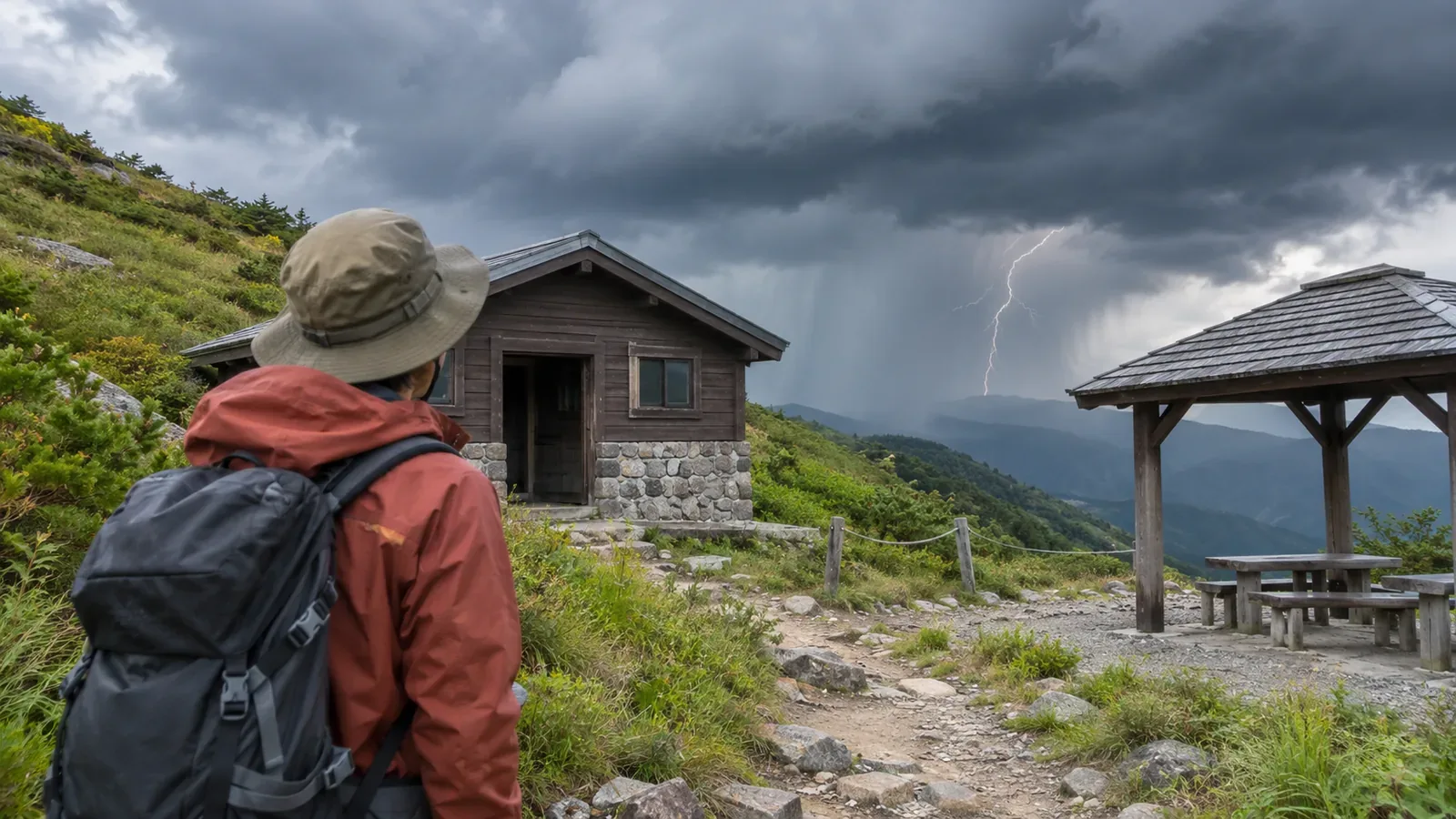
A hut, pavilion or lookout label tells you little about lightning protection. Check the construction, lightning protection, whether you can get inside, and the route and time needed to get there. The Japan Meteorological Agency (JMA) lists reinforced concrete buildings and enclosed vehicles among relatively safe spaces. Treat outdoor protective areas as emergency measures for when you cannot reach a safe space.
A hut or pavilion label does not establish safety
The JMA explains that lightning can strike in many places, including mountains, and that people are more exposed on summits, ridges and open ground. The Society of Atmospheric Electricity of Japan also warns that a strike can jump from trees to people, even in woodland. Check lightning protection separately from whether a place keeps off the rain.
You cannot judge the safety of an individual hut or pavilion from its appearance or name. Ask the operator whether it has walls, whether there is guidance on lightning protection, when it is open and where to enter. The materials you can see from outside tell you little about grounding or protection for the entire structure.
Decide which signals will prompt action
The Lightning Nowcast analyses intensity and potential on a 1 km grid, looks 10 to 60 minutes ahead and updates every 10 minutes. Activity levels range from 1 to 4. At levels 2–4, cumulonimbus clouds are present and a strike can occur at any time. Seek shelter immediately inside a suitable building or another safe space. Level 1 means rain clouds may develop into thunderstorms. Plan for possible lightning within an hour. If it takes time to reach shelter, act early at a thunder advisory or level 1.
The day-before and same-day forecasts offer earlier signals. The JMA advises planning what to do if the forecast mentions thunder or the outlook describes an unstable atmosphere. Thunder advisories are issued several hours before damage is expected. Local offices issue forecasts at 05:00, 11:00 and 17:00. The monitoring network misses some discharges, and storms can develop rapidly where no activity level is displayed. If you hear thunder or see other signs of an approaching storm, seek shelter promptly whatever the display shows.
If it takes time to get from a ridge or summit to shelter, review the plan using forecasts and advisories before level 1 appears. Level 1 does not guarantee time to get to safety. Consider avoiding stretches without nearby shelter, cancelling or choosing a different plan.
Evaluate shelters by construction and access
The JMA lists reinforced concrete buildings, enclosed cars, buses and trains as relatively safe. The inside of a wooden building generally provides protection too. Staying at least 1 m from electrical appliances, the ceiling and walls improves safety. The Society of Atmospheric Electricity of Japan says the inside of a home generally protects, though lightning current can travel through power and telephone lines. It recommends an enclosed car if no suitable building is available, and choosing a suitable building when there is one nearby. Whether a place is enclosed and how it is built affect the protection it offers.
The JMA and the society describe what to do when you cannot get into a suitable building or vehicle. Outdoor protective areas depend on the kind of structure, its grounding and other conditions. A fixed distance from a pole or tree cannot establish safety. A nearby strike can also harm people through the ground. Revisit a route with distant shelter early instead of planning to designate an outdoor protective area by appearance.
The waiting times have different contexts. The JMA’s guidance to wait at least 20 minutes after lightning activity stops concerns moving to a safe space after taking emergency cover outside. The society’s 30 minutes without further thunder concerns resuming an outdoor event, with a check of current weather for nearby storms. Elapsed time alone cannot establish that a hike can resume.
Check your shelter options on paper before leaving
List possible shelters and check construction, lightning guidance, opening and use conditions, safe access routes and travel times. A hut symbol on the map does not tell you whether you can get inside. Look up information you lack in official notices from the operator or local authority. Revisit the route if its only shelter has not been verified. Before leaving, check for closures or access changes.
Compare your itinerary with the times covered by forecasts and advisories. The JMA’s example of outdoor activity from 14:00 to 16:00 illustrates its guidance. Lightning can be a danger at other times too. Consider the whole period you expect to spend on ridges or open ground, including travel time to shelter. A small shift around the forecast window gives no assurance of safety.
Agree how to discuss cancelling or changing the plan. The Society of Atmospheric Electricity of Japan advises cancelling, postponing or going home when needed during recreation at sea or in the mountains. If lightning is forecast and your plan leaves you far from shelter, decide early whether to stay off the mountain. Allow anyone to speak up and act if you hear thunder or see the sky change, even before the agreed conditions are met.
Choose shelter by checking construction and the time needed to reach it
Check shelter construction, access, the route to it and how long it takes. At levels 2–4 or signs such as thunder, seek shelter promptly. Where shelter is far away, consider cancelling or changing the plan using forecasts and advisories. Check beyond the map or appearance before treating a building or protective area as safe, and revisit a plan that depends on an unverified shelter.
References and sources
- Japan Meteorological Agency, Using the Lightning Nowcast and its limitations
- Japan Meteorological Agency, What is the Lightning Nowcast?
- Japan Meteorological Agency, Protecting yourself from sudden heavy rain, lightning and tornadoes: Check weather information often
- Society of Atmospheric Electricity of Japan, How to protect your life from lightning
- Japan Meteorological Agency, Staying safe from lightning
- Japan Meteorological Agency, Using weather information issued in stages