
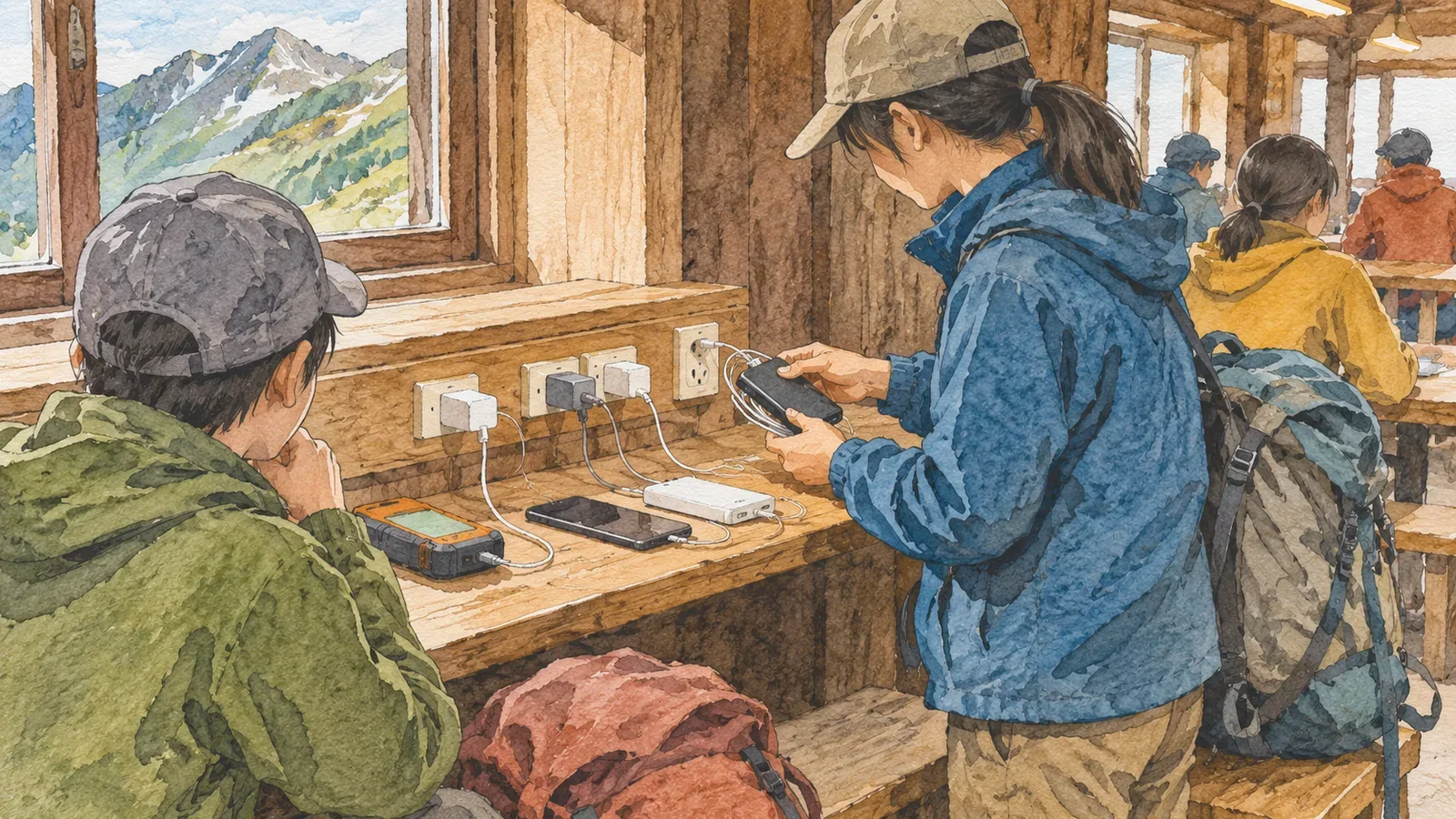
Before using a hut’s charging point, check which devices you can plug in, where and when. Unplug as soon as you have enough charge. Charge your devices before the trip and bring the backup power your route requires. Some huts restrict how you use or store power banks indoors. The examples below show what to check from preparation to pickup.
Check the rules for rooms, shared outlets and power banks
The Yarigatake Hut Group says its huts generate their own electricity and that voltage can fluctuate. It asks guests to avoid charging phones and camera batteries in sleeping rooms.
Enzanso has outlets near reception. Charging costs ¥100 per session, with about an hour per user, and guests are asked to take turns. Outlets are unavailable while the generator is off, including after lights-out, and the hut does not lend chargers. It asks guests to refrain from charging power banks or using them to power other devices indoors. Check where you can use the backup power you carry.
At Sugoroku group huts, store power banks in the designated lockers at the entrance or in the entrance hall. Keep them out of guest rooms and other indoor areas, and do not charge or use them inside the hut or in the lockers. For devices the hut allows, such as smartphones and PSE-marked headlamps or cameras, use PSE-marked equipment or a manufacturer-specified charger and keep the device in sight while it charges. Check which devices the hut accepts and where to put them afterwards.
Work out how much power you need for the overnight trip
You can reduce the need to charge at the hut. Before the trip, list your devices and distinguish what you’ll need on the trail, such as maps, communications and lighting, from optional uses such as taking photos or playing music. Save optional uses for when you have charge to spare so you spend less time waiting for an outlet.
Make sure your lights, maps and communication devices have enough power for the trip. Enzanso tells guests to take a headlamp to the toilet at night even though the corridors have night lights. Test your headlamp and check the battery before leaving. Estimate consumption from how you normally use it, then allow extra for different settings, longer use and conditions in the mountains.
For each device, check the charge level, the cable and how to use the backup power. Follow the manufacturer’s instructions for replaceable batteries. Test the functions you’ll use for navigation or communication before you set out. If the hut limits how you use or store certain power sources, plan separately for the trail and indoors.
How to use a shared charging point
Decide which devices actually need a charge. Start with what you’ll need the next day and charge only as much as needed. If you’re in a group, take turns under the hut’s rules and keep to the time limit. A fully charged device left plugged in makes it hard to see whether the outlet is free. When you’re done, unplug and take the device and cable with you.
If your trip depends on charging at the hut, ask before booking. At check-in, confirm which devices are allowed, the fee, hours, queue, whether you must stay with the device and where it goes afterwards. If someone else made the booking, pass the answer on to whoever needs to charge. Confirm that the outlet is for guest use before plugging in your charger.
If every outlet is taken, ask about the queue and wait to charge lower-priority devices. Leave other guests’ chargers and devices alone. Mark your cable or charger and make it easy to see which device it belongs to. Keep cords out of walkways and leave neighbouring outlets accessible.
At places with a time limit like Enzanso, stick to it and remove your device and cable as soon as you have enough charge. Use an extension cord or adapter only if the hut permits it. Ask staff about outlet availability or whose turn it is. If the device you need for communication is out of power, explain the situation to staff so they can help.
Plan around charging hours and lights-out
Check charging hours separately from meals and lights-out. Minamidake Hut lists free charging upstairs from 16:00 to 20:00 for people staying inside. Campers and passing hikers have a separate point open from 06:00 to 20:00 for ¥100 per 30 minutes. Confirm which area you can use and when it closes.
At huts such as those in the Sugoroku group, you must stay with a charging device. Pick a time when you can keep it in sight, and unplug before going to eat or sleep. Once you’re done, collect the device and put it away as directed. Be mindful of screen light and noise, and find your cables before others turn in.
Before you leave, check your sleeping space and any designated storage. Collect any power bank you put in a locker, and make sure you have your devices, chargers and cables. Finish charging and pack the night before to avoid waiting for an outlet in the morning. If you need to charge early, ask the day before whether it’s possible.
Prepare your power supply and check at reception
Charge devices and prepare backup power before the trip. At the hut, check which devices are allowed, where and when to charge, and how to store them. Take turns, keep to the time limit, stay with your device where required and unplug promptly. Follow the hut’s rules on using and storing power banks.