
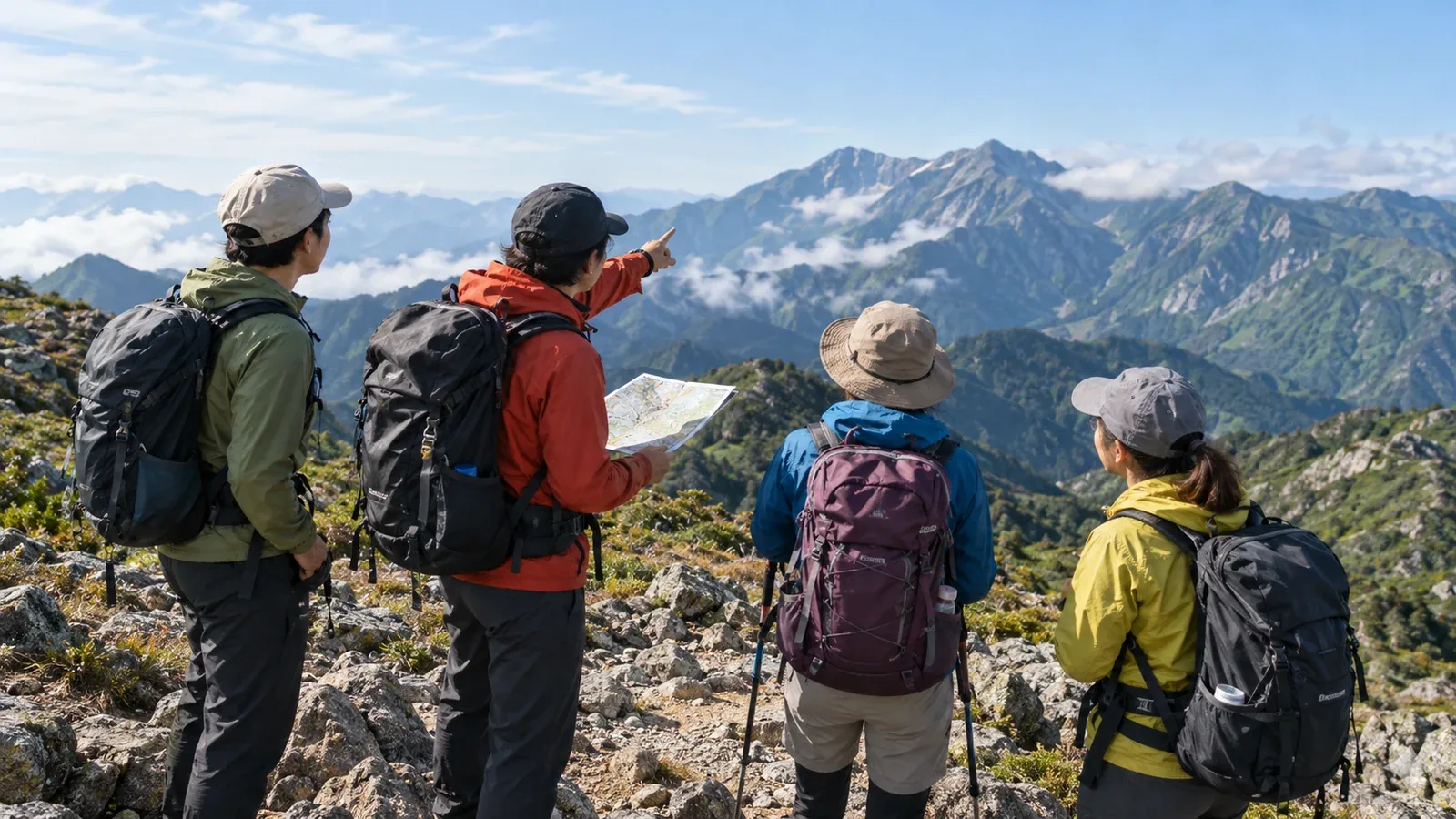
On group hikes, we often use the word “leader” without agreeing what the role entails. If you set off assuming that the most experienced person will simply walk in front, decisions can be delayed in an emergency and people may be unsure whose directions to follow.
The role has three main parts: planning before departure, making decisions on the trail, and communicating with the group to build agreement. Each calls for different skills. A gap in any one can affect the safety of the whole group. This article sets out steps and criteria for each.
A leader thinks through the decisions in advance
A hike leader thinks through likely scenarios before setting out and applies those decisions on the trail as conditions change.
Fatigue, cold, reduced oxygen at altitude and time pressure can all affect judgment in the mountains. Think through your criteria before you leave: “We’ll turn around if we haven’t reached this point by this time,” or “If we hear thunder, we’ll leave the ridge promptly and find safe shelter.”
Questions you leave unresolved at home will be harder to answer on the mountain.
Planning before departure
Choosing a route is one part of the job. Work through the following items and share the plan in a form everyone can refer to.
What to agree on and share
- Escape routes and turnaround criteria: Mark any points beyond which you can no longer retrace the route. State which time and weather conditions will trigger a turnaround.
- Fitness and experience: People bring different levels of fitness. Set the pace and itinerary around the least experienced member.
- Roles: Assign someone to navigate, someone to walk at the back and watch for anyone falling behind (the sweeper), and someone to handle emergency calls.
- Emergency contacts and check-in: Everyone should know where to file the trip plan, who to tell once the group is down and which emergency service to contact, such as fire and rescue or the police.
Check the weather the evening before and again on the morning of the hike. Use Japan Meteorological Agency regional forecasts for the overall outlook, then check forecasts for your mountain and elevation and local updates from authorities and huts.
Making decisions on the trail
Once the group sets out, the leader gathers information and makes the final decision on what the group will do.
Common decisions
Adjusting the pace: Slowing down may bring the group close to nightfall, while speeding up can exhaust those at the back. Keep to a pace the slowest member can manage. If you’re falling far behind schedule, check on that person and consider an escape route or a different descent. Pushing the pace can make things worse.
Deteriorating weather: Waiting to see what happens can turn a difficult situation into an emergency. When conditions meet one of the thresholds you set before the hike, act on it. The time and effort already spent getting there should stay out of the decision.
A member feels unwell: Stop in a safe spot and ask about symptoms. Even if the person says they’re fine, observe their color, gait and speech. If you suspect altitude illness, stop ascending and descend if symptoms worsen. Call for rescue promptly if you suspect hypothermia or see signs such as confusion, inability to walk straight or shortness of breath at rest. Get help with the descent if it can be done safely.
Losing the trail: Stop as soon as you’re unsure of your location. If you can do so safely, retrace your steps to the last point you recognized. If you cannot identify a safe way back, request help from a safe place and stay there unless there’s immediate danger or rescuers direct you to move.
Communicating decisions to the group
A sound decision only works if the group knows what to do. Clear communication helps everyone act safely.
Calling a turnaround
An apologetic delivery may invite people to push for another few minutes. Say, “We’ve reached the limit we agreed on, so we’re turning back here.” Stating what has happened and which criterion applies gives the group something concrete to confirm.
When fitness levels differ
Telling someone they’re slow can make them withdraw. Frame the next step as something everyone will do: “We’re stopping for a short rest” or “Let’s all slow the pace.”
When someone is worried
Reassurance should have a basis. Explain what’s happening and how you can proceed safely. Specific information and a clear next step can ease anxiety and build trust.
Communicating in an emergency
Use short, direct instructions. “Alex, put down your pack and come here” or “Everyone, stop where you are” identifies who should act and what to do in one sentence. Save longer explanations for later.
Sharing the workload
The leader makes the final decisions on the group’s actions and can delegate gathering information to other members. Ask regularly how people are feeling and whether anything about the route concerns them. You’ll hear about things you might otherwise miss.
If someone has substantial experience, you can ask them to act as a deputy. A simple request like “Could you walk at the back and let me know if anyone falls behind or starts to feel unwell?” lets the leader focus on the front of the group.
Fatigue affects the leader’s judgment, too. Manage your own pace, hydration and food as carefully as you monitor the group.
What to do next
If you’re organizing a group hike, start by writing down your turnaround criteria and emergency contacts before you leave, then share them with everyone. Nordwand’s Base Camp and communities organized around different interests can help you meet experienced hike leaders, discuss a plan and learn how to share roles. Before leading for the first time, you can also use the platform to arrange a hike with a certified guide and see how they make decisions on the trail.
Sources
- National Police Agency of Japan: overview of mountain incidents
- Japan Meteorological Agency: regional forecasts and weather information for hikers
- Mountain safety guidance from prefectural police rescue teams
References and sources
- National Police Agency of Japan: mountain incident statistics
- Japan Meteorological Agency: weather forecasts
- Japan Meteorological Agency: staying safe in lightning
- Nagano Prefectural Police: mountain safety information
- US Centers for Disease Control and Prevention: high-altitude travel and altitude illness
- US Centers for Disease Control and Prevention: preventing hypothermia
- US National Park Service: outdoor emergency plan