
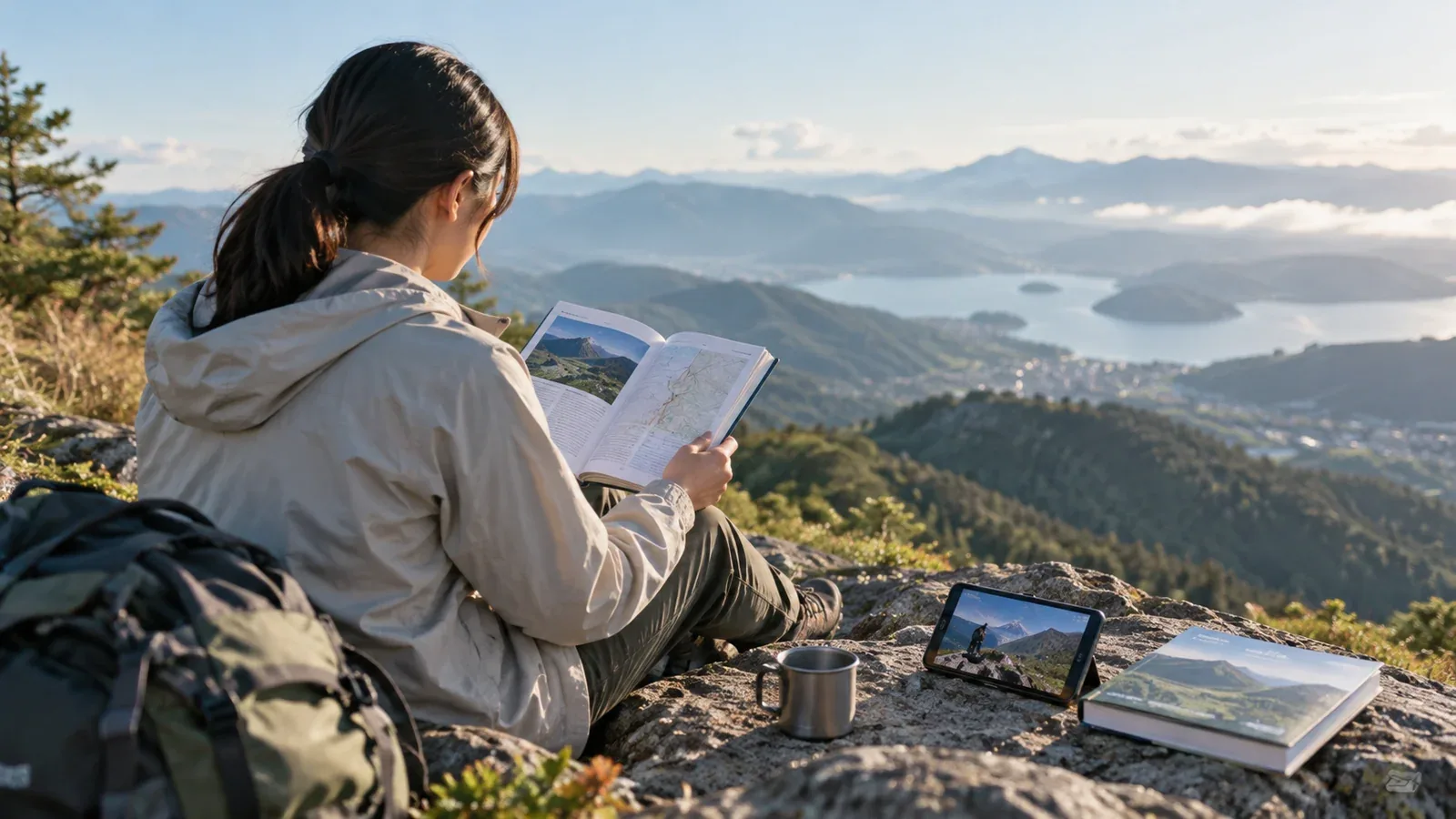
“I want to start hiking. What should I read?” A single book or channel is unlikely to cover everything. Gear, walking technique, weather and decision-making, and first aid each call for a different way of learning. If you use a format that doesn't suit the skill, you may remember the steps and still struggle to put them into practice.
This guide explains how to judge different sources and avoid common mistakes when choosing them. Once you know what makes a source reliable and useful, you can choose the books and videos that fit what you're trying to learn.
What books and videos each do well
Books, on paper or on a screen, give you a structured way to learn. They suit topics where understanding the reasoning matters, such as choosing gear, understanding mountain weather, reading a map, and learning the principles of first aid. It's easy to flip back to an earlier page, take notes, or review a chapter on the way to work.
Videos are particularly good at showing movement. Seeing how someone plants a trekking pole, adjusts a pack, aligns a map and compass, or applies tape can make a technique much clearer than reading about it. Watching can also give you a false sense of familiarity. You still need to practice the movements yourself.
Use books to learn the principles and videos to see what they look like in practice.
How to tell whether a source is reliable
Hiking resources vary widely in quality. The following checks can help you choose.
Check the author's or creator's background
For a book, check the author’s relevant experience, affiliations, and any guide credentials. The Japan Mountain Guides Association (JMGA) lists several qualifications with different scopes. Look for sources that explain why a technique works and what conditions it applies to.
Views and subscriber counts tell you how popular a video is. Even a widely watched video can contain errors. Get in the habit of checking the description or profile for relevant experience, guide qualifications, or affiliations.
Check when it was published or updated
Materials and designs change over time. Books from the early 2010s or earlier may give different advice from today's on lightweight materials or choosing a pack. Trail conditions, restrictions, and mountain hut operations also change frequently. Check current information for the specific area with local authorities or the hut itself before each trip.
When choosing a book, look up when the latest edition came out as well as when it was first published.
Read the contents to see if it suits beginners
A book labeled “beginner” or “first steps” may assume you already take on nonstandard routes or winter mountains. Before choosing one, check whether the opening chapters cover choosing footwear, packing a backpack, and starting on low mountains. A book that opens with selecting crampons is likely aimed at people building on existing skills.
What to learn from books first
For a beginner, it makes sense to read about these topics in roughly this order.
- Choosing and using gear. Learn the basics of hiking footwear, packs, rain gear, and layering. Focus on the reasoning behind the criteria you use when choosing.
- Map reading. Practice reading contour lines on a topographic map and checking your location. Reviewing these skills repeatedly in a book may help them stick better than watching a video.
- Mountain weather. Learn how low-pressure systems move, why afternoon thunderstorms are a concern in summer, and how wind can change on a ridge. Those basics help you interpret forecasts in an app.
- Making decisions and turning back. This topic is easy to overlook, but it matters especially for beginners. Before a hike, be able to explain in your own words what would make you turn back.
For first aid, consider taking a hands-on course after reading about the basics. The Japanese Red Cross Society and mountaineering organizations run courses.
How to get more out of videos
Use videos to supplement what you've read. Once you understand a principle from a book, watch how someone applies it. Relying on videos alone makes it easier to miss why a movement matters or how to adapt it to a different situation.
When choosing a video, try these checks.
- Read comments for possible corrections. Treat a comment as a lead and check it against an authoritative source.
- Compare independent demonstrations. Check that they apply to the same equipment and conditions. For pack fit, use the maker’s instructions and try the fit yourself.
- Check what the video is for. An entertaining trip diary may skip steps a teaching video shows in full.
What to verify with primary sources
Use current, primary information for the details below.
Check these before each trip.
- Whether trails are open or closed, using notices from local authorities or the Forestry Agency
- Mountain hut opening dates, prices, and booking procedures, directly with the hut
- Trailhead access and parking, using current notices from local authorities or site managers
- The day's forecast, using the Japan Meteorological Agency or a mountain-specific weather service
Walking times and hut details printed in a book reflect when it was written. Check up-to-date sources before relying on them for your itinerary.
What to do next
Pick a book, video, or social media post you've already saved. Check who made it, when it was updated, and what it's trying to teach. Practicing on an appropriate low-mountain trail will help skills stick. If you want to compare notes with people asking the same questions, try the Nordwand community.
References
- Japan Mountain Guides Association (JMGA), guide qualifications.
- Japanese Red Cross Society, first-aid training
- Japan Meteorological Agency, mountain weather and weekly forecasts
- Geospatial Information Authority of Japan, topographic maps and map reading