
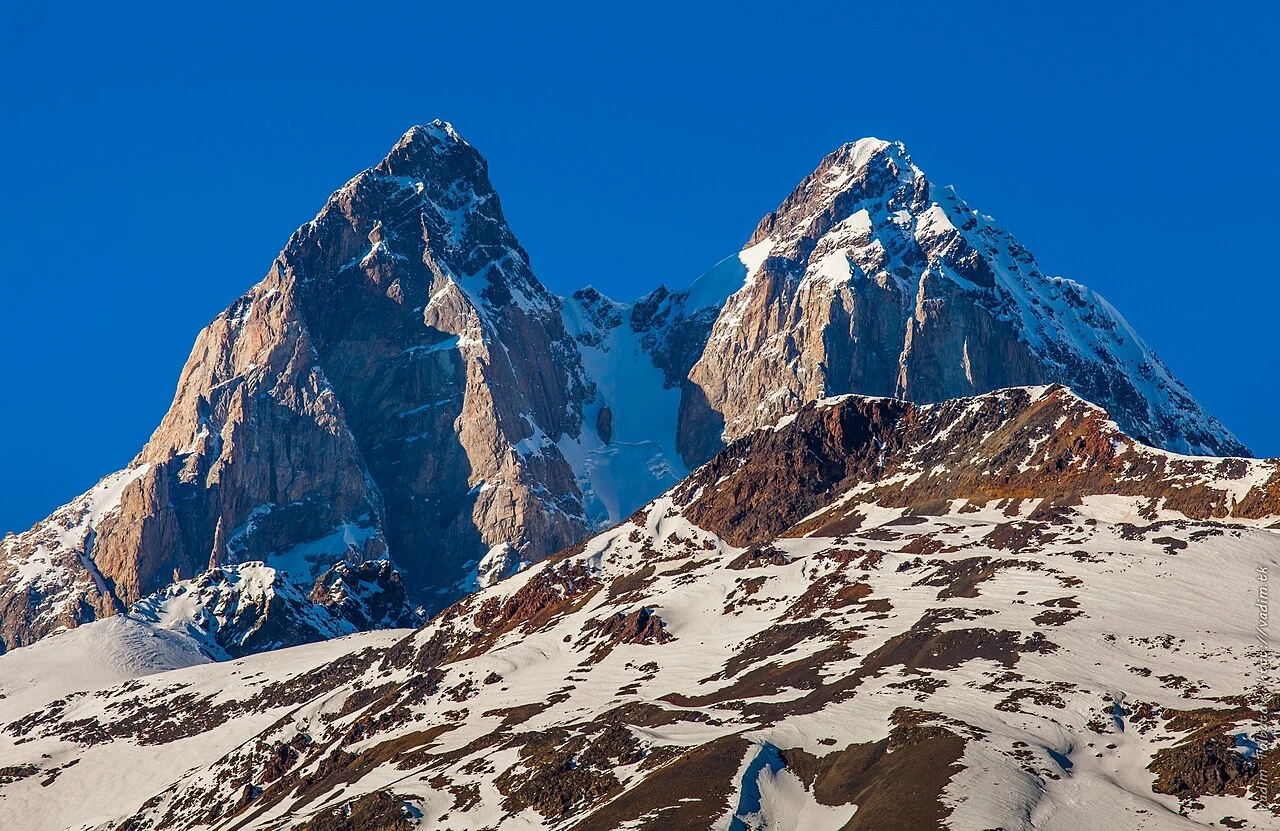
Twin summits and topographic character
The two summits rise steeply from the glaciated terrain of Upper Svaneti, with the saddle between them defining the massif's double-topped profile. The traditional nickname Matterhorn of the Caucasus, used in climbing literature, describes the peak's steep and isolated silhouette.
First ascents and early climbing history
John Garford Cockin and Ulrich Almer reached the North Peak in 1888, ascending from the Guli Glacier toward the saddle. In 1903, Adolf Schulze, Robert Helbling, Fritz Reichert, Oskar Schuster, and Albert Weber reached the South Peak by the Red Corner route. Later in the same 1903 season, Ludwig Distel, Georg Leuchs, and Hans Pfann completed a five-day traverse of both summits. In 1934, Alexandra and Alexander Japaridze, Iagor Kazalikashvili, and the Svan hunter Giorgi Niguriani made the first local ascent, an achievement recorded in the American Alpine Journal by Archil Badriashvili.
Upper Svaneti setting
Ushba stands within Upper Svaneti, the high-altitude region of northwestern Georgia whose medieval stone defensive towers have shaped its cultural identity. Archil Badriashvili's account in the American Alpine Journal traces the climbing history of both summits.