
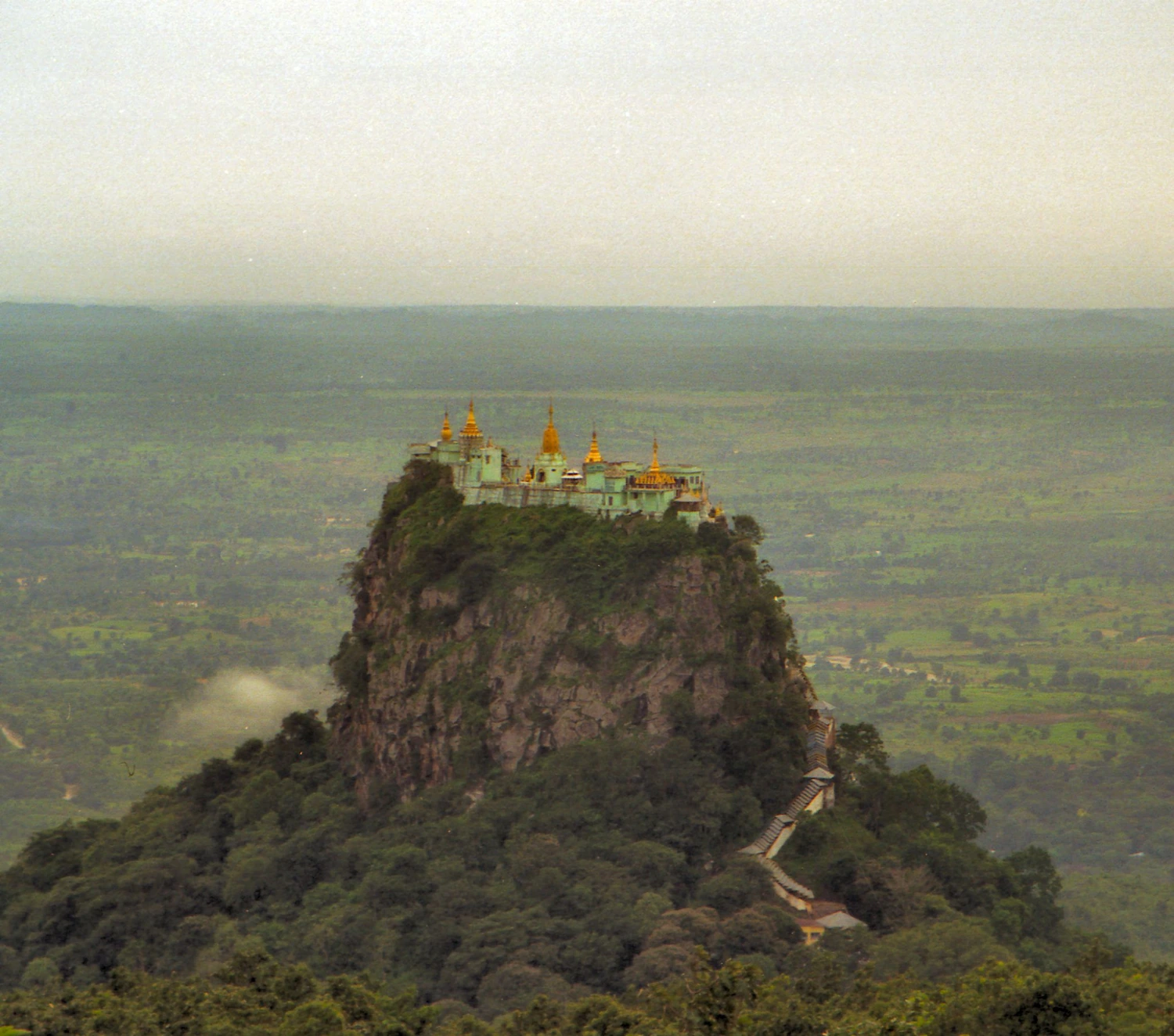
Geology of the Rock Pillar
The Smithsonian GVP classifies Taung Kalat as a lava plug. Belousov et al. observed roughly 100 m of local rock relief composed of blocky hornblende-bearing andesite. They found no vertically brecciated contact or hydrothermal alteration typical of a volcanic conduit. Their field interpretation is that lava flowed into low ground cut into weakly cemented Irrawaddy sandstone. As the softer surrounding material eroded away, the harder lava remained as elevated ground. Belousov et al. presented this as a field-based interpretation.
Two independent radiometric ages have been obtained from rock samples at Taung Kalat. Belousov et al. reported a zircon U–Pb age of 0.68 ± 0.04 million years. Sano et al. independently obtained a K–Ar age of 0.82 ± 0.07 million years and mapped Taung Kalat within an early plateau stage of Popa's volcanic sequence. Both figures are ages of lava samples.
Nat Shrines and Pilgrimage
Buddhist monuments and shrines for nats coexist at Taung Kalat. Nats are spirits who in Burmese religious practice can serve as guardians of a place. The JICA survey identifies Taung Kalat as a major site of nat faith in the Bagan area. Sally Jane Bamford records a traditional association between the hill and Min Mahagiri and his sister Hnamedaw Taungyi Shin. Than Tun's 2018 reporting documents gatherings for nat pwe, ceremonies held in honour of the nats, at the site.
At Popa in the commemoration of Bomingaung, Bénédicte Brac de la Perrière documented the interactions of spirit mediums and weikza practitioners.
Shrine Architecture and Commissioned Images
Bamford documents that U Parama Wunna Theikdi, who died in 1994, established a shrine for Popa Medaw, also known as Mei Wunna, at the base of Taung Kalat and commissioned larger-than-life wooden images of nats from Mandalay carver U Ba Tint, also known as U Pandita. A further set of life-sized images was commissioned for another shrine within the Taung Kalat complex.
Bamford notes that the patron deliberately selected modern paints for the carved wooden figures at the base shrine. Bamford also observed silk wraps on some of the female images.
Stair, Rock Face, and Gilded Roofs
Brian Snelson's photograph taken on 1 October 2001 shows the roofed staircase climbing the side of the rock face. Above it, the gilded spires and roofs of the monastery cluster at the brow of the hill, connecting the natural rock slope to the architecture built upon it.