
Southwest Slope Geology
Fieldwork by Jelaska and colleagues, published in 2003, examined Triassic sedimentary exposures on the southwest slope of Svilaja. They identified Lower Triassic shallow-water shelf sediments succeeded upward by breccia and then by deeper-water Middle Triassic beds containing volcanic material. Their interpretation is that extensional faults stretched the ancient Adria microplate, an event consistent with the transition from shelf conditions to deeper water and the introduction of volcanic-derived material in the sequence.
Tiny fossil elements from extinct marine animals called conodonts helped the team distinguish the ages of the rock layers. Their work places the older strata in a shallow sea and traces what happened when part of that setting deepened during the Triassic.
Karst Landscape and Caves
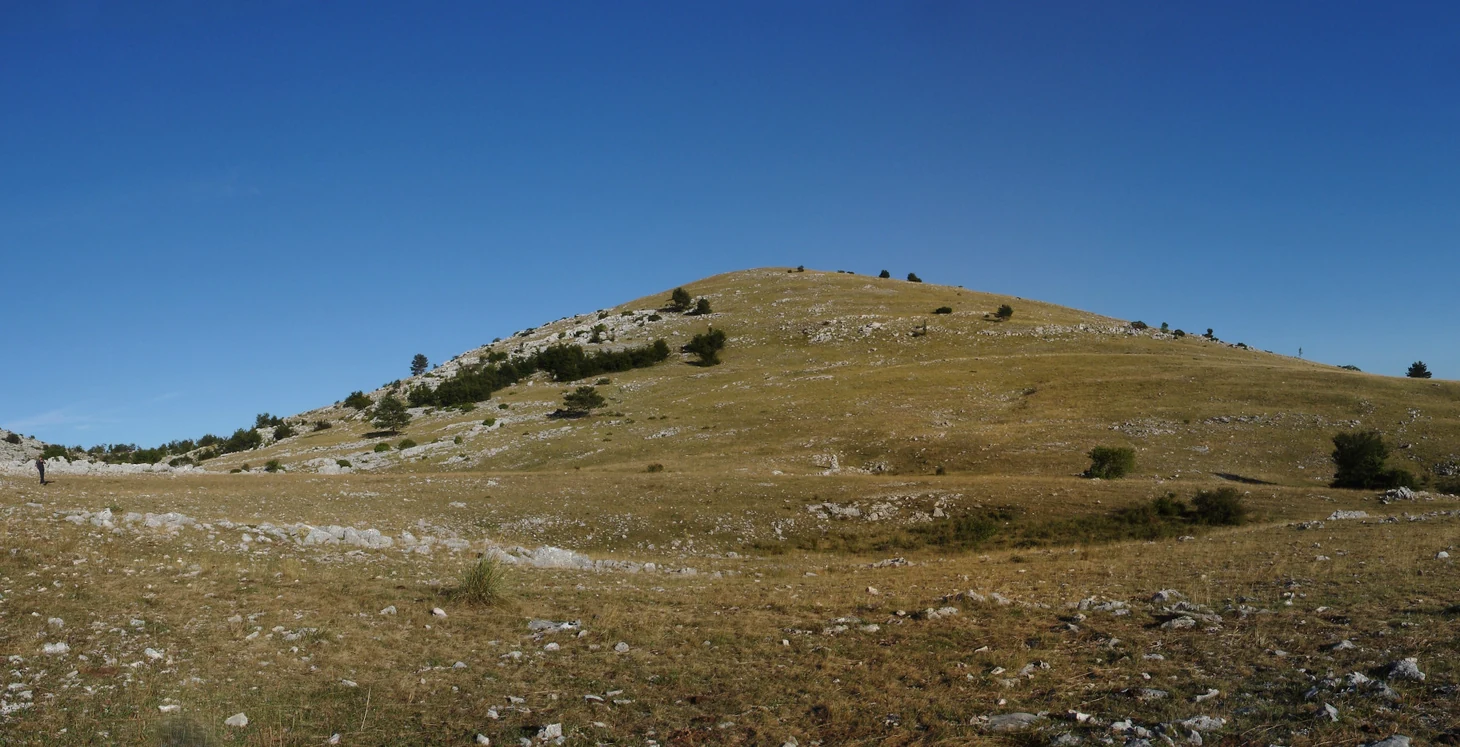
Rainwater dissolves Svilaja’s limestone over time, leaving enclosed hollows and caves in the ridges. Speleologists began investigating the Dragić caves in summer 2005. In his 2006 report, Vlado Božić described their setting in a narrow valley resembling a karst basin, about 4 km north of Bat at the northeastern foot of the mountain. In the same year, Željko Poljak noted the broad beech belt on the northeastern slopes, alongside the terraces and open grasslands on the other side of the ridge.
The Record of Svilaja’s Plants
A systematic survey led by Milenko Milović combined fieldwork from 2013 to 2019 with earlier publications. Its 2021 inventory lists 1,285 vascular plant taxa on Svilaja, counting species and subspecies together. The records bring the grasslands, rocky areas, and woodland into one account of the mountain’s flora.
Shelters Built by Sinj Mountaineers
In Poljak’s account, Sinj mountaineers added to a forestry building below Jelinjak in 1952. The building later needed repairs after an earthquake. It took the name Paunovac from a nearby pond. The foundation stone for another project, beneath Orlove stine, was laid in 2003. During his visit in 2006, Poljak met Boris Buljan and others working on the new hut.
Poljak also found a different kind of mountain infrastructure on the slopes above Muć and Petrovo polje. Dry-stone walls and watering pools remained from the time when livestock grazed the open ground. The watering pools record how herders used the slopes. The shelters capture a later chapter in the ridge’s use by walking clubs.